
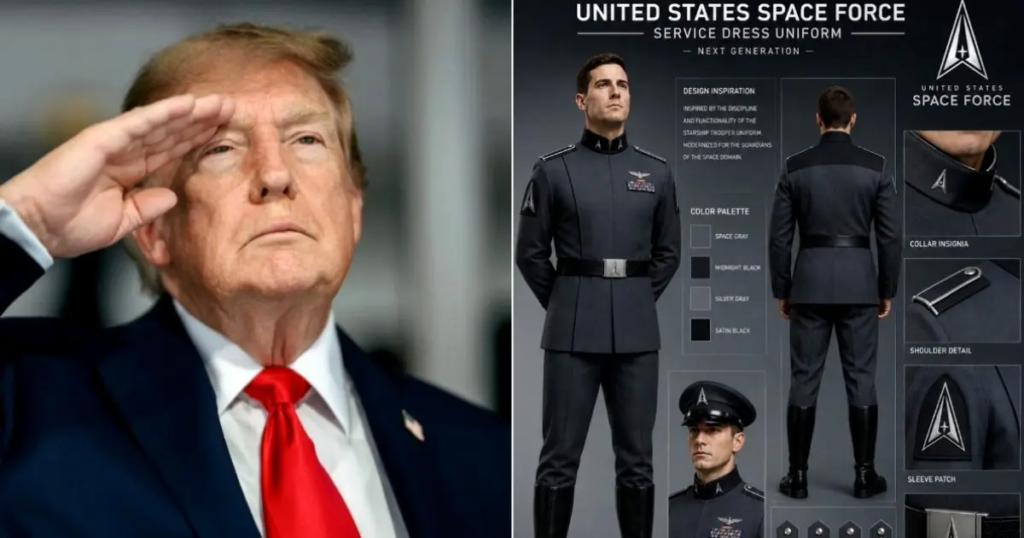
TL;DR: President Donald Trump has shared a proposed “next generation” U.S. Space Force uniform inspired by the 1997 film Starship Troopers. The dark military-style design quickly drew comparisons to Nazi SS uniforms and the Galactic Empire from Star Wars. The controversy is partly rooted in the fact that Starship Troopers director Paul Verhoeven deliberately used Nazi-inspired imagery to satirize fascism.
President Donald Trump has sparked an unexpected controversy over the future look of the U.S. Space Force after sharing images of a proposed new service dress uniform on Truth Social.
The design features a dark charcoal-and-black color scheme, high collar, fitted jacket, black belt, knee-high black boots and a military-style cap. The graphic accompanying the images says the uniform was “inspired by the discipline and functionality of the Starship Trooper uniform” and modernized for the “Guardians of the space domain.”
The reference immediately caught attention because Starship Troopers is not simply a futuristic military movie. Director Paul Verhoeven deliberately filled the 1997 film with imagery inspired by Nazi propaganda and fascist aesthetics.
As images of Trump’s proposed uniform circulated online, users compared it to everything from Star Wars‘ Imperial officers to Nazi-era military uniforms.
But there is an important distinction: there is currently no clear evidence that this design has been formally adopted as the Space Force’s new uniform. Current reporting describes it as a proposed or next-generation design shared by Trump.
What does Trump’s proposed Space Force uniform look like?
The proposed uniform takes a distinctly darker approach to military dress.
The design shown in Trump’s social-media post features:
- A charcoal or “space gray” jacket and trousers
- A black belt with a Space Force insignia
- Tall black boots
- A dark military-style cap
- A stiff, high collar
- Space Force insignia placed prominently on the uniform
- Silver-gray and satin-black details
The graphic describes the palette using names including “Space Gray,” “Midnight Black,” “Silver Gray” and “Satin Black.”
Visually, the uniform is far removed from the more conventional military styling Americans might associate with the Army, Navy or Air Force.
That futuristic quality appears intentional.
The Space Force is the newest branch of the U.S. military, established in December 2019. Its public identity has always been closely associated with science fiction, space exploration and futuristic imagery.
But this particular reference has created a problem: the fictional military being referenced was itself designed to look authoritarian.
Why are people comparing the Space Force uniform to Nazi SS uniforms?
The comparisons are based primarily on visual similarities, rather than evidence that the proposed uniform represents Nazi ideology.
The combination of dark colors, tall boots, a structured military jacket, high collar, belt and peaked cap resembles imagery that has long been associated with authoritarian military regimes.
The controversy became sharper because the stated inspiration was Starship Troopers.
In the 1997 film, soldiers of the fictional United Citizen Federation wear uniforms influenced by Nazi and fascist visual language. Director Paul Verhoeven intentionally used those references as part of the film’s satire.
So critics are not simply saying, “The uniform is black, therefore it looks Nazi.”
Their argument is more specific:
The proposed uniform is explicitly inspired by a film whose military aesthetics were deliberately modeled on fascist and Nazi imagery.
That context makes the comparison considerably more difficult to dismiss as a coincidence.
What is the connection to Starship Troopers?
Released in 1997, Starship Troopers was directed by Dutch filmmaker Paul Verhoeven and loosely adapted from Robert A. Heinlein’s 1959 novel.
The film follows young soldiers fighting giant alien creatures known as Arachnids in a futuristic interstellar war.
On the surface, it looks like a straightforward military science-fiction blockbuster.
But Verhoeven had a different idea.
He designed the film as a satire of fascism and militarism, creating a society in which military service is closely tied to citizenship and political power.
The film’s propaganda-style advertisements, uniforms, choreography and imagery intentionally evoke authoritarian regimes.
Verhoeven later explained that he wanted the film to depict fascists who did not recognize themselves as fascists. He also drew directly on Nazi propaganda aesthetics when designing the film.
Why did Verhoeven use Nazi imagery?
Verhoeven grew up in the Netherlands during World War II and has spoken extensively about his childhood experiences around Nazi occupation.
That history informed his filmmaking.
For Starship Troopers, he deliberately borrowed elements from the visual language of Nazi propaganda filmmaker Leni Riefenstahl. He even placed actor Neil Patrick Harris in an SS-style uniform in the film.
The goal was not to glorify fascism.
It was to make the fictional regime look attractive, powerful and efficient on the surface while revealing the authoritarianism underneath.
That is why the Trump administration’s stated inspiration has attracted so much attention.
Did Trump actually say the Space Force should wear Nazi-style uniforms?
No.
That characterization goes beyond what the available evidence establishes.
Trump’s post did not say the uniforms were inspired by Nazi Germany or the SS. The stated inspiration was the discipline and functionality of the fictional Starship Troopers uniform.
The Nazi comparison comes from the visual similarities and from the historical context of the movie’s design.
That distinction is important.
There is currently no evidence establishing that Trump or the U.S. government intended the proposed uniform to communicate Nazi ideology.
What can be established is that the design was presented as being inspired by Starship Troopers, a film whose director intentionally incorporated Nazi-inspired imagery.
Why are people also comparing it to Star Wars?
The Nazi comparison is not the only one circulating online.
Many people immediately recognized similarities to the Galactic Empire’s military uniforms in Star Wars.
The comparison is understandable because George Lucas also drew on historical authoritarian imagery when creating the Empire’s visual identity.
The Imperial officers’ dark uniforms, rigid posture, military hierarchy and authoritarian presentation have become some of the most recognizable villain imagery in science fiction.
The proposed Space Force uniform similarly uses a dark, formal silhouette.
Some commentators therefore described the design as looking less like a real-world military uniform and more like something a costume designer would use to visually identify the villains in a science-fiction movie.
That creates an unusual situation for the Space Force.
A military branch attempting to establish its own futuristic identity has ended up with a design that critics say looks like the uniform of the fictional enemy.
Is this actually the new Space Force uniform?
That remains unclear.
This is perhaps the most important fact to keep in mind amid the online reaction.
Trump shared the proposed design on Truth Social, but current reporting has not established that the U.S. Space Force has formally adopted it. The Space Force has already introduced its own service dress uniform, with rollout beginning in 2025 and continuing into 2026.
That makes the timing significant.
The branch is already in the process of implementing a recently designed uniform. Replacing it with another service dress uniform would involve substantial costs, logistics and personnel changes.
For that reason, some reporting has questioned whether Trump’s post represents an actual upcoming uniform change or simply a proposed design or visual concept.
The Space Force has not publicly confirmed that the posted design will become its official uniform.
When was the U.S. Space Force created?
The U.S. Space Force was established in December 2019 during Trump’s first presidential administration.
It became the sixth branch of the U.S. military and is responsible for organising, training and equipping forces to conduct military operations in and through space.
Its creation was itself controversial at the time, but the branch has since developed its own organisational structure, uniforms, insignia and identity.
Because it is the first new U.S. military branch created in decades, questions about how it should look and present itself have attracted unusual public attention.
The service’s branding has also repeatedly prompted science-fiction comparisons.
Its emblem was compared online to Star Trek‘s Starfleet insignia, while its first service dress uniform attracted comparisons to Battlestar Galactica and Star Wars.
The latest controversy is therefore part of a longer pattern.
Why does the Starship Troopers reference matter so much?
The controversy would probably be much smaller if the inspiration were simply “futuristic military uniforms.”
The specific movie reference changes the context.
Starship Troopers uses propaganda and fascist aesthetics deliberately. Its military uniforms are designed to make authoritarianism look polished, powerful and appealing—the very mechanism that allows the film to satirise it.
The film’s soldiers are not presented as obvious cartoon villains.
They look disciplined.
They look professional.
They look heroic.
That was precisely the point.
By choosing that visual language as inspiration for a real military organization, Trump’s proposed design inevitably carries some of the same historical associations.
That does not prove ideological intent.
But it does explain why the reaction has been so strong.
What has the reaction been?
The proposed uniform triggered criticism and jokes across social media almost immediately.
Some users compared it to the Galactic Empire from Star Wars. Others pointed specifically to Nazi military uniforms.
Political commentators also questioned whether the people behind the design understood the satirical purpose of Starship Troopers. Jonah Goldberg, editor-in-chief of The Dispatch, questioned whether the designers understood what Verhoeven was trying to communicate through the film.
The reaction has not been limited to Trump’s political opponents.
The choice has also prompted criticism from commentators who otherwise have no objection to a strong military aesthetic.
That is significant because it suggests the controversy is not simply about whether the Space Force should look “tough.”
It is about which historical and fictional visual references are appropriate for a U.S. military institution.
Is there a deeper problem with using science fiction for military design?
Not necessarily.
Military organizations have borrowed from science fiction for decades, and science-fiction imagery has influenced everything from aircraft concepts to space exploration.
NASA and military space programs have also inspired science-fiction creators in return.
The challenge is choosing the right reference.
A futuristic military uniform can communicate:
- Technological sophistication
- Discipline
- Professionalism
- Exploration
- National ambition
- A distinct institutional identity
But it can also communicate:
- Authoritarianism
- Militarism
- Aggression
- Totalitarian control
The difference often comes down to context.
In the case of Starship Troopers, the authoritarian imagery was not accidental. It was the message.
What happens next for the Space Force uniform?
For now, the biggest unanswered question is whether the proposed design will move beyond social media.
The Space Force has already begun rolling out its existing service dress uniform, meaning a replacement would require a formal process and significant resources.
Until the Department of the Air Force or Space Force formally confirms the proposed design, it is safer to describe it as a proposed or next-generation concept, rather than the new official uniform.
That distinction should remain in headlines and social posts as well.
Why the controversy is bigger than a uniform
Uniforms are rarely just clothing.
For military organizations, they communicate authority, history, professionalism and institutional identity.
The U.S. Space Force faces an unusual branding challenge because it is responsible for a domain that was once the stuff of science fiction. It needs to look futuristic while still communicating that its members are part of the U.S. military.
Trump’s proposed design clearly aims for the futuristic side of that equation.
But by explicitly invoking Starship Troopers, it also inherited a visual language that was created to critique fascism.
That is why a uniform concept has generated such an outsized reaction.
The debate is not simply about whether the jacket looks good.
It is about whether a military branch tasked with representing American power in space should borrow its visual identity from a fictional regime designed as a warning about authoritarianism.
For now, the answer is not clear—and neither is whether the proposed uniform will ever be worn by a Space Force Guardian.