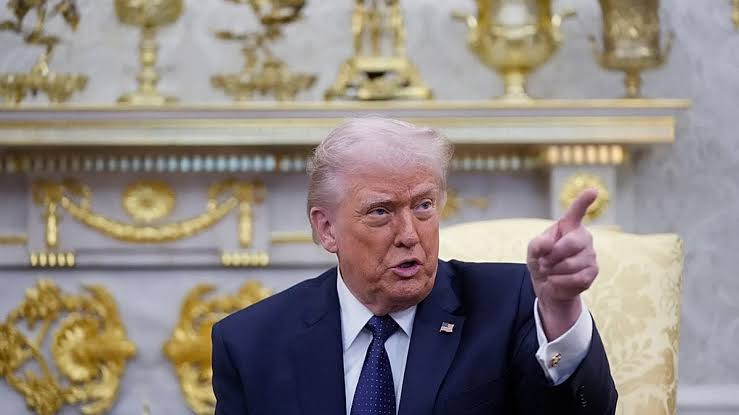
A series of unusual comments by US President Donald Trump has triggered another round of debate over his public speaking style, stamina and fitness for office, with critics pointing to remarks about Vladimir Putin’s birthday, the war with Iran and his repeated claims about the Nobel Peace Prize.
The latest controversy unfolded on October 7, when Trump appeared alongside senior administration officials and business leaders at the White House to promote his “Trump Accounts” program.
At one point, Trump appeared tired and leaned back with his eyes closed for portions of the event. The images quickly spread online, prompting renewed discussion about whether the 80-year-old president was struggling with fatigue.
But a few moments of visible tiredness are not evidence of a medical condition, and there is no public medical diagnosis establishing that Trump has a cognitive or psychiatric disorder.
The controversy instead reflects a broader political argument that has surrounded Trump throughout his second presidency: whether his age, increasingly spontaneous speeches and sometimes convoluted remarks should be viewed as ordinary political rhetoric, signs of fatigue or evidence of something more serious.
Why did Trump bring up Putin’s birthday during a plague question?
One of the most widely discussed moments came when a reporter asked Trump whether he had spoken with Russian President Vladimir Putin about the mysterious illness surrounding a laboratory worker in Siberia.
Instead of immediately addressing the health investigation, Trump responded by noting that October 7 was Putin’s birthday.
“Today is Vladimir Putin’s birthday,” Trump said, adding that he had a call scheduled with the Russian leader.
Trump later did address the health concerns, telling reporters that the United States did not currently believe the incident was a bioweapon.
The context is important because the alleged plague case in Russia remains unresolved.
The World Health Organization said on October 7 that it had received information from Russia but still needed additional laboratory data to determine what caused the woman’s death. Russian authorities have said she died from pneumonia of unknown origin and have denied that plague was involved.
That means Trump’s exchange with reporters took place against a real but still uncertain international health issue.
His reference to Putin’s birthday, however, became the headline moment.
What is known about the suspected plague case in Russia?
A 28-year-old laboratory worker, Darya Shipilova, died on October 2 after developing severe pneumonia in the Siberian region of Irkutsk.
She worked at the Irkutsk Anti-Plague Research Institute, which specializes in dangerous infectious diseases including plague.
The circumstances prompted international concern because of the nature of her workplace and reports that she may have been exposed to a dangerous pathogen.
But the exact cause of death remains unknown.
The WHO said Russia had reported that no case of plague had been registered in the Irkutsk region and that around 200 contacts had been placed in quarantine. The agency has asked for additional information on the laboratory testing of the deceased woman and those who came into contact with her.
Russia has also said extensive testing found no evidence that people connected to the worker were infected with plague.
Trump himself told reporters, “We don’t think so,” when asked whether a bioweapon was involved.
So the original framing of a confirmed “plague scare” is too strong. There is concern surrounding a possible infectious disease incident, but there is not yet confirmation that the woman died from pneumonic plague.
Why were people watching Trump so closely at the White House?
The comments came during a day when Trump was already facing intense scrutiny over his public appearances.
Video from the White House event showed him repeatedly leaning back and appearing to close his eyes while speakers discussed the “Trump Accounts” initiative.
Such footage has repeatedly fueled speculation about the president’s stamina.
Trump, who is now 80, is the oldest person ever to serve as president of the United States. His schedule has remained unusually demanding, with frequent political rallies and travel ahead of the November midterm elections.
Still, appearances of fatigue should not automatically be converted into a medical diagnosis.
A person can close their eyes, pause or appear exhausted for countless reasons. Determining cognitive impairment requires clinical assessment, not video clips from political events.
Trump’s latest Nobel Peace Prize pitch
The same White House appearance also featured another of Trump’s recurring themes: his belief that he deserves the Nobel Peace Prize.
With the 2026 winner due to be announced on Friday, Trump again argued that he had accomplished more for peace than previous presidents.
He claimed he had “settled eight wars” and said he had brought hostages home while preventing additional conflicts.
Trump also criticized the Nobel Committee and suggested that failing to award him the prize would discredit the institution.
His claims have been repeatedly challenged by fact-checkers because several conflicts he describes as “settled” have involved ceasefires, mediation or temporary agreements rather than comprehensive and lasting peace settlements.
That does not prevent the Nobel Committee from considering him, but it does mean Trump’s personal description of his record should not be treated as an established list of eight wars he definitively ended.
Trump has made similarly unusual comments about Iran
Another recent controversy has been considerably more serious.
During a rally in Nebraska on October 5, Trump said Iran could “take out” Los Angeles and San Diego, describing such a possibility as a “small price to pay” for protecting the country from a nuclear threat.
The remarks triggered immediate outrage in California.
Governor Gavin Newsom called Trump “deranged and dangerous” and invoked the 25th Amendment in calling for his removal. Other California politicians, including the mayors of Los Angeles and San Diego, also condemned the comments.
Importantly, Trump did not explicitly use the word “nuke” when making the remarks. The controversy arose from his apparent willingness to contemplate the destruction of major American cities in the context of the Iran conflict.
The White House subsequently argued that Trump was emphasizing the danger that a nuclear-armed Iran could pose to the United States and that his comments were intended to justify the administration’s military strategy.
That explanation did not end the backlash.
Did Trump threaten Los Angeles with a nuclear attack?
No.
The phrase “nuking LA” is misleading because Trump did not say that he wanted the United States or Iran to launch a nuclear attack on Los Angeles.
Instead, he suggested that allowing Iran to “take out” Los Angeles or San Diego would be a small price to pay for broader national security.
The language was sufficiently ambiguous that different audiences interpreted it differently, but describing it as a direct call for a nuclear strike on California goes beyond what Trump actually said.
The distinction matters when assessing an already highly charged political statement.
Trump also made a bizarre “vegan” detour in Texas
The president’s Texas rally on October 7 produced another unusual moment.
Trump was campaigning for Republican Senate candidate Ken Paxton when he launched into repeated attacks on Democratic rival James Talarico.
Among other claims, Trump said Talarico was secretly vegan, an accusation Talarico has denied.
Trump then went on a lengthy tangent about the pronunciation of the word “vegan,” recounting how Melania Trump had corrected him.
“My wife told me, ‘Sir, you have to do me a favor, it’s not vay-gan, it’s vee-gan,’” Trump said.
He continued joking about Talarico supposedly eating meat for political reasons while secretly being vegan.
The remarks were not directly connected to the central issues of the Senate race, but they fit a pattern that has become increasingly familiar in Trump’s rallies: political attacks frequently blend into personal anecdotes, jokes and abrupt topic changes.
What about Trump’s claim that he won three elections?
Another issue raised by the source article concerns Trump’s repeated references to having won the presidency three times.
That claim is false.
Trump won the 2016 presidential election and lost the 2020 election to Joe Biden. He then won the 2024 election.
His continued insistence that the 2020 election was stolen remains unsupported by evidence establishing widespread fraud capable of changing the result.
Trump nevertheless continues to refer to the 2020 contest as fraudulent and has repeatedly described himself as a three-time election winner in political remarks.
Can Trump legally run for a third elected term?
Under the 22nd Amendment to the US Constitution, a person cannot be elected president more than twice.
Trump has been elected president twice, in 2016 and 2024.
That means he cannot simply run for and win a third elected presidential term under the current Constitution.
Trump has occasionally encouraged speculation about seeking another term, while his supporters have floated theories about how that might happen. But the constitutional language is straightforward: the 22nd Amendment bars a person from being elected president more than twice.
Changing that would require a constitutional amendment, an exceptionally difficult process.
Does the 25th Amendment mean Trump can be removed for unusual statements?
Not simply for making strange remarks.
The 25th Amendment provides mechanisms for dealing with presidential incapacity, including situations in which a president is unable to discharge the powers and duties of the office.
But political opponents saying a president is “mentally ill” does not activate the amendment.
Section 4 involves the vice president and a majority of the principal officers of the executive departments declaring that the president is unable to perform the duties of office. Congress then becomes involved if the president contests the declaration.
Calling for the 25th Amendment is therefore a political statement unless the constitutional process is actually initiated.
Are Trump’s latest remarks evidence of cognitive decline?
There is no reliable basis to make that conclusion from these incidents alone.
Public observers can debate whether Trump’s language has become more disorganized, whether his speeches contain more digressions or whether his schedule is taking a toll.
But none of those observations constitutes a clinical diagnosis.
The same caution applies to photographs and videos showing him with his eyes closed or appearing sleepy.
Political critics can legitimately discuss whether his performance is affecting public confidence. Medical professionals, however, would require substantially more information before diagnosing a neurological, psychiatric or cognitive condition.
That distinction has become especially important because health claims about political leaders can rapidly turn into partisan narratives.
Why the issue keeps returning
Trump’s age has made questions about stamina and mental sharpness unavoidable during his second presidency.
Unlike a private citizen, a president is responsible for decisions involving military force, nuclear weapons, national security and diplomacy.
That naturally creates greater public interest in signs of physical or cognitive impairment.
At the same time, Trump has spent much of his political career using improvisational speeches, repetition, exaggeration and provocative language as part of his communication style.
Supporters often see the approach as unscripted and authentic. Critics see it as increasingly incoherent and reckless.
The same sentence can therefore become evidence for two completely different political narratives depending on who is interpreting it.
The real question is not whether Trump sometimes sounds unusual
Presidents regularly misspeak, lose their train of thought, appear tired or say things that later require clarification.
The more meaningful question is whether there is a sustained, independently documented decline that materially affects the president’s ability to perform his constitutional duties.
The incidents cited in the current wave of criticism do not establish that.
They do show a president continuing to make highly provocative statements on subjects ranging from Iran and Russia to domestic politics and the Nobel Peace Prize.
That creates genuine political and diplomatic consequences even without a medical diagnosis.
Trump’s comments about Los Angeles and San Diego prompted backlash from elected officials and renewed concerns about the rhetoric surrounding the Iran war. His handling of the Russian health scare highlighted uncertainty around an unresolved international medical incident. His Texas “vegan” rant added another example of his tendency to veer from one subject into another.
Meanwhile, his repeated claims about settling eight wars have become part of his campaign for a Nobel Peace Prize whose winner will be announced on October 9.
What the latest controversy actually shows
The strongest conclusion from the latest episodes is not that Trump has been proven to have a mental health disorder.
There is no such public evidence.
What is clear is that Trump’s age, stamina, improvisational speaking style and unusually provocative statements continue to generate scrutiny at a level rarely seen around a modern US president.
That scrutiny is unlikely to disappear as the midterm elections approach and the administration remains deeply involved in the Iran conflict.
For Trump, the political challenge is therefore broader than any single “gaffe.”
Every unusual remark becomes part of a larger argument over judgment, leadership, and credibility.
And as his critics have learned repeatedly, sometimes the most politically consequential part of a Trump statement is not what he intended to say, but what millions of people believe they just heard.