
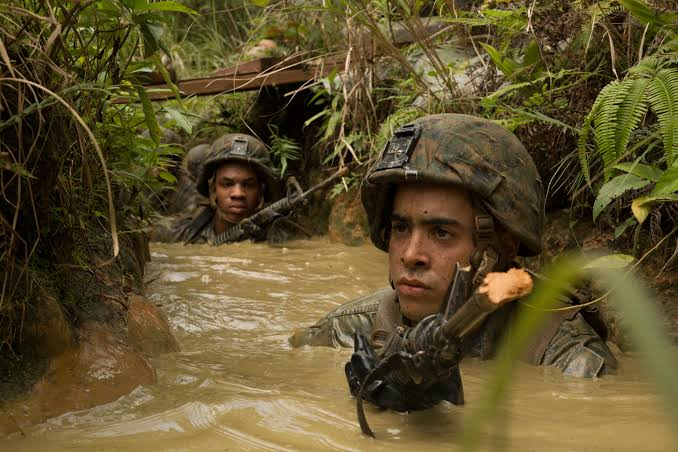
The course combines survival skills with tactical exercises that test how soldiers move, observe, and respond under demanding conditions.
Detecting hidden threats
One exercise observed by Military Times required one squad to conceal itself in the vegetation, remove signs of its movement, and prepare to detect approaching personnel. A second squad had to find the hidden team.
The searchers eventually spotted a suspicious vine lying unusually straight and close to the ground. It was a makeshift tripwire assembled from a vine and a piece of rubbish to alert the concealed squad when someone approached.
The discovery was particularly revealing because a formal lesson on tripwires was scheduled for later that day. A trainee had recognized the potential warning sign before receiving the classroom instruction.
The episode demonstrated how field experience and careful observation can complement formal teaching. In a jungle environment, a detail that appears insignificant may provide an important clue about another person’s movements or intentions.
Learning to track and conceal movement
Tracking and concealment are closely connected. Soldiers must learn to identify signs left by others while avoiding the creation of similar clues themselves.
The exercises require participants to interpret their surroundings rather than simply follow visible trails. They must also consider how their own movement might reveal their location.
Dense vegetation complicates both tasks. Restricted sightlines make it harder to observe activity at a distance, while the abundance of natural features can make deliberate disturbances difficult to distinguish from ordinary changes in the environment.
These conditions demand patience, attention to detail, and an understanding of how people interact with the terrain.
Building survival skills
Jungle operations also require soldiers to manage basic needs in difficult conditions. The course includes survival instruction that helps participants develop the skills needed to remain effective when operating away from established facilities.
US Southern Command’s description of the program identifies core training areas such as fire-making, water purification, shelter construction, and the use of tools for movement through thick vegetation.
The wider course structure also covers small-unit tactics, casualty evacuation, waterborne operations, and navigation. Together, these skills prepare participants to move and function in an environment that places sustained physical and mental demands on personnel.
The training is therefore broader than learning to detect hidden threats. Soldiers must also maintain their ability to operate when the terrain, weather, and logistical challenges make routine military tasks more difficult.
Why Does the Panama Jungle Matter for US Military Readiness?
Jungle terrain creates operational challenges that differ from those found in open fields, deserts, or urban areas. Vegetation can limit visibility, slow movement, complicate navigation, and make communication between personnel more difficult.
These conditions can also increase the importance of small-unit decision-making. When soldiers cannot see far ahead, they must rely on observation, coordination, and an accurate understanding of their immediate surroundings.
Training in Panama allows US personnel to practice these skills in a real tropical environment rather than relying exclusively on simulations or instruction conducted elsewhere.
The location also offers a way to strengthen cooperation between American forces and Panamanian security institutions. Joint exercises give participants experience working alongside personnel from another country, including learning to coordinate their actions and communicate under pressure.
US Southern Command has described the program as an effort to improve interoperability—the ability of different military services and partner forces to operate together effectively.
That objective matters because multinational operations require more than individual proficiency. Personnel must also understand how to work within mixed teams, coordinate responsibilities, and respond consistently when conditions change.
The course’s practical approach connects these goals: participants develop jungle-specific skills while learning to operate alongside partners who bring different experiences and expertise.
Who Is Albis Fajardo, and Why Does His Experience Matter?
For Panamanian First Sergeant Albis Fajardo, jungle-related military instruction is grounded in personal experience.
More than a decade ago, Fajardo participated in a counter-drug mission along Panama’s Pacific coast. His team was attempting to target a cartel leader when the operation came under fire.
During the withdrawal, a bullet tore through the flesh of a fellow soldier. His friend survived, but the incident left a lasting impression on Fajardo and motivated him to deepen his military knowledge.
He eventually became one of the Panamanian instructors involved in the revived US Army training program.
His experience illustrates the human dimension of the partnership. Military knowledge is not developed solely through formal courses or written procedures; it can also emerge from difficult operations, lessons learned in the field, and the determination to improve after dangerous encounters.
Fajardo’s role also highlights why local instructors are valuable to foreign troops. Their experience helps connect general military principles with the practical demands of the environment in which those principles must be applied.
The value of that knowledge is not limited to any single technique. It lies in helping trainees understand what to look for, how to interpret what they see, and why seemingly minor observations may deserve attention.
What the Revival of Jungle Training Says About Military Cooperation
The return of the Jungle Operations Training Course to Panama reflects a renewed emphasis on preparing troops for specialized operating environments while strengthening relationships with regional partners.
Its structure recognizes that expertise is not distributed evenly across military organizations. American forces may bring their own tactical capabilities and institutional experience, while Panamanian personnel contribute extensive familiarity with the local terrain and its challenges.
The training brings those strengths together rather than treating instruction as a one-way transfer of knowledge.
For the Panamanian instructors, the program provides an opportunity to share experience and work alongside American personnel. For US troops, it offers exposure to an environment in which the smallest details can influence how a patrol moves, identifies threats, and maintains its position.
The course also makes a broader point about military readiness: skills must be adapted to the conditions in which they will be used. Training that works well in one environment may need substantial adjustment in another.
The Bottom Line
The revived US Army Jungle Operations Training Course in Panama is built around a straightforward principle: operating effectively in the jungle requires more than conventional military skills.
Through an 18-day program, American and Panamanian personnel train together in survival, tracking, concealment, navigation, and small-unit tactics. Panamanian instructors contribute practical knowledge shaped by their familiarity with the region, helping American troops recognize challenges that can be difficult to understand from classroom instruction alone.
The tripwire exercise captures the value of that approach. A simple vine and a piece of rubbish were enough to turn an ordinary patch of vegetation into a tactical warning system—and recognizing it required close observation before the formal lesson had even begun.
The program’s revival is therefore about more than returning to an old training location. It is about combining military instruction with local experience to prepare soldiers for an environment where careful observation and adaptability can matter as much as established tactics.