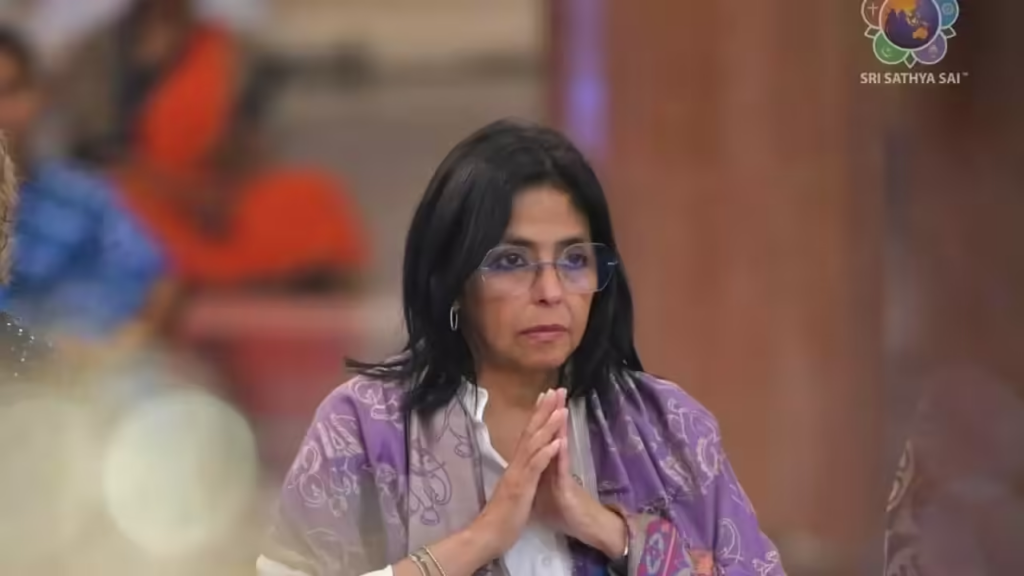
When Delcy Rodriguez was sworn in this week as Venezuela’s interim president, her political résumé drew global attention. But another detail, less expected and quietly personal, has also resurfaced: her repeated visits to a Sathya Sai Baba ashram in southern India.
Rodriguez is an outspoken admirer of Sathya Sai Baba, the Indian spiritual leader whose followers span continents and political systems. Over the past two years, she has traveled twice to Prasanthi Nilayam, the Sai Baba spiritual complex in Andhra Pradesh. These visits, made while she held senior government roles, raise an intriguing question: why does one of Latin America’s most powerful political figures keep returning to a spiritual center thousands of miles from Caracas?
The answer sits at the intersection of personal faith, soft diplomacy, and the often-overlooked role spirituality plays in global politics.
Who is Delcy Rodriguez, Venezuela’s interim president?
Delcy Rodriguez is no stranger to power or controversy. A lawyer by training, she has been one of the most influential figures in Venezuela’s political establishment for more than a decade.
A key figure in Venezuela’s leadership
Before becoming interim president, Rodriguez served as:
- Venezuela’s executive vice president
- Minister of Foreign Affairs
- A close political ally of Nicolás Maduro
Her rise reflects loyalty to the ruling establishment and a reputation for sharp political instincts. Internationally, she is known for her firm resistance to U.S. pressure and sanctions, often positioning Venezuela’s leadership as defenders of national sovereignty.
Against that backdrop, her interest in Indian spirituality appears, at first glance, unexpected.
What is Prasanthi Nilayam?
Prasanthi Nilayam, located in Puttaparthi, Andhra Pradesh, is the spiritual headquarters and final resting place of Sathya Sai Baba, who died in 2011.
A global spiritual hub
Far from being a local ashram, Prasanthi Nilayam is:
- A major pilgrimage site for Sai Baba followers worldwide
- The administrative center of the Sri Sathya Sai Central Trust
- Known for its emphasis on universal values such as truth, nonviolence, service, and unity of religions
Devotees include business leaders, academics, celebrities, and political figures from Asia, Africa, Europe, and Latin America. A map showing the global spread of Sai Baba centers would help illustrate how far this influence extends.
When and how did Delcy Rodriguez visit the Sai Baba ashram?
Rodriguez’s connection to Prasanthi Nilayam is not symbolic or fleeting. It has involved repeated, documented visits during high-profile official trips.
Her first visit in August 2023
Rodriguez first visited the ashram on August 5, 2023, while in India as part of a Venezuelan delegation attending the G20 Summit.
- The visit was described as personal rather than diplomatic
- She traveled with her husband, who is also a Sai Baba devotee
- The focus was on paying respects at the samadhi mandir
Despite the packed G20 agenda, she made time for the visit, signaling that it held personal importance.
Her second visit in October 2024
Nearly a year later, on October 26, 2024, Rodriguez returned to Prasanthi Nilayam while serving as Venezuela’s executive vice president.
According to a press release from the Sri Sathya Sai Central Trust:
- She was accompanied by Venezuela’s ambassador to India, Capaya Rodriguez Gonzalez
- She was received by the Trust’s managing trustee, R J Rathnakar
- She toured key sites, including the Sanctum Sanctorum and Shanthi Bhavan
The second visit reinforced the impression of an ongoing spiritual relationship rather than a one-time gesture.
Why does Delcy Rodriguez follow Sathya Sai Baba?
Rodriguez has not publicly offered a detailed explanation of her devotion. Still, the appeal of Sathya Sai Baba’s teachings helps explain why his influence resonates far beyond India.
Universal values over ideology
Sai Baba’s philosophy emphasizes:
- Moral discipline over religious dogma
- Service to society as a spiritual duty
- Unity across faiths and cultures
For political leaders navigating crisis, conflict, and public scrutiny, such teachings can provide a sense of personal grounding. A short comparison with other global spiritual movements, followed by the political elite, could add useful context here.
Is this spirituality or soft diplomacy?
While Rodriguez’s visits were framed as personal, their timing and visibility invite broader interpretation.
India–Venezuela relations in context
India and Venezuela have maintained diplomatic and economic ties for decades, particularly in energy and trade. Visits by senior Venezuelan officials often include cultural engagements alongside official meetings.
Several factors suggest Rodriguez’s ashram visits were not conventional diplomacy:
- No policy announcements accompanied the trips
- The visits were coordinated through the Sai Baba Trust, not government channels
- The focus remained on spiritual observance rather than public events
Even so, personal belief and diplomacy often overlap. Leaders frequently carry private faith into public life, especially during overseas travel.
How does this fit with Rodriguez’s political stance at home?
Rodriguez’s spiritual side contrasts sharply with her assertive political messaging in Venezuela.
A firm voice against foreign influence
Following the U.S. capture of Nicolás Maduro and his wife, Cilia Flores, Rodriguez rejected claims of foreign control over Venezuela in a televised address.
She said Venezuela is governed by its own people, not external powers, and framed ongoing protests as part of an internal political struggle. The remarks reinforced her image as a nationalist leader who fiercely guards sovereignty while privately seeking spiritual reassurance abroad.
Why this story resonates globally
The interest in why Venezuela’s interim president keeps returning to a Sai Baba ashram is not just about curiosity. It reflects broader global patterns.
The quiet role of spirituality in modern leadership
Across regions, political leaders are increasingly
- Open about faith and spiritual influences
- Seeking moral authority beyond institutions
- Turning to belief systems during periods of instability
Rodriguez’s visits show how spiritual networks often operate alongside political power, quietly and without formal acknowledgment. An infographic comparing global leaders and their known spiritual influences could strengthen this section.
Why does it matter now?
With Rodriguez now serving as interim president, her personal influences matter more than ever.
They help explain:
- How leaders cope with political isolation and pressure
- Why faith-based networks continue to shape global relationships
- How personal belief systems influence leadership styles, even when unspoken
Her repeated returns to Prasanthi Nilayam suggest that amid political upheaval, she finds clarity not in Caracas or global summits, but in a spiritual enclave in Andhra Pradesh.
TL;DR
- Delcy Rodriguez has visited Sathya Sai Baba’s Prasanthi Nilayam ashram twice, in 2023 and 2024
- The visits were personal and linked to her spiritual devotion
- Sai Baba’s teachings attract followers across political and cultural lines
- Rodriguez’s faith contrasts with her firm nationalist stance at home
- The story highlights how spirituality continues to shape modern leadership