
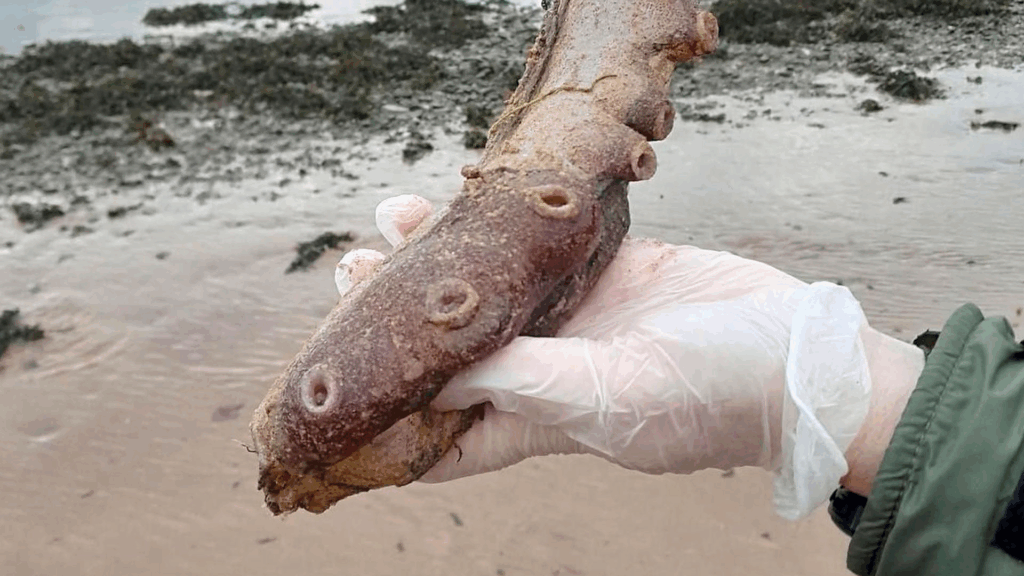
The mysterious fragments of a seven-legged octopus found on a Scottish beach in late November sparked curiosity among marine researchers and the public alike. What initially looked like pieces of an unknown sea creature scattered across the shore turned out to be one of the rarest octopus species ever recorded in UK waters.
This deep-sea dweller, known for its unusual anatomy and elusive behavior, sparked a global surge of interest as experts rushed to piece together how a creature normally living thousands of feet below the surface ended up on land.
The discovery raises fascinating questions about deep-ocean life, marine predators, changing ecosystems, and the challenges of studying species that rarely interact with the surface world. This article breaks down what scientists know so far, why the species is unusual, and why the seven-legged octopus matters.
What exactly washed ashore in Scotland?
A rare septopus with unusually long arms
The creature found along the Ythan estuary in Aberdeenshire was not a mutant or a new species but a septopus, a seven-armed deep-sea octopus scientifically known as Haliphron atlanticus.
Key characteristics researchers noted included:
- Seven arms measuring about 20 inches
- A large, gelatinous body typical of deep-sea octopuses
- Soft tissue structure that differs from the coastal octopus species
- Fragments of the body were found in different locations along the beach
Because the remains were scattered, beachgoers initially could not determine what species it belonged to. Photos sent to marine biologist Dr. Lauren Smith eventually confirmed it was Haliphron atlanticus, commonly called the giant gelatinous octopus or seven-arm octopus.
A creature native to deep, cold waters
This species typically lives at depths of 1,600 feet or more, far beyond where light penetrates the ocean. It is rarely seen by humans except through deep-sea cameras or when accidentally caught in fishing gear.
Haliphron atlanticus has been documented in:
- The Azores west of Portugal
- Puget Sound in Washington State
- Chatham Rise near New Zealand
Its appearance in Scotland makes this sighting particularly unusual.
Why is the seven-legged octopus sighting so rare?
A species that rarely comes to the surface
Deep-sea animals like Haliphron atlanticus thrive in high-pressure, low-light environments. For them to reach coastal shallows is extremely uncommon unless something has gone wrong.
Researchers say this species:
- avoids warm surface waters
- is not typically migratory
- feeds mostly on gelatinous organisms like jellyfish
- is adapted to survival in depths where predators differ from coastal ecosystems
Finding one on land, especially fragmented, is an extraordinary event.
Not native to Scottish waters
Early images led some observers to believe it might be a giant squid. But marine biologists quickly ruled that out after studying the beak, the arm structure, and the absence of toothed suckers.
This makes its presence in Scotland anomalous and important for scientific documentation.
How did the deep-sea septopus end up on a Scottish beach?
Scientists are exploring multiple possibilities
Researchers studying the septopus have put forward three main theories:
1. A whale attack
Several whale species prey on deep-sea octopuses. Dr. Smith noted that whales often leave behind fragmented remains, which aligns with the scattered body parts found along the estuary.
2. A trawling incident
Fishing trawls sometimes pull deep-sea species to the surface unintentionally. If the animal is discarded back into the sea after dying, currents can carry the body toward the shore.
3. Disorientation followed by predation
Marine animals can occasionally get disoriented due to:
- shifting ocean currents
- underwater noise
- temperature anomalies
- illness or injury
Once closer to the surface, the septopus might have encountered predators it was not adapted to face.
Scientists emphasize that without a full intact specimen, determining the exact cause is difficult. Still, the consistency of bite marks and the body’s condition support the whale-attack hypothesis.
Why are researchers so interested in this discovery?
A rare chance to study a deep-sea species up close
Encounters with Haliphron atlanticus are extremely uncommon. Most research relies on:
- remote deep-sea footage
- accidental captures
- limited biological samples
Finding a specimen in the wild, even a fragmented one, gives researchers an opportunity to:
- analyze tissue composition
- study reproductive structures
- examine the beak and suckers
- compare morphology with related species
The labs in Scotland are reportedly excited about what can be learned from this unexpected find.
Clues about changing ocean ecosystems
Marine experts are increasingly concerned about shifts in ocean circulation, warming waters, and changing predator-prey patterns. A deep-sea species appearing far from its usual range may point to:
- altered migration paths
- food scarcity in deeper waters
- increased predator encounters
- disturbances caused by fishing activity
Documenting these anomalies helps scientists track how climate and human activity may be impacting hidden ocean ecosystems.
How does a seven-armed octopus differ from typical octopus species?
The seventh arm is a reproductive structure
Male Haliphron atlanticus have a specialized arm called a hectocotylus, used for reproduction. It is often tucked inside a sac, which makes it appear as though the animal has only seven arms.
In this case, researchers believe the specimen was female, which means the missing arm was likely due to injury rather than biology.
More gelatinous, less muscular
Unlike the agile, muscular octopuses found in shallow waters, septopuses have:
- softer bodies
- reduced musculature
- larger arm spans
- slower movement patterns
Their body composition helps them survive in cold, high-pressure environments.
Why the discovery matters for marine science
It highlights how little we know about the deep sea
More than 80 percent of the ocean remains unexplored. Species like Haliphron atlanticus remind researchers that even large marine animals can remain mysterious.
Rare strandings provide data points
Every unusual encounter contributes to long-term scientific databases that track:
- species distribution
- ocean temperature patterns
- migration anomalies
- predator–prey relationships
These sightings often spark new research questions and help marine conservation groups understand ecosystem health.
It brings public attention to the deep ocean
Unusual creatures washing ashore draw widespread public interest. This helps raise awareness about:
- deep-sea biodiversity
- ocean conservation
- threats from pollution and trawling
- the importance of marine research funding
The Scotland find is already popular online, proving how powerful curiosity-driven science stories can be.
TL;DR: What happened in Scotland?
- Fragments of a rare seven-legged deep-sea octopus washed ashore in Aberdeenshire
- The species was identified as Haliphron atlanticus, the giant gelatinous octopus
- Its arms measured around 20 inches, and its body was scattered across the shore
- Scientists believe whales or fishing activity may have caused its injuries
- The species is usually found at depths of 1,600 feet or more
- Researchers consider the incident an extraordinary and scientifically valuable find