
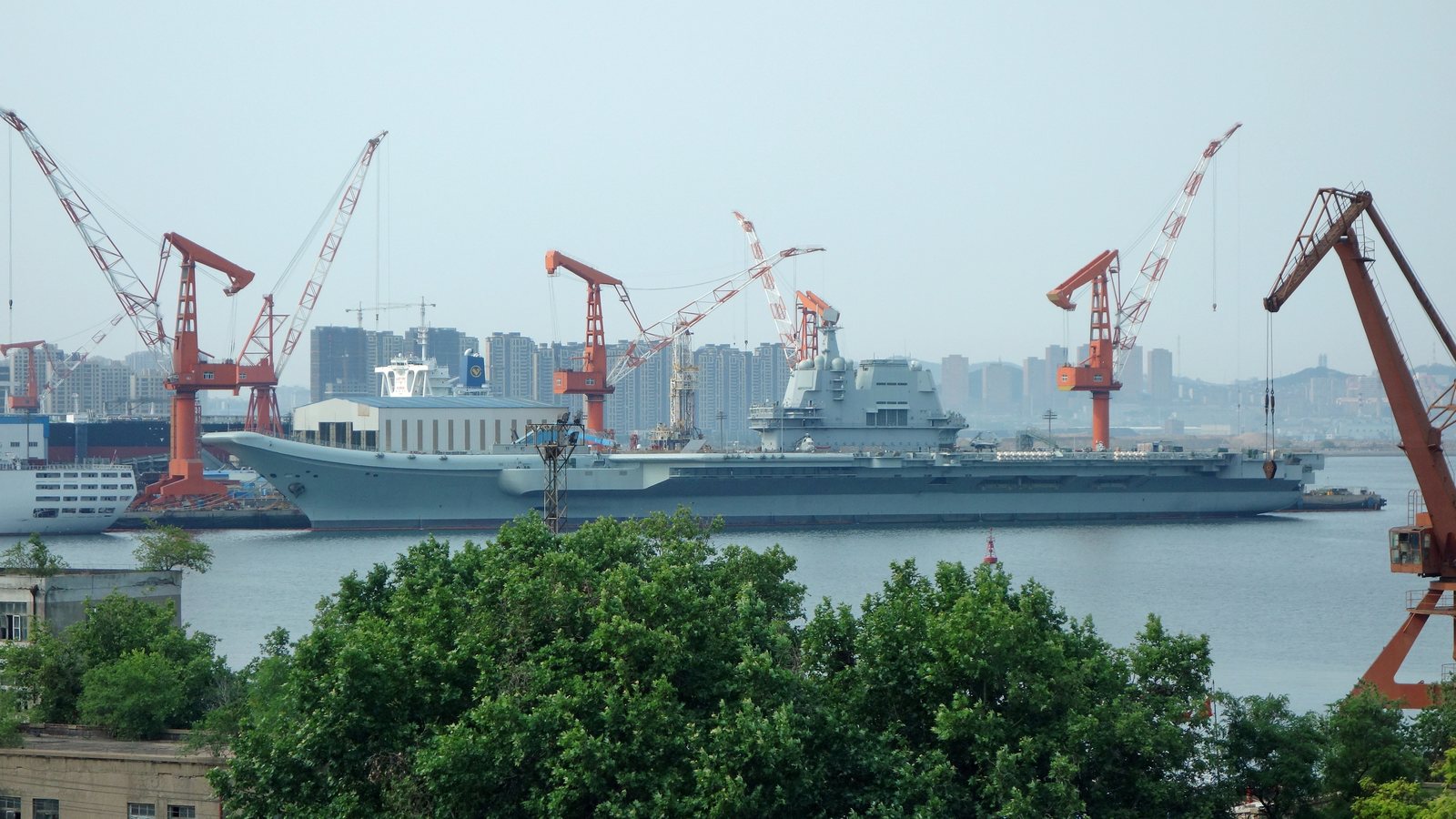

China’s fourth aircraft carrier could be in the water as soon as next year. New satellite images show the Type 004 carrier at Dalian Shipyard at roughly the stage China’s third carrier reached in May 2021, according to an update from the Center for Strategic and International Studies (CSIS). That carrier, the Fujian, went into the water about a year later.
The ship matters to Americans for two reasons. It looks set to rival the US Navy’s biggest carriers in size. It would also likely be China’s first nuclear-powered carrier, the kind of propulsion that runs all 11 current US carriers. Beijing has confirmed neither, and it doesn’t publish construction schedules.
What the satellite images show at Dalian
The CSIS team tracks the ship with commercial imagery from Vantor. Its update, dated Oct. 27, is by Matthew Funaiole, Brian Hart, Aidan Powers-Riggs and Joseph Bermudez Jr.
As of October, they measured the unfinished hull at about 322 meters, or roughly 1,056 feet. Its beam is about 46 meters.
That already makes it bigger than the Fujian. At a similar stage, the Fujian’s hull was about 40 meters wide, and the finished ship is about 316 meters long, CSIS says. The bow, the flight deck and the island, the tower that holds the bridge, are still to come.
CSIS says the Type 004 “could approach or even conceivably exceed the size” of America’s Nimitz-class and Ford-class supercarriers. The defense analysts at Janes went further in September.
Janes estimated the finished hull at 336 to 339 meters. The USS Gerald R. Ford is about 333 meters long, so the Chinese ship may come out slightly longer.
Why analysts think it will run on nuclear power
The strongest clue came in imagery from May 4, 2026. CSIS spotted two compartments in the hull, each about 15 by 15 meters. It says they “bear the hallmarks of shielded nuclear reactor containment systems.” The Fujian burns conventional fuel, and CSIS saw no similar openings in it at a comparable stage.
Janes reported the same pair of compartments taking shape in November 2025. CSIS rates nuclear propulsion as “likely,” not confirmed. It cites a late-2024 Associated Press investigation that found a land-based prototype naval reactor in Sichuan province. That project was linked to the 701st Research Institute, which designs China’s carriers.
Reactors would let the ship sail far longer between refuelings. They would also supply more electricity for systems like catapults.
CSIS expects electromagnetic catapults, like the three on the Fujian, but can’t yet tell whether there will be three or four. A third aircraft elevator is possible too. It would move planes between hangar and deck faster.
A 2027 launch date, and what it would mean
The people who track the ship are careful about dates. Hart, deputy director of CSIS’s China Power Project, told the South China Morning Post he wouldn’t be surprised by a launch in late 2027 or early 2028. That assumes work follows the Fujian’s pace, WION reported, citing the Post. CSIS warns that the ship’s size and design could change the timeline.
Jim Fanell is a retired US Navy captain who once ran intelligence for the US Pacific Fleet. He told the Post that the scale and pace of work at Dalian made him more confident of a launch next year. Bradley Martin, a senior policy researcher at the RAND Corporation, called a launch feasible. He pointed to China’s experience with naval nuclear technology.
A launch is the day a hull first floats, not the day the ship is ready to fight.
The Fujian went into the water at Jiangnan Shipyard in Shanghai on June 17, 2022. It entered service at a naval base in Sanya on Nov. 5, 2025, The Aviationist reported. That took more than three years.
Martin warned that a hard nuclear fit-out could add two to three years between launch and readiness.
The calendar adds a symbolic layer. The People’s Liberation Army turns 100 on Aug. 1, 2027, and Beijing has tied its 2027 military goals to that date, Hart and two colleagues wrote for the Jamestown Foundation in 2021.
China has used past military anniversaries to show off new hardware, WION noted. Nothing official ties this carrier to the centenary.
The Pentagon’s nine-carrier forecast
The Type 004 is one part of a larger plan. The Pentagon’s 2025 China report to Congress said for the first time that China aims to field six more carriers by 2035, CSIS notes. That would bring its fleet from three to nine: the Liaoning, the Shandong, the Fujian and six more.
Hitting that number would mean building at least two carriers at once. CSIS names Jiangnan, which built the Fujian, as the likely second yard. Hart told the Post that building at both yards at once was plausible. Fanell was more skeptical, telling the Post that six working carriers by 2035 is the more realistic figure.
Even six would change the picture in the western Pacific, where Chinese ships already operate close to US allies. In one recent case, a Chinese navy warship and a coast guard ship collided while chasing a Philippine patrol boat near Scarborough Shoal. Washington’s response to China’s buildup also reaches beyond the Navy, as our report on what 30 universities cut after the Pentagon’s China ties audit shows.
Why hulls alone don’t make a carrier fleet
A carrier rarely sails alone. It travels with cruisers, destroyers, frigates, supply ships and sometimes nuclear attack submarines. CSIS says China’s carrier plans depend on building those escorts as well. China recently launched a new class of large supply ship at a shipyard near Guangzhou, the group notes.
Size and reactors also don’t settle how useful the ship would be in a fight. Martin told the Post he expects Chinese carriers to fly fewer missions than US ones. He also sees them as vulnerable in heavily contested waters, even as they give Beijing more options worldwide.
For now, the US leads with 11 nuclear-powered carriers to China’s three conventional ones. The next sign to watch at Dalian is the Type 004’s finished bow and flight deck. After that, the dry dock floods, the ship floats, and CSIS’s 2027 timeline gets its test.