

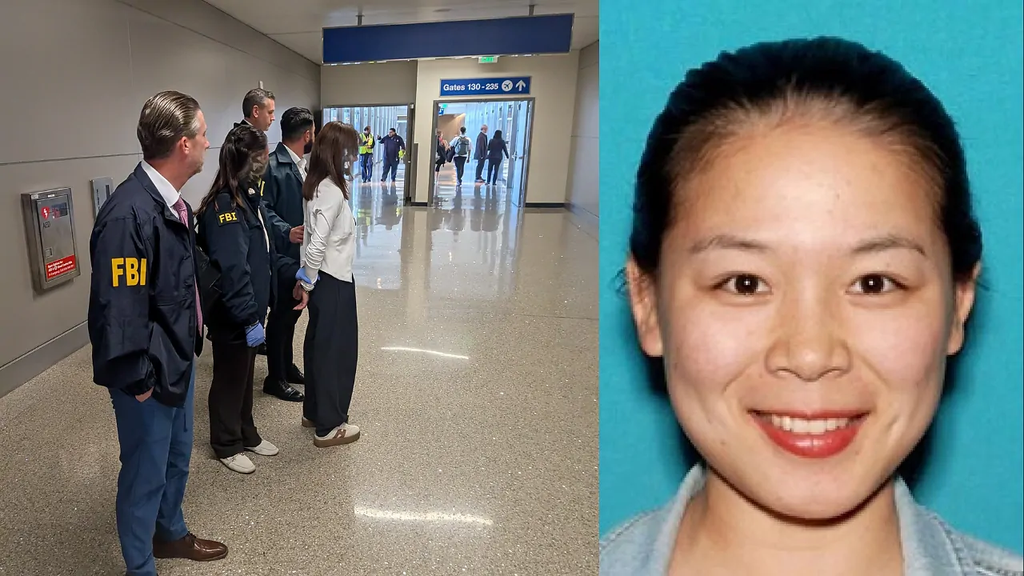
Wanying “Heather” Zhang appeared to be living the polished Southern California life of a successful real estate professional.
The 34-year-old Irvine realtor had built a career selling high-value homes, appeared in luxury travel and lifestyle posts on social media, and, together with her husband, owned a multimillion-dollar property.
Now, federal prosecutors allege that there was another side to her life.
Zhang was arrested by the FBI at Los Angeles International Airport on October 4 while preparing to board a flight to Shanghai, according to the US Justice Department. She has been charged in a federal criminal complaint with acting in the United States as an unregistered agent of the Chinese government.
Prosecutors allege that Zhang was directed by Chinese officials to conduct surveillance of the US-based relatives of Taiwanese President Lai Ching-te, including his son, Lai Ting-yu.
The allegations center on a surveillance trip to the Seattle area in September 2025, messages allegedly exchanged with Chinese government contacts and photographs and vehicle information that Zhang is accused of sending to them.
Zhang appeared in federal court in Los Angeles on October 5, where she confirmed her identity and that she understood the charge. A detention hearing was postponed to October 7 to give her time to obtain private counsel.
She is presumed innocent unless proven guilty in court.
What is Heather Zhang accused of doing?
The federal complaint alleges that Zhang acted at the direction of Chinese government officials while operating inside the United States.
According to the FBI’s account, Zhang and another individual traveled from Southern California through Las Vegas and then to the Pacific Northwest in late August and early September 2025.
After arriving, the pair allegedly rented a vehicle and drove to a residence connected to Lai Ting-yu and his family.
The FBI says Zhang conducted surveillance at the location and recorded Lai and members of his family. Investigators also allege that she sent photographs, video and the license plate numbers of vehicles parked outside the home to a person she understood to be a Chinese government official.
In one message cited in the complaint, Zhang allegedly told the contact, “Saw him. Young male. It’s that young one.”
When asked to participate in an audio call, she allegedly replied that she was recording video.
The FBI says the messages were recovered through a search warrant involving Zhang’s iCloud account.
Why was the son of Taiwan’s president allegedly targeted?
The investigation suggests the surveillance may have been connected to Taiwan’s broader geopolitical dispute with China.
Lai Ting-yu is the son of Taiwanese President Lai Ching-te and lives in the United States. According to CBS News, he is an engineer and works for Dutch electronics company Philips.
The FBI’s complaint argues that information about close relatives, including their homes and vehicles, could potentially provide Beijing with leverage over a senior Taiwanese official during a future conflict.
The alleged operation therefore appears to have focused not on classified government information, but on identifying and monitoring members of a politically important family living in the United States.
Taiwan’s presidential office has condemned the alleged surveillance as an example of transnational repression.
How did the FBI allegedly connect Zhang to Chinese officials?
According to the complaint, investigators traced Zhang’s alleged contacts with Chinese government personnel through electronic communications and her travel history.
The FBI alleges that Zhang was introduced to a Chinese official through a former classmate from Beijing’s University of International Relations, where she had studied.
Special Agent Kevin Holt, who prepared the complaint, said the university has close connections to China’s Ministry of State Security.
Investigators allege that Zhang traveled to China in June 2025 and met a Chinese government official in Changsha.
The complaint says the meeting took place in a private room and that Zhang subsequently communicated with the person about carrying out the surveillance assignment.
In another alleged message cited by investigators, Zhang wrote, “I can take care of this thing.”
Those communications form an important part of the government’s case because prosecutors are seeking to establish that Zhang’s alleged activities were not an independent decision but were carried out at the direction of a foreign government.
What was Zhang’s life like in California?
Before the allegations emerged, Zhang had built a substantial real estate career in Orange County.
She obtained her California real estate license in 2016 and worked with Irvine-based JC Pacific Corp. Zillow records reviewed by CBS News showed that she had been associated with more than 130 property listings.
The listings ranged from properties worth hundreds of thousands of dollars to homes valued at more than $8 million.
Zhang and her husband, Edric Ding, who is also a realtor at the same company, purchased a six-bedroom, roughly 6,030-square-foot home for about $5.65 million in 2024.
They sold the property in June for approximately $6 million.
Her social-media presence also portrayed an affluent lifestyle, with posts showing designer clothing, upscale restaurants, shopping trips and travel across the United States, Canada and Europe.
None of those activities, by themselves, establish any connection to espionage.
What has drawn attention is the contrast between that public profile and the federal allegations involving covert surveillance.
Did investigators find other links to Chinese organizations?
The FBI complaint and subsequent reporting have raised questions about Zhang’s broader contacts within Chinese-American communities.
CBS News reported that Zhang attended Chinese-American events and activities involving individuals connected to organizations regarded by US authorities and researchers as having links to Beijing’s overseas influence networks.
In 2023, she was photographed at an event surrounding Chinese President Xi Jinping’s visit to San Francisco.
CBS also reported that Zhang had attended a Chinese student entrepreneurship event in 2022 involving Chinese consular officials and was recognized at another event as a “young entrepreneur.”
These associations do not in themselves prove that Zhang was working for the Chinese government.
The criminal case instead rests on the government’s allegation that she knowingly acted at the direction of Chinese officials and carried out a specific surveillance mission.
Why was Zhang arrested at the airport?
The timing of the arrest was significant.
Federal authorities detained Zhang on October 4 at LAX as she was preparing to leave the United States for China.
The Justice Department announced that she had been arrested on a one-count complaint alleging that she acted as an unregistered agent of the People’s Republic of China.
The arrest came more than a year after the alleged surveillance trip, indicating that investigators had spent substantial time examining her communications, travel and other records.
The FBI says the investigation remains active.
What does “unregistered foreign agent” mean?
The charge does not simply mean that Zhang allegedly had contact with Chinese officials.
US law can criminalize acting in the United States as an agent of a foreign government without properly notifying the US government, depending on the circumstances.
The statute involved in Zhang’s case is distinct from the Foreign Agents Registration Act, or FARA, although both concern undisclosed activities undertaken on behalf of foreign interests.
According to the Justice Department, Zhang faces a statutory maximum penalty of 10 years in federal prison if convicted.
The government must still prove its allegations beyond a reasonable doubt.
What happened when Zhang appeared in court?
Zhang made her initial federal court appearance in Los Angeles on October 5.
She spoke briefly during the hearing, confirming her name and acknowledging that she understood the charge against her.
A public defender represented her at the initial hearing, while her husband attended the proceedings.
The judge rescheduled the detention hearing for October 7 to provide additional time for Zhang to obtain private legal representation.
Until the court decides otherwise, she remains in US Marshals custody.
What is the evidence against her?
The government’s case appears to rely heavily on digital communications, travel records and surveillance evidence.
The FBI says it recovered messages from Zhang’s account that allegedly show her communicating with Chinese officials before, during and after the Seattle trip.
The complaint also describes surveillance footage from a neighboring property that investigators say shows Zhang and another person appearing to record Lai and his family.
Authorities say they were able to connect the footage to the residence and corroborate aspects of the alleged surveillance through other investigative records.
The alleged transfer of vehicle license plate information is another significant detail in the complaint.
Whether those pieces of evidence are sufficient to establish criminal intent will ultimately be determined in court.
Is Zhang accused of stealing US government secrets?
Not according to the charge announced by the Justice Department.
The central allegation is that she acted as an unregistered agent of the Chinese government and conducted surveillance on relatives of a senior Taiwanese official.
The publicly described case does not accuse her of stealing classified US government documents or penetrating a US intelligence agency.
That distinction is important.
Foreign intelligence operations can involve information that is not classified. Personal locations, photographs, travel patterns and family information can potentially be useful to an intelligence service even when the material itself is publicly accessible or not formally classified.
Why the case matters beyond one California realtor
The case arrives as US officials continue to warn about foreign governments conducting intelligence, influence and intimidation operations inside the United States.
Taiwan is particularly sensitive because of China’s claim that the island is part of its territory and Beijing’s opposition to the Taiwanese government’s push for greater international recognition.
The alleged surveillance of a Taiwanese leader’s family on American soil therefore sits at the intersection of US national security, Taiwan-China tensions and growing concern over transnational repression.
It also highlights how an alleged intelligence operation can be hidden inside ordinary civilian life.
Zhang’s publicly visible career involved property listings and multimillion-dollar homes. The allegations now before a federal court concern overseas contacts, covert surveillance and an alleged foreign-government assignment.
The contrast is striking, but the legal question is narrower: did Zhang knowingly act on behalf of the Chinese government without registering as required by US law?
That question will now move from the FBI’s investigation to the federal court system.