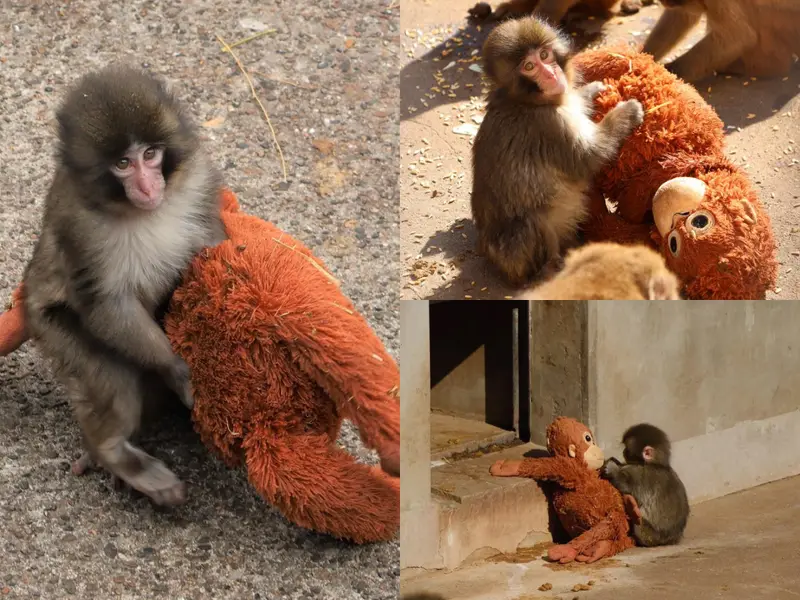
Punch the monkey was born in July 2025 at Japan’s Ichikawa City Zoo. Six months later, he’s an unlikely global star.
Videos of the baby Japanese macaque clutching an orange orangutan plushie have racked up thousands of shares online. In clip after clip, Punch drags the toy across the enclosure, curls up with it, and even hides behind it when other monkeys approach. The hashtag #HangInTherePunch says it all.
But the viral cuteness masks a more complicated story—about maternal rejection, animal behavior, and how zoos step in when nature falters.
Who Is Punch the Monkey?
Punch, known locally as Panchi-kun, is a Japanese macaque born to a first-time mother who rejected him shortly after birth.
According to reporting from Japan’s Mainichi Shimbun, maternal rejection can happen in inexperienced primate mothers who struggle to establish early bonding. While not common, it’s not unheard of in captivity or in the wild.
Zoo staffers Kosuke Shikano and Shumpei Miyakoshi began hand-rearing Punch to keep him alive and stable.
He was physically healthy. The problem wasn’t medical—it was emotional and social.
That distinction matters.
Why Does Punch the Monkey Carry a Plushie?
The now-famous plush orangutan isn’t a gimmick. It’s a behavioral intervention.
The science behind surrogate comfort
Infant macaques depend heavily on their mothers for:
- Warmth
- Grooming
- Physical contact
- Social learning
Without that contact, young primates can experience elevated stress levels and long-term social difficulties.
This isn’t speculation. Research dating back to psychologist Harry Harlow’s controversial primate studies in the 1950s showed that infant monkeys preferred soft surrogate “mothers” over wire ones that provided food. Comfort and touch were critical to development.
How the zoo intervened
To replicate maternal contact, staff introduced:
- Rolled towels
- Soft toys
- Fabric substitutes
Punch ultimately bonded with an orangutan plushie. Zookeepers have described it as his “surrogate mother.”
He carries it constantly.
When other monkeys approach or scold him, he retreats to the plushie. In some videos, he hides behind it like a shield.
For viewers, it’s heartbreaking. For animal behavior experts, it’s predictable.
What Happens When a Hand-Reared Monkey Rejoins the Troop?
Reintegration is the real test.
Punch has been reintroduced to other macaques in the enclosure. That’s essential—long-term isolation would create deeper problems.
But the transition hasn’t been smooth.
Social friction inside the troop
In a widely shared video filmed on February 19, an adult monkey dragged Punch across the enclosure. The clip sparked concern online.
The zoo later clarified on X (formerly Twitter) that the adult was the mother of another baby monkey Punch had been interacting with. Staff suggested she may have interpreted the interaction as rough or inappropriate.
In primate groups, maternal protectiveness is strong. Adult females often intervene aggressively if they perceive a risk to their own offspring.
This is normal macaque behavior, not targeted abuse.
Why social rejection is part of the process
Young primates learn boundaries through:
- Grooming rituals
- Hierarchical corrections
- Occasional physical reprimands
While uncomfortable to watch, mild aggression and social correction are part of troop integration.
The plushie provides emotional regulation while Punch navigates these interactions.
Over time, the goal is gradual independence from the surrogate object.
How Punch the Monkey Went Viral
Punch’s rise wasn’t orchestrated marketing. It was organic.
Videos of him clutching the plushie began circulating on Japanese social media. International accounts picked them up. Within days, #HangInTherePunch was trending among animal lovers.
The emotional arc is simple and powerful:
- Rejected baby
- Substitute comfort object
- Social struggle
- Resilience
It’s the kind of narrative the internet amplifies. But there’s also a broader trend at play.
Why animal rescue stories travel so far
In a digital landscape saturated with conflict and crisis, small, hopeful stories offer relief.
Studies on social media engagement show that emotionally uplifting animal content consistently outperforms neutral updates.
Punch’s story checks several boxes:
- Vulnerability
- Visual distinctiveness (the plushie is instantly recognizable)
- Ongoing updates
He’s not just cute. He’s a character.
Corporate Attention: IKEA Steps In
Punch’s popularity caught the attention of IKEA Japan’s president, who visited the zoo and donated replacement plushies.
The move ensures continuity if the original toy wears out—a practical concern, given how tightly Punch clings to it.
This isn’t just a feel-good corporate cameo. It highlights how viral animal stories can mobilize brand engagement in low-stakes, high-visibility ways.
What Punch’s Story Says About Animal Welfare
It’s easy to treat Punch as a meme. It’s more useful to see him as a case study.
Maternal rejection in captivity
Maternal rejection can occur in:
- First-time mothers
- Stressed environments
- Situations lacking prior social modeling
Captive breeding programs walk a fine line. Human intervention can save individuals but may complicate long-term social development.
The balance between intervention and nature
Zoos face difficult choices:
- Intervene and hand-rear
- Allow natural mortality
- Reintegrate with varying degrees of risk
Punch’s case reflects a middle path:
- Immediate survival support
- Emotional substitution
- Gradual social reintroduction
The plushie is not a permanent solution. It’s scaffolding.
Will Punch Outgrow the Plushie?
That’s the question many online followers are asking.
In many cases, young primates gradually reduce reliance on surrogate objects as:
- Peer bonds strengthen
- Grooming increases
- Hierarchical position stabilizes
There’s no guaranteed timeline.
Some animals maintain attachments longer if early stress was significant. Others abandon substitutes once social bonds solidify.
A future follow-up could explore:
- How often hand-reared macaques fully integrate
- Long-term behavioral differences between rejected and non-rejected infants
Why Punch the Monkey Resonates
At its core, Punch’s story is about resilience. He was rejected, but not abandoned by everyone.
He found comfort, even if synthetic. He’s trying—awkwardly—to belong. And in a fractured online space, that’s enough to draw millions in. Punch the Monkey isn’t just viral content. He’s a reminder of how attachment shapes development—across species.
TL;DR:
Punch the monkey, a six-month-old Japanese macaque rejected by his mother at Ichikawa City Zoo, bonded with an orangutan plushie used as a surrogate comfort object. As he reintegrates with his troop, the plushie helps him manage social stress. His story has gone viral under #HangInTherePunch, blending animal behavior science with internet empathy.