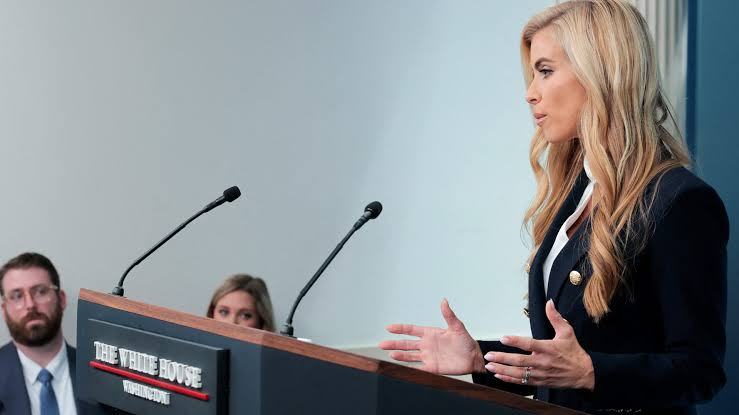
New White House press secretary Katie Zacharia is facing questions about her legal qualifications after Reuters reported that it could not find records showing she was licensed to practice law in any U.S. state or the District of Columbia.
Zacharia, who joined President Donald Trump’s administration on October 12, 2026, has described herself as a lawyer with experience in international transactions. Trump has also referred to her as an attorney. However, questions about her professional credentials emerged within days of her appointment, placing her background under scrutiny as she takes on one of the administration’s most visible communications roles.
The controversy centers on a distinction between earning a law degree, working in a legal environment and holding the professional authorization required to practice law in the United States.
In a statement emailed to Reuters on October 14, Zacharia said, “I practiced international transaction law, with all the appropriate credentials.” The statement did not publicly identify a U.S. state bar or licensing authority where she was admitted.
Who Is Katie Zacharia?
Zacharia is a political and legal professional who has worked in China and with a California-based advocacy organization before joining the White House communications team.
According to her LinkedIn profile, she worked as an associate at Zhong Lun Law Firm in Beijing from 2011 to 2013. She later served as general counsel at Fix California, an advocacy organization founded by Ric Grenell, a longtime Trump ally, from 2024 to 2025.
Grenell offered a different description of her responsibilities at the organization. In a text message to Reuters, he said Zacharia was a senior adviser who handled several roles, including leading the outside counsel used by the group.
The distinction between serving as an organization’s general counsel and coordinating external legal advisers may be relevant to understanding the nature of her work. However, neither title alone establishes whether someone holds a U.S. law license.
Zhong Lun did not respond to Reuters’ emailed requests for comment, and the White House did not answer questions about Zacharia’s legal background, according to the report.
What Is Known About Her Education?
Pepperdine University confirmed that Zacharia earned her law degree in 2011.
A law degree is an important academic qualification, but it does not automatically authorize a graduate to practice law in the United States. Lawyers generally must satisfy the admission requirements of the relevant state or jurisdiction, which commonly include passing a bar examination and meeting character and fitness requirements, subject to applicable rules and exceptions.
The available information establishes that Zacharia earned a law degree and has described professional experience involving legal work. It does not, by itself, establish whether she was admitted to a U.S. bar, held another relevant professional qualification or practiced under a legally permitted arrangement abroad.
Those questions are central to the dispute over how her legal background has been presented.
Did Katie Zacharia Pass the Bar Exam in China?
The question became more complicated after Zacharia was asked during her first White House press briefing where she had passed the bar examination. She replied, “when I moved to China,” without identifying a specific jurisdiction.
Her answer raised questions because China has its own requirements for admission to legal practice, which differ from those in the United States.
Under China’s legal framework, foreign nationals cannot qualify as practicing Chinese lawyers through the country’s national legal professional qualification examination. Foreign legal professionals may, subject to applicable rules, provide certain advisory services or work with Chinese law firms, but that is not equivalent to being admitted as a Chinese lawyer.
Reuters reported that it could not find records showing Zacharia was registered as an attorney or bar member in any U.S. state or Washington, D.C. Other media investigations have also reported that they could not establish that she held a U.S. law license.
The distinction matters because working at a law firm abroad does not necessarily mean someone is licensed to practice law in that country. Lawyers working across borders may perform research, transaction support and other legal work under arrangements that do not require the same qualifications as local practitioners.
As a result, the available information leaves an important question unanswered: What specific credentials was Zacharia referring to when she said she had practiced international transaction law?
Why Are Zacharia’s Legal Credentials Under Scrutiny?
The controversy concerns more than her employment history. It raises questions about how a senior government official’s professional qualifications are described and verified.
A press secretary does not need a law degree or a law license to serve in the White House. The role primarily involves communicating the president’s positions, answering questions from journalists, and representing the administration in public briefings.
However, describing someone as an attorney can imply that the person has met the professional requirements for admission to legal practice. Whether that description is accurate depends on the individual’s qualifications, the jurisdiction involved, and the context in which the title is used.
Renee Knake Jefferson, a University of Houston law professor and legal ethics expert, told Reuters that the issue was a fundamental matter of public trust rather than simply a question of professional terminology.
Her broader point is that the public should be able to distinguish between an academic qualification, experience performing legal work and formal authorisation to practise law.
Could the controversy have legal consequences?
Potentially, depending on the facts and applicable law. In the United States, unauthorised practice of law and false representations about professional qualifications are governed by jurisdiction-specific rules.
California, where Zacharia studied and has been associated with professional roles, has laws regulating who may represent themselves as licensed attorneys. But the existence of those rules does not establish that Zacharia violated them.
The Associated Press reported on October 15 that the watchdog organization Campaign for Accountability had asked the State Bar of California to review the matter. That request is not a finding of wrongdoing, and the available reporting does not establish that Zacharia has been charged with an offence.
Any determination would depend on the precise statements made, the circumstances in which they were made, and the relevant legal requirements.
How Has the White House Responded?
The White House did not answer Reuters’ questions about Zacharia’s legal background, while Zacharia issued a statement maintaining that she had practiced international transaction law with the appropriate credentials.
That statement did not publicly identify a bar association, licensing jurisdiction or specific qualification that would resolve the questions raised by the reporting.
The distinction between her own account and the records identified by journalists remains central to the controversy. An absence of publicly located licensing records is not, by itself, conclusive proof that a person has never held any relevant professional qualification. However, it makes a clear explanation of the credentials being claimed particularly important.
Pepperdine University’s confirmation that Zacharia earned her law degree in 2011 establishes her academic qualification, but it does not independently settle the question of professional licensing.
Why Does the Controversy Matter Ahead of the Midterm Elections?
The questions about Zacharia’s background emerged at a politically sensitive moment for the Trump administration, with the November 2026 midterm elections approaching.
According to Reuters, Trump selected Zacharia after expressing concern about media coverage of his administration and wanting a spokesperson who could better communicate its accomplishments. She replaced Karoline Leavitt, who left the White House in August.
Zacharia’s first briefing, held on October 13, lasted less than 15 minutes and included questions from just three reporters. Some commentators criticized the performance, although Trump publicly praised her appearance.
The subsequent questions about her legal credentials have added another challenge as she establishes herself as the administration’s principal spokesperson.
For the White House, the immediate issue is not whether a press secretary must be a lawyer. It is whether the professional background presented to the public is accurate and adequately explained.
For journalists, the episode underscores the importance of verifying biographical claims, particularly when they involve regulated professions. For the public, it highlights the difference between a person’s stated qualifications and independently confirmed professional credentials.
What Happens Next?
The key unanswered question is whether Zacharia can provide specific, verifiable information explaining the credentials behind her claim that she practiced international transaction law.
That could involve identifying the jurisdiction in which she was admitted to practice, clarifying the nature of her work in Beijing, or explaining which professional qualifications she meant when she referred to having the appropriate credentials.
Until further documentation or clarification becomes available, it would be premature to conclude either that she was licensed to practice law or that she deliberately misrepresented her qualifications.
The controversy is ultimately about transparency. Zacharia can serve as White House press secretary without holding a law licence. But when her legal background becomes part of the public discussion, a clear distinction between education, professional experience, and formal admission to practice is essential.