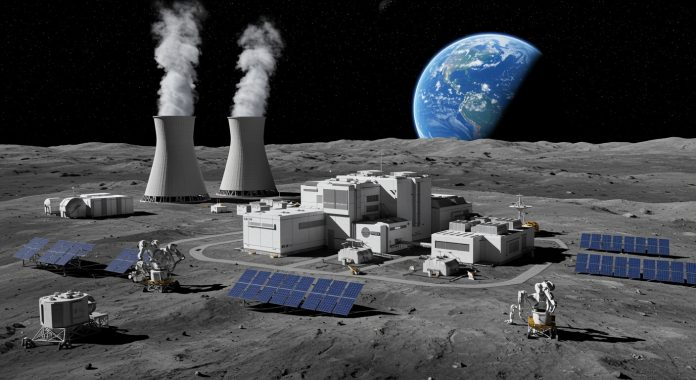
The United States, China and Russia are advancing plans to establish a sustained presence on the Moon, and nuclear power is emerging as a key technology that could make long-term lunar exploration possible. With NASA targeting a lunar surface reactor by 2030 and Russia outlining plans for a lunar power plant by 2036, the countries are working toward an energy infrastructure that could support future bases, robotic explorers, and scientific research.
The push reflects a fundamental challenge of living on the Moon: providing reliable electricity in an environment where sunlight is not always available. Solar panels can generate power in illuminated areas, but long lunar nights and permanently shadowed craters complicate their use. Nuclear fission reactors could provide a continuous energy source, helping future missions operate for extended periods without depending on direct sunlight.
NASA reinforced its plans on October 8, 2026, when it announced a new agreement with the US Department of Energy to advance nuclear power and propulsion technologies for space exploration. China and Russia, meanwhile, are pursuing a joint International Lunar Research Station that could eventually rely on nuclear energy.
Although the countries have different schedules and approaches, their plans point toward a common objective: moving lunar exploration beyond short visits and toward longer-lasting scientific operations.
Why Does the Moon Need Nuclear Power?
The Moon’s day-night cycle lasts approximately 29.5 Earth days. At many locations, this means roughly two weeks of daylight followed by about two weeks of darkness, creating a substantial challenge for solar-powered equipment.
Solar panels could generate electricity during illuminated periods, but missions operating through the lunar night would need energy storage or another dependable source of power. Batteries capable of sustaining habitats, communications equipment, heating systems, and scientific instruments over long periods could add significant weight and complexity to a mission.
Nuclear fission offers a different approach. A reactor produces heat through the splitting of atomic nuclei, and that heat can be converted into electricity. Unlike solar panels, a fission system does not need sunlight to generate power.
NASA says its fission surface power program is intended to develop a system capable of supplying electricity regardless of sunlight or environmental conditions. The agency has been working with the Department of Energy and industry on designs intended to support future lunar and Martian exploration.
A nuclear power system could supply electricity for several essential functions, including:
- Habitat operations: Powering lighting, environmental controls, and other equipment needed for astronauts to live and work on the Moon.
- Heating and thermal management: Helping equipment and habitats maintain operating temperatures in the lunar environment.
- Communications: Supporting data transmission between astronauts, robotic vehicles, lunar infrastructure, and Earth.
- Scientific research: Keeping instruments and experiments running for longer periods.
- Robotic exploration: Allowing rovers and other equipment to operate in areas where sunlight is limited.
The potential benefit extends beyond individual missions. If a reliable power source becomes part of a permanent lunar infrastructure, later missions could use it rather than having to carry every energy system they need.
NASA Targets a Lunar Reactor by 2030
In January 2026, NASA and the US Department of Energy renewed their partnership to develop a fission surface power system for the Moon. The agreement established a goal of developing a lunar surface reactor by 2030, supporting NASA’s Artemis program and longer-term exploration plans.
The agencies are working to develop, fuel, test, and prepare a reactor system for a future launch. The intended technology would provide sustained electrical power for lunar operations without requiring frequent refueling.
NASA’s broader fission surface power work has focused on a system in the 40-kilowatt class. The agency has described that level of output as sufficient to support substantial lunar operations, although the final system configuration and its actual mission capabilities will depend on design and deployment decisions.
The October 8 agreement between NASA and the Department of Energy adds a wider framework for cooperation on space nuclear technologies. According to NASA, the partnership covers development activities ranging from research and fuel production to testing, launch integration and operations.
The agreement also supports the planned launch of Space Reactor-1 Freedom in 2028. That mission is intended to demonstrate nuclear-electric propulsion technology, which uses a nuclear power source to generate electricity for a spacecraft’s propulsion system.
The distinction matters: Space Reactor-1 Freedom and a lunar surface reactor serve different purposes. Nuclear-electric propulsion concerns powering a spacecraft in transit, while a fission surface power system is designed to generate electricity on the Moon. NASA’s plans connect these technologies within a broader strategy for future deep-space exploration.
The 2030 target remains a development goal, not confirmation that a reactor will be operating on the lunar surface by that date. The project will depend on engineering progress, testing, safety requirements, launch readiness, and the availability of supporting lunar infrastructure.
China and Russia Are Planning a Joint Lunar Research Station
China and Russia are also pursuing plans for long-term lunar exploration through the International Lunar Research Station, or ILRS. The proposed research facility is intended to support scientific investigations and technological development on the lunar surface and potentially in lunar orbit.
The two countries signed a memorandum of understanding on cooperation for the station in March 2021. Their plans envision a facility capable of conducting scientific research over extended periods, rather than relying exclusively on individual missions.
China has set a goal of landing astronauts on the Moon before 2030. Its lunar program includes developing the Long March-10 rocket, the Mengzhou crewed spacecraft and the Lanyue lunar lander. The country is also planning robotic missions to investigate the lunar south pole and test technologies that could support later infrastructure.
In April 2025, Reuters reported that a presentation by Chinese space official Pei Zhaoyu outlined a possible nuclear power plant for the proposed research station. The broader concept also included solar arrays and other infrastructure to provide heating and electricity.
The nuclear component is part of a longer-term vision for the station, rather than evidence that a lunar reactor has already been built or deployed. China’s stated plans for a basic version of the ILRS place its development around 2035, with further expansion envisioned in subsequent decades.
Russia has separately announced a target of building a lunar power plant by 2036. In December 2025, Roscosmos said it had signed a contract with NPO Lavochkin for work on the project, including spacecraft development, ground testing, test flights and deployment of infrastructure on the Moon.
Roscosmos said the plant would supply long-term power to Russia’s lunar program and infrastructure associated with the international research station. Russian state announcements have described the project as based on a nuclear power unit, although the precise technical design and deployment arrangements remain subject to development.
The Russian and Chinese programs are related, but their announced milestones should not be treated as interchangeable. China has its own crewed lunar landing target, while Russia has announced a separate 2036 deadline for its power-plant project. The success of the wider joint station will depend on how those plans, along with the necessary launch vehicles and surface systems, develop over time.
Why Are Countries Targeting the Moon’s South Pole?
The lunar south pole has become a major focus of exploration because some craters there remain permanently shadowed. These regions receive little or no direct sunlight, and scientists believe some contain water ice.
Water ice could provide important evidence about the history and distribution of water in the Solar System. It could also become a valuable resource for future missions if its presence, accessibility and suitability for use can be confirmed.
In principle, water extracted from lunar ice could be processed for drinking water and, with suitable equipment, separated into hydrogen and oxygen for potential use as rocket propellant. Such activities would require substantial infrastructure and energy, however, and the practicality of extracting and processing the material remains a technical challenge.
The same terrain that makes the south pole scientifically valuable also complicates exploration. Permanently shadowed craters can be extremely cold, difficult to navigate and challenging to study using solar-powered equipment. Their surrounding terrain may also create obstacles for landing, communications and transporting supplies.
Nuclear power could help support robotic explorers and scientific instruments in these low-light environments. It could also provide electricity for equipment used to investigate potential resources.
However, nuclear reactors would not eliminate the other difficulties of lunar exploration. Missions would still need reliable landing systems, thermal controls, communications, radiation protection and equipment designed to operate in abrasive lunar dust and extreme temperatures.
Establishing a power source near a research site would also require careful planning. The reactor, its shielding and its supporting infrastructure would have to be positioned and operated in a way that protects astronauts, equipment and scientific activities.
What Challenges Must Lunar Nuclear Reactors Overcome?
Despite their potential, nuclear power systems for the Moon present significant engineering challenges.
Launch and deployment: A reactor must survive launch, travel through space and deployment on the lunar surface. The complete system must fit within the constraints of its launch vehicle and landing architecture.
Safety: Nuclear fuel, reactor components and the power-conversion system must be designed to meet stringent safety requirements. Mission planners must also consider launch accidents, reactor startup procedures and safe operating conditions.
Heat management: A reactor generates heat, but removing excess heat in a vacuum is more difficult than doing so on Earth. Space systems rely on carefully designed radiators and other thermal-control technologies.
Reliability and maintenance: A lunar power plant may need to operate for years with limited opportunities for repairs. Engineers must design for long service life and account for the possibility of component failures.
Infrastructure: A reactor alone cannot create a functioning lunar base. Astronauts and robots also need habitats, communications systems, transport, life-support equipment and the ability to deliver supplies and spare parts.
Cost and coordination: Developing, testing and deploying space nuclear systems requires sustained investment. International lunar projects also involve complex coordination among agencies, contractors and partner countries.
The technology is not entirely new to space exploration. Radioisotope power systems have powered spacecraft and instruments for decades, while NASA and its partners have tested technologies intended to support compact fission reactors. However, a fission reactor capable of supplying substantial electricity to a lunar base is a different undertaking from the smaller power sources used on many robotic missions.
The projects will need to demonstrate that reactors can operate reliably in the lunar environment and deliver enough power to justify their mass, cost and operational complexity.
Could Lunar Nuclear Power Help Humans Reach Mars?
A dependable power supply could transform how future missions operate on the Moon. Instead of planning activities around short visits and limited energy reserves, mission designers could build toward longer scientific campaigns and more capable robotic systems.
A lunar research station could support repeated investigations of the surface, the surrounding environment and potential resources. If infrastructure becomes available, later missions could also use established power and communications systems, reducing the amount of equipment that must be delivered for each expedition.
The experience gained from operating nuclear systems on the Moon could inform the development of power technologies for Mars missions. Both destinations present challenges involving distance, environmental conditions, equipment reliability and the need to sustain operations far from Earth.
Nuclear power and nuclear propulsion, however, solve different problems. Surface reactors generate electricity for equipment and habitats, while nuclear propulsion technologies are intended to help spacecraft travel through space. Progress in one area may contribute to the wider field of space nuclear engineering, but it does not automatically establish that the other technology is ready for operational use.
NASA has explicitly connected its lunar fission power work with longer-term exploration of Mars. The agency’s October 2026 agreement also supports work on nuclear-electric propulsion and other space nuclear technologies.
For China and Russia, a lunar research station could similarly provide a platform for extended scientific work and technological demonstrations. The actual contribution of nuclear power to future Mars missions will depend on how these systems perform and what capabilities later missions require.
The Moon’s Future Will Depend on Reliable Energy
The United States, China and Russia are pursuing different paths toward sustained lunar exploration, but all three recognize that reliable energy will be essential to long-term operations.
NASA’s 2030 lunar reactor goal, China’s proposed nuclear-powered research station and Russia’s 2036 power-plant target represent major development ambitions. None should be confused with a completed lunar power installation, and the countries still face substantial engineering and logistical challenges.
If these plans succeed, nuclear power could help keep lunar habitats, robotic explorers and scientific instruments operating through extended darkness. Combined with solar energy, batteries and other technologies, it could form part of the infrastructure needed to support a more continuous human and robotic presence on the Moon.
The broader significance extends beyond a new source of electricity. Reliable power could help turn the Moon from a destination for occasional visits into a place where scientific work can continue over longer periods, laying some of the technical groundwork for future missions farther into the Solar System.