
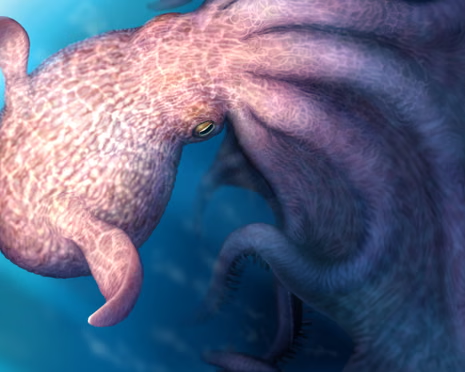
History has long painted the Late Cretaceous seas as a battlefield dominated by toothy marine reptiles like Mosasaurs and Plesiosaurs. However, a groundbreaking discovery by scientists at Hokkaido University, recently published in the journal Science, has introduced a terrifying new contender for the title of apex predator: a 62-foot giant octopus.
Analyzing 15 fossilized jaws, researchers have identified two new species of ancient cephalopods that didn’t just coexist with dinosaurs—they ate them. These massive invertebrates represent a major shift in our understanding of the prehistoric marine food web.
Meeting the Giants: Nanaimoteuthis Haggarti
The larger of the two newly discovered species, Nanaimoteuthis haggarti, is a biological marvel. Measuring an estimated 62 feet (19 meters) in length, it rivals the size of a modern sperm whale. This makes it potentially the largest invertebrate to have ever lived on Earth, surpassing even the legendary Giant Squid.
A Bone-Crushing Predator
What truly sets N. haggarti apart is its diet. Unlike modern octopuses that primarily feast on crustaceans or fish, the wear patterns on these fossilized jaws tell a much more violent story.
- Mechanical Wear: The jaw edges were found to be blunted and rounded, suggesting “dynamic crushing” of hard skeletons.
- The Prey: Scientists believe these octopuses actively hunted Mosasaurs—the “T-Rex of the ocean”—crushing their bones and shells with ease.
- The Technique: Using long, flexible arms to pin down thrashing marine reptiles, the octopus would use its powerful beak to mangle and dismantle its prey.
Intelligence Beyond Their Time
The discovery of the second species, Nanaimoteuthis jeletzkyi, which grew up to 26 feet, provided even deeper insights into cephalopod evolution. The research team found that these ancient octopuses already possessed advanced intelligence 100 million years ago.
Asymmetrical Chewing
Interestingly, the jaws of N. jeletzkyi showed extensive wear and scratches that were blunted on only one side. This indicates that these creatures “chewed” or dismantled their prey from a preferred side, a level of lateralization and specialized feeding behavior typically associated with high-functioning, intelligent predators.
The Trade-off: Shells for Speed
The study highlights a critical evolutionary turning point. During this period, these ancient relatives began losing their heavy protective shells. While this made them more vulnerable, it also made them
- Extremely Mobile: Allowing for jet-propelled bursts to ambush fast-moving dinosaurs.
- Visually Advanced: Developing complex eyes to track prey in the murky depths.
- Intellectually Capable: Requiring a larger brain to manage the complex coordination of eight arms without the “safety net” of a shell.
Rewriting the History of the Cretaceous Seas
For decades, the narrative of the ancient oceans was centered on vertebrates—sharks and giant reptiles. This discovery proves that invertebrates played a much larger role in shaping the marine ecosystem than previously thought. These octopuses weren’t just scavengers hiding in crevices; they were ocean-ruling titans competing directly with the most famous predators of the dinosaur age.
TL;DR: The “Dino-Eating” Octopus
- Size: Up to 62 feet long, matching a sperm whale.
- Diet: Crushed the skeletons of giant marine reptiles like Mosasaurs.
- Significance: Largest invertebrate ever described; proves octopuses were highly intelligent predators 100 million years ago.
- Discovery: Led by researchers at Hokkaido University using fossilized jaw analysis.