
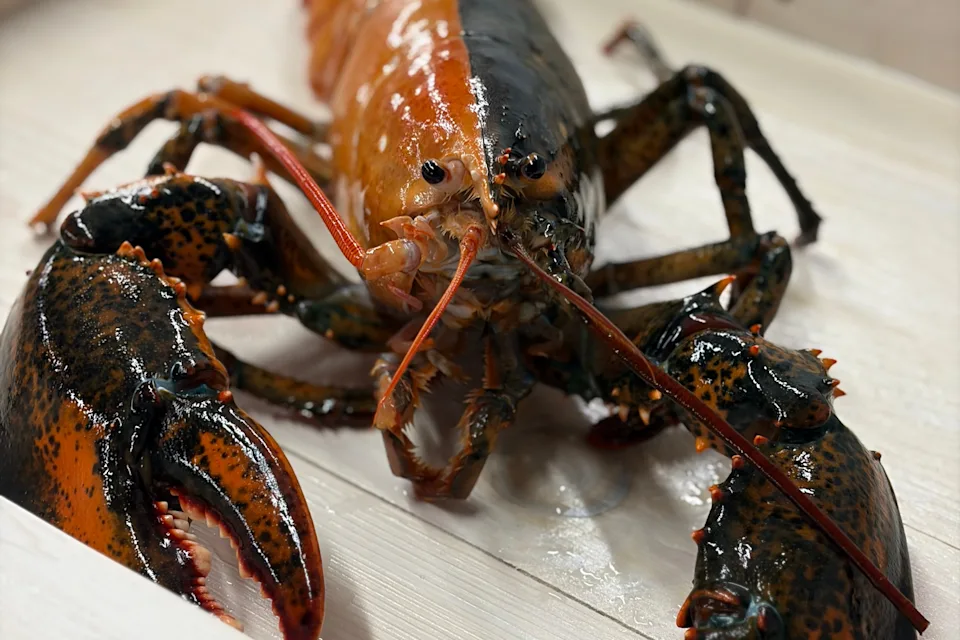
A split-colored lobster pulled from the waters off Cape Cod is turning heads across the marine science community—and for good reason. The rare crustacean, discovered by a crew aboard the fishing vessel Timothy Michael, is almost perfectly divided down the middle: one side a typical brown, the other a vivid orange.
The catch, later shared by Wellfleet Shellfish Company, has sparked widespread curiosity online and among researchers. While unusual lobsters occasionally surface, one with such a clean, two-tone split is exceptionally rare.
What makes this split-colored lobster so rare?
Lobsters come in a variety of unusual colors, from bright blue to calico—but a clean bilateral split like this is in a category of its own.
A near-perfect divide
Photos show the lobster divided almost symmetrically:
- Left side: dark brown (typical colouration)
- Right side: bright orange
This kind of sharp contrast is what makes the specimen stand out. It has drawn comparisons to a “two-faced” appearance, though the underlying biology is far more complex than a visual gimmick.
Just how rare is it?
While exact probabilities are hard to pin down, marine experts consider such lobsters to be extraordinarily uncommon, far rarer than even blue or albino lobsters.
What causes a lobster to be split-colored?
Scientists point to a mix of rare biological phenomena that can produce this striking effect.
Genetic mosaicism
One possibility is genetic mosaicism, where:
- Different cells in the same organism carry different genetic information
- This leads to visible differences in colour or structure
In this case, pigment-producing cells on each side of the lobster may have developed differently.
Gynandromorphism
Another explanation is gynandromorphism, a rare condition in which an organism exhibits both male and female characteristics.
- One side of the body may be genetically male
- The other side is genetically female
This condition has been observed in various species, including insects and crustaceans, and can sometimes result in split coloration.
Pigment irregularities
Less dramatic but still rare causes include the following:
- Disruptions in pigment production during development
- Environmental or cellular anomalies affecting shell colouration
Why didn’t the lobster end up on a dinner plate?
Most lobsters caught commercially never make headlines—they go straight to market. This one had a different fate.
A deliberate decision to preserve it
According to Dan Brandt, COO of Wellfleet Shellfish, the company chose not to sell or cook the lobster.
Instead, it was donated to the Woods Hole Science Aquarium, a well-known marine research and public education facility.
“When something that rare comes across our docks, we see it as part of our role to share it with the broader community,” Brandt told Popular Science.
From catch to classroom
At the aquarium, the lobster will:
- Be studied by marine biologists
- Serve as an educational exhibit
- Help explain genetic diversity to the public
Aquarium biologist Julia Studley emphasised its scientific value, noting that such specimens highlight the complexity of genetic processes in marine life.
Why does this discovery matter?
At first glance, a colorful lobster might seem like a novelty. But discoveries like this offer real scientific insight.
A window into genetic diversity
Rare specimens help scientists:
- Understand how genes control physical traits
- Study developmental anomalies
- Explore how environmental factors influence biology
Public engagement with science
Unusual animals often capture public attention in ways textbooks can’t.
- They make abstract concepts like genetics more tangible
- They encourage curiosity about marine ecosystems
- They help aquariums and institutions educate broader audiences
Are rare lobsters becoming more common?
Not necessarily—but they are becoming more visible.
The role of social media
Fishing companies and aquariums now share unusual finds widely, which means the following:
- More people see rare specimens
- Reports spread faster than ever before
- Public awareness increases
Improved reporting and documentation
Scientists and institutions are also better equipped to:
- Document rare cases
- Share findings globally
- Study specimens in detail
This creates the impression of increasing frequency, even if actual occurrences remain rare.
What happens next for the lobster?
The split-colored lobster won’t be immediately displayed.
A future exhibit
The Woods Hole Science Aquarium is currently undergoing renovations, with reopening expected in 2027.
Once complete, the lobster will likely become a featured exhibit, offering visitors a rare look at one of nature’s more unusual creations.
TL;DR
- A rare split-colored lobster was caught off Cape Cod.
- The lobster is divided into brown and orange halves.
- Possible causes include genetic mosaicism or gynandromorphism.
- It was donated to the Woods Hole Science Aquarium instead of being sold.
- The specimen will be studied and eventually displayed as an educational exhibit.