
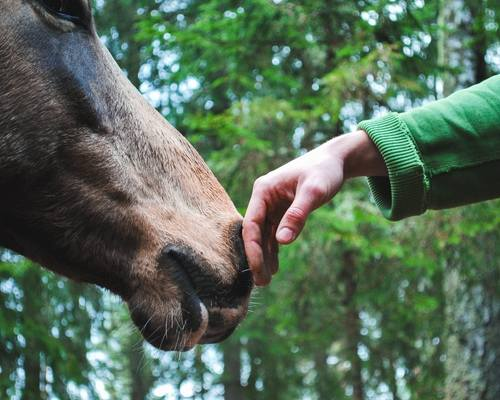
A new scientific study suggests that horses may be able to smell fear in humans and that this scent alone is enough to change how the animals behave. Researchers found that horses exposed to the body odor of people who had just watched horror movies became more alert, more easily startled, and showed increased heart rates compared with horses exposed to the scent of people who watched joyful films.
The findings add to growing evidence that emotional signals can pass between humans and animals, not just through body language or tone of voice, but through smell. For riders, trainers, and anyone working closely with horses, the results point to something simple but powerful: your emotional state may matter more than you think.
What did the study find about horses and human fear?
The study shows that fear may be chemically communicated from humans to horses through sweat.
When horses were exposed to the scent of humans who had experienced fear, they reacted as if they themselves sensed potential danger. Compared with control conditions, the horses:
- Startled more easily
- Showed heightened vigilance
- Displayed increased heart rates
In contrast, horses exposed to the odor of humans who had watched happy, calm films showed fewer stress responses.
This suggests that horses are not just reacting to human behavior in the moment but may be detecting emotional cues embedded in scent.
How fear may be transmitted between humans and horses
According to the researchers, fear alters the volatile organic compounds released in human sweat. These compounds can act as chemical signals, unintentionally communicating emotional states to others both human and animal.
Why smell matters to horses
Horses rely heavily on their senses to assess risk in their environment. While humans tend to prioritize sight and sound, horses evolved to detect subtle changes that could signal danger, including:
- Movement
- Sound patterns
- Body tension
- Smell
Dr. Lea Lansade of the University of Tours, one of the study’s authors, said the findings highlight how emotionally connected humans and animals can be.
“This study shows how closely connected animals and humans are,” she explained, pointing to emotional transmission between species.
How the experiment was conducted
To test whether horses respond specifically to the smell of fear, researchers designed a controlled experiment using human sweat samples.
Step-by-step experiment design
- Human participants watched different film clips
- Fear condition: scenes from Sinister
- Joy condition: upbeat scenes from Singin’ in the Rain
- Participants wore cotton pads under their arms to absorb sweat during the viewing.
- The pads were then placed near the horses’ muzzles so the animals could smell them.
- Researchers observed:
- Horse behavior toward handlers
- Reactions to sudden stimuli, such as an umbrella opening unexpectedly
- Heart rate changes
The results were clear: horses exposed to “fear sweat” showed stronger stress responses than those exposed to “joy sweat.”
Why did horses react so strongly
Fear, from an evolutionary perspective, is not just an emotion—it’s a survival signal.
Possible biological explanation
- Fear-related sweat may contain compounds that signal threat or uncertainty
- Horses may interpret these compounds as warnings of nearby danger
- The response is likely automatic rather than learned
Dr. Plotine Jardat, the study’s lead author, emphasized that people do not consciously control these chemical signals. However, awareness of emotional states still matters.
What this means for riders, trainers, and caretakers
This research has practical implications for anyone who works with horses regularly.
Key takeaways for daily horse handling
- Emotional regulation matters: Nervous or fearful riders may unintentionally stress their horses.
- Calm environments help: Arriving at the stable relaxed may improve training and bonding.
- Behavior issues may not be “disobedience”: Some reactions could stem from human emotional cues rather than the horse itself.
In other words, a horse that seems jumpy or uncooperative may be responding to how its human feels—not what the human is doing.
How does this fit into broader animal behavior research
The findings align with a growing body of research showing that emotions can cross species boundaries.
Prof. Biagio D’Aniello from the University of Naples Federico II noted that the study strengthens evidence that animals respond to human emotional signals through unexpected channels.
“The findings add to growing evidence that emotional signals can cross species boundaries, with horses reacting to human fear via smell,” he said.
Similar research has shown emotional scent detection in dogs and even rodents, suggesting this ability may be more common in mammals than previously thought.
What the study does not claim
It’s important not to overstate the findings.
- The study does not suggest horses understand the fear conceptually
- It does not mean horses can identify who is afraid
- It does not imply fear, and guarantees negative behavior
Instead, it shows that horses may pick up on chemical cues that influence their emotional state—subtly but measurably.
Why this research matters now
As equine-assisted therapy, competitive riding, and recreational horse ownership grow, understanding how humans influence horse behavior becomes increasingly important.
This study challenges a long-held assumption: that animals only react to visible or audible cues. Smell—often overlooked in human-centered thinking—may play a crucial role in interspecies communication.
TL;DR
- Horses may be able to smell fear in humans through sweat
- Exposure to “fear odor” made horses more alert and stressed
- The study suggests emotional signals can pass between species
- Riders and caretakers may benefit from managing their own emotional state
- Smell could be an underappreciated channel of human-animal communication