
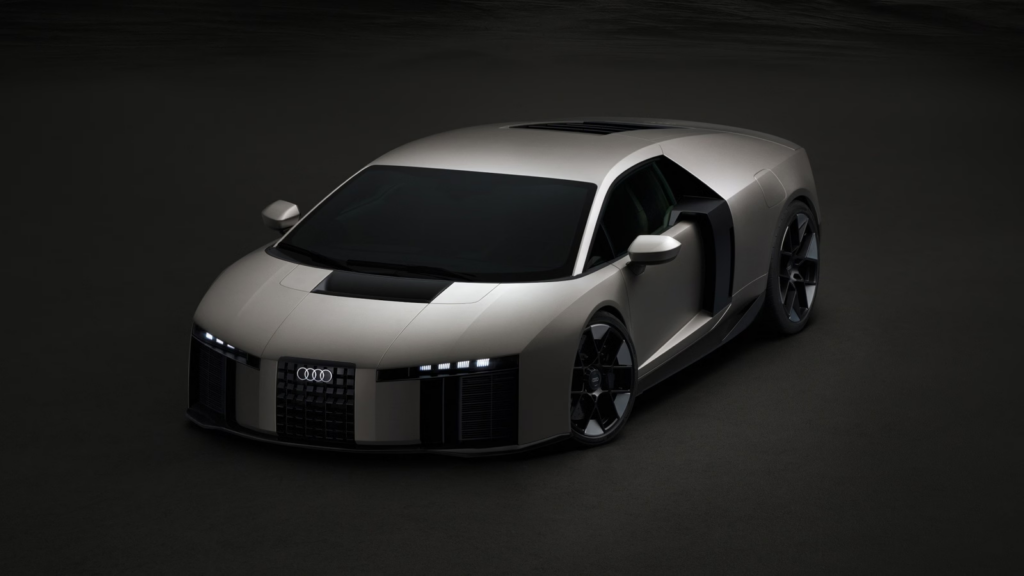
Audi has entered a new chapter in the supercar race with the unveiling of the Nuvolari, a limited-production hybrid hypercar that becomes the most powerful road-going vehicle ever built by the German automaker.
Named after legendary Italian racing driver Tazio Nuvolari, the new flagship combines a twin-turbocharged V8 engine with advanced electric motors to produce nearly 1,000 horsepower. With a top speed exceeding 350 km/h (217 mph) and a production run capped at just 499 units, the Nuvolari is Audi’s most ambitious performance car since the R8.
The launch signals a shift in Audi’s strategy as the company embraces electrified performance without abandoning the emotional appeal of combustion-powered supercars.
What is the Audi Nuvolari?
The Audi Nuvolari is a plug-in hybrid hypercar designed to showcase the brand’s latest advancements in performance engineering, electrification, and aerodynamics.
Unlike the mid-engine Audi R8, the Nuvolari adopts a next-generation hybrid architecture that combines traditional power with electric assistance to deliver extraordinary performance figures.
The car honors Tazio Nuvolari, one of motorsport’s most celebrated drivers and a racing icon closely associated with Auto Union, the predecessor of modern Audi.
For Audi, the name is more than a tribute. It reflects the company’s effort to reconnect with its racing heritage while looking toward the future of high-performance mobility.
Why the Nuvolari matters for Audi
The Nuvolari is more than another limited-edition supercar.
It represents Audi’s answer to a growing market dominated by electrified hypercars from manufacturers such as Ferrari, McLaren, and Lamborghini.
As emissions regulations tighten globally, automakers face increasing pressure to reduce their environmental footprint while maintaining performance credentials. Plug-in hybrid technology has emerged as a bridge between traditional internal combustion engines and fully electric supercars.
The Nuvolari demonstrates how manufacturers can combine both worlds.
Powertrain: Nearly 1,000 horsepower on tap
At the heart of the Nuvolari is a twin-turbocharged 4.0-liter V8 engine paired with three axial-flux electric motors.
Together, the system produces an astonishing 987 horsepower.
Key performance figures
- Power output: 987 hp
- 0-100 km/h: 2.6 seconds
- Top speed: Over 350 km/h
- Powertrain: Plug-in hybrid
- Battery capacity: 7.3 kWh
- Production volume: 499 units
The use of axial-flux motors is particularly noteworthy because they are lighter and more compact than conventional electric motors while delivering high power density. Several hypercar manufacturers have begun adopting the technology as the industry searches for ways to improve efficiency without adding excessive weight.
How the hybrid system works
Unlike traditional hybrids that focus primarily on fuel economy, the Nuvolari’s electrified setup is engineered for performance.
The battery pack provides short-distance electric driving capability, allowing the car to operate in low-speed urban environments with reduced emissions.
However, its primary purpose is performance enhancement.
The electric motors deliver instant torque, helping eliminate turbo lag and providing rapid acceleration from a standstill. The result is a driving experience that combines the responsiveness of an electric vehicle with the soundtrack and character of a high-performance V8.
Aerodynamics plays a major role
Modern hypercars rely as much on airflow as horsepower.
The Nuvolari features an adaptive rear wing that automatically adjusts based on driving conditions and selected drive modes.
Benefits of active aerodynamics
- Increased downforce during high-speed cornering
- Improved stability at top speed
- Reduced drag when maximum aerodynamic assistance is unnecessary
- Better overall efficiency
This technology allows the car to adapt its aerodynamic profile in real time, balancing speed and handling depending on the situation.
A successor to the R8?
While Audi has not officially described the Nuvolari as an R8 replacement, the vehicle effectively takes over as the brand’s performance flagship.
The departure from the R8’s mid-engine formula signals a broader transformation within Audi’s performance division.
The company appears to be embracing a future where electrification is not simply an environmental necessity but a performance advantage.
For enthusiasts, the Nuvolari offers something increasingly rare in the automotive industry: a powerful V8 paired with cutting-edge hybrid technology rather than a fully electric drivetrain.
Exclusivity comes at a price
Audi plans to build only 499 examples of the Nuvolari worldwide.
The hypercar will start at €600,000 in Germany before taxes and customization options.
That pricing places it firmly within the ultra-luxury performance segment and ensures that demand will likely exceed supply.
Limited production runs have become increasingly common among premium manufacturers, allowing brands to maintain exclusivity while showcasing their most advanced technologies.
Why the Nuvolari could shape Audi’s future
Beyond its impressive specifications, the Nuvolari serves as a rolling technology laboratory.
Features developed for flagship performance vehicles often find their way into mainstream production cars over time.
Technologies such as advanced hybrid systems, active aerodynamics, lightweight materials, and high-efficiency electric motors could eventually influence future Audi models across multiple segments.
For now, the Nuvolari stands as a statement of intent: Audi believes the future of performance is not purely electric or purely gasoline-powered, but a carefully engineered combination of both.
TL;DR
- The Audi Nuvolari is the most powerful production car ever built by Audi.
- It combines a twin-turbo 4.0-liter V8 with three electric motors for 987 hp.
- The hypercar accelerates from 0-100 km/h in 2.6 seconds and exceeds 350 km/h.
- An adaptive rear wing improves performance and stability.
- Only 499 units will be produced.
- Pricing starts at €600,000, with deliveries beginning in 2027.
- The model signals Audi’s future direction for high-performance hybrid vehicles.