
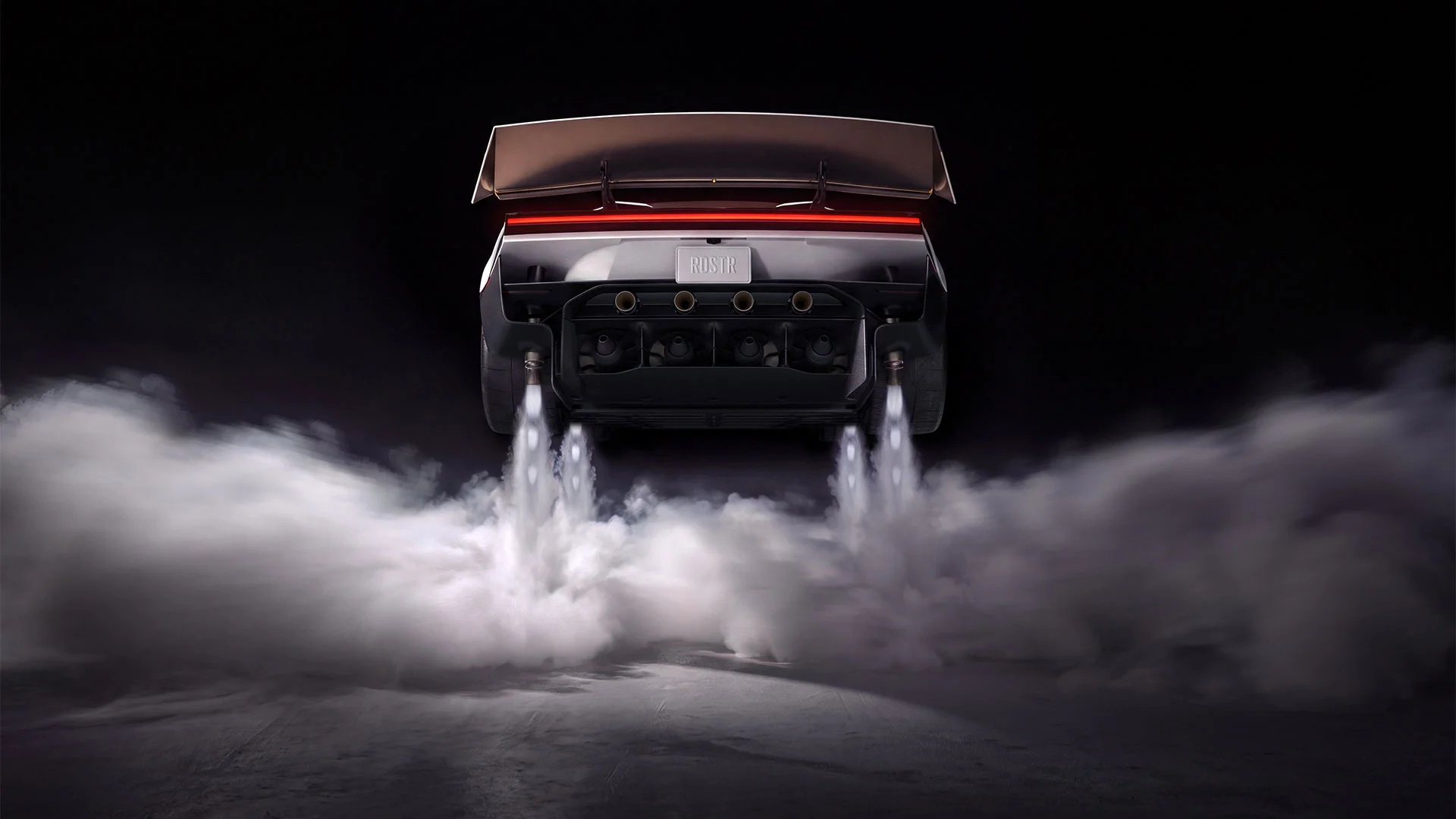
Tesla’s new Roadster did leave the ground at its October 15 reveal in Texas, but it jumped rather than flew. Compressed air fired through 10 cold-gas nozzles lifted the car over a row of other Teslas. Fans under the floor held it to an upside-down ramp.
That matters for anyone weighing a $50,000 reservation. The version that does the airborne tricks is invite-only and seats one person. Tesla’s own fine print says it is “not approved for public road use.”
A driverless car cleared five Teslas at a SpaceX test site
The demonstration took place at SpaceX’s rocket test site in McGregor, Texas, near Waco. Severe weather had forced Tesla to scrap an October 1 date. According to TechCrunch, the white prototype drove up an inverted ramp, spun around, and landed on the pavement. Its thrusters then lifted it over five vehicles: a Cybercab, a Cybertruck, a Semi, a Model Y and a Model 3.
Nobody was driving. Elon Musk said the demo car ran autonomously “to make sure we don’t kill anyone,” the Associated Press reported. He also told the crowd it is “not necessarily a safety-optimized car.”
Tesla said a second jump reached 27 feet and included a barrel roll, NBC News reported. The company also claimed a 0-60 mph run of 0.81 seconds during the show. Nobody outside Tesla has timed either figure.
Musk’s own post on X, quoted by the AP, read “Turns out the future does have flying cars.” The footage supports a shorter claim, as we laid out in whether the Roadster can really fly. The car made brief, ballistic hops and rolls, then came down within seconds.
Ten nozzles of compressed air, no combustion
A cold-gas thruster is about as simple as a rocket gets. It stores gas under high pressure and releases it through a nozzle. Nothing burns, so the push comes only from the gas rushing out, and the car moves the opposite way.
Spacecraft use the same idea for small attitude adjustments, where low thrust is fine. Tesla has to make it work in thick air, at ground level, on a car that weighs well over a ton. Tesla says the thrusters needed new hardware and controls to work in the atmosphere, Electrek reported. The company claims they produce four to five times the force the tires can handle.
Engineering chief Lars Moravy said on stage that the 10 thrusters draw on 600 liters of compressed air, per TechCrunch, and Tesla says the tanks are rechargeable.
Tesla has not published the tank pressure, the nozzle design, or how many seconds of thrust a full charge buys. Some explainers quote 10,000 psi. We could not trace that number to anything Tesla has published, so treat it as unconfirmed.
Firing a nozzle away from the car’s center of mass also makes it rotate, which is how the Roadster rolled in midair. Software decides which nozzles fire and for how long, the same problem SpaceX solves when it steers a spacecraft.
The tanks are SpaceX hardware, and the riskiest part
The gas sits in composite overwrapped pressure vessels, or COPVs. Tesla said on X that it packed them into “every usable void” in the car, according to TechCrunch.
A COPV is a thin liner wrapped in carbon fiber and resin. The fibers carry the load, which makes the tank much lighter than an all-metal one. NASA’s engineering safety center says they are common on launch vehicles and spacecraft. It also warns that a failure can destroy a spacecraft because of the stored energy. Cracks in thin liners are hard to detect.
SpaceX knows that risk first-hand. On September 1, 2016, a Falcon 9 exploded on the pad and destroyed the Amos-6 satellite. SpaceX’s own investigation blamed a failed COPV.
This idea is eight years old. In June 2018, Musk described the thruster option as “ultra high pressure air in a SpaceX rocket COPV bottle.” The tanks would go “in place of the kid seats,” he wrote, as Electrek reported at the time. That trade-off shows up in the final lineup. The thruster-heavy Rocket version seats one person, while the other two seat two.
Fans pull the car onto the road, or onto a ceiling
The second system is quieter but used in every version. Tesla calls it a “multi-mode suction system.” Fans pull air out from under the car, and a seal around the floor keeps the low pressure in. The pressure difference pushes the car against the surface.
Tesla says this produces enough suction to hold the car upside down even when it is stationary, according to Electrek. That is what kept the prototype stuck to the inverted ramp before the thrusters pushed it off.
Fan-assisted grip has a racing history. Niki Lauda won the 1978 Swedish Grand Prix in Brabham’s BT46B “fan car”. The team withdrew it after that one race. Tesla promises the same benefit on a road car: grip that does not depend on speed.
Tesla hasn’t said how much power the fans draw or how they handle gravel and potholes.
The road-legal Roadster will not do most of this
Tesla’s Roadster page splits the car into three versions. We compared them in our guide to the Performance, Thrust and Rocket configurations. Only the Rocket carries the “not approved for public road use” warning:
- Performance: “road ready,” two seats, the suction system, no thrusters. Reservation deposit: $50,000.
- Thrust: “race ready,” two seats, rear-mounted thrusters for acceleration. Deposit: $250,000.
- Rocket: “air ready,” one seat, thrusters around the whole car, invite-only and not approved for public roads.
So the car most buyers can reserve is a very fast EV with clever fans. The jumping belongs mostly to a small number of invite-only cars. Electrek’s Fred Lambert doubted Tesla would sell “more than a handful” of the stunt versions.
Experts quoted by the AP were skeptical too. “This was a demonstration of a one-off car using technology around for many years,” said Bryant Walker Smith. He is a former vice chair of a Department of Transportation innovation advisory group.
The Roadster has a long record of slips. Tesla first showed it in November 2017, on the same night as the Semi, and promised production in 2020. The Semi only reached customers in September 2026.
Musk now says Roadster production starts in 2028, and Tesla’s reservation terms do not guarantee when, or whether, buyers will get a car, the AP reported. Until that date, Tesla is collecting $50,000 deposits on a car that still has no price.