
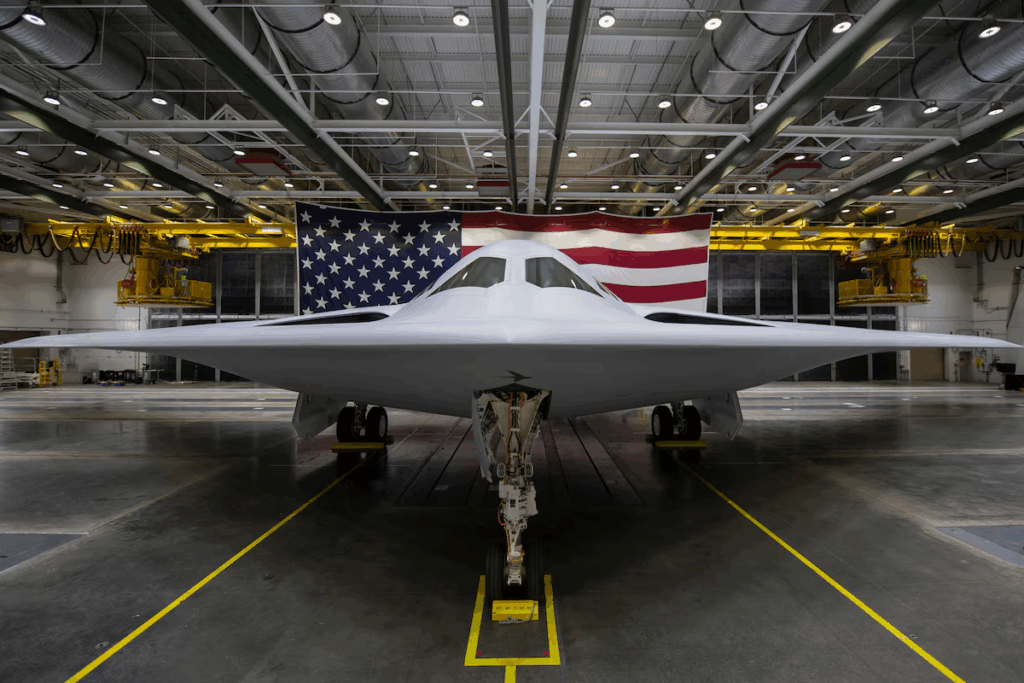
The United States Air Force is preparing to phase out the B-2 Spirit stealth bomber and replace it with the B-21 Raider, a new aircraft designed to dominate 21st-century skies. Developed under the Long Range Strike Bomber (LRS-B) program, the B-21 is being built by Northrop Grumman to ensure America maintains its edge in nuclear deterrence and long-range strike capability in an era of rising great-power competition.
The B-21 is not just an upgrade—it represents a rethinking of how the U.S. projects power globally. With its dual capability to deliver both nuclear and conventional weapons, the Raider will form the backbone of America’s bomber fleet alongside the upgraded B-52 Stratofortress well into the 2050s.
What is the B-21 Raider?
The B-21 Raider is a long-range, stealth, penetrating strike bomber designed to evade the most advanced air defense systems. Unlike traditional bombers, its stealth technology allows it to penetrate enemy airspace undetected and deliver precision strikes.
Key highlights:
- Dual-capable: Can carry both nuclear and conventional munitions.
- Future backbone: Will replace the B-1 Lancer and B-2 Spirit while complementing modernized B-52s.
- Designed for contested skies: Built for survival against cutting-edge air defense networks deployed by China and Russia.
The aircraft was officially unveiled in 2022, with first images of it flying released by the U.S. Air Force in 2024.
How is it different from the B-2 Spirit?
At first glance, the B-21 looks similar to the B-2 Spirit due to its flying-wing design. But beneath the surface, it represents a generational leap.
Major differences:
- Cost efficiency: The B-2 cost nearly $2 billion per aircraft, while the B-21 is expected to be significantly cheaper to build and maintain.
- Easier maintenance: Designed with modular systems to reduce downtime and repair costs.
- Digital engineering: Built using advanced modeling and open-systems architecture, allowing upgrades without redesigning the entire aircraft.
- Production scale: Only 21 B-2s were built. The Air Force plans at least 100 B-21s, with the possibility of expanding to 200.
What are the features of the B-21 Raider?
According to the U.S. Air Force, the B-21 is designed to be “highly survivable, long-range, and flexible.”
Key features include:
- Stealth design: Optimized to defeat modern radar and sensor networks.
- Global reach: Capable of striking targets anywhere in the world from bases in the U.S. or allied territories.
- Open systems architecture: Allows software and hardware upgrades as new technologies emerge.
- Dual-capable strike: Supports nuclear deterrence and conventional operations.
- High survivability: Built to operate in heavily contested environments with advanced surface-to-air missile systems.
Why does the B-21 matter for U.S. air power?
The Raider is not just about replacing old bombers—it’s about adapting to a new strategic era.
1. Nuclear deterrence in a multipolar world
The U.S. nuclear triad—land-based missiles, submarine-launched missiles, and strategic bombers—depends on bombers for flexibility. Unlike missiles, bombers can be recalled after launch, giving policymakers more options during crises.
2. Countering rivals’ defenses
China and Russia have invested heavily in advanced radar and missile systems designed to keep U.S. aircraft out of their airspace. The B-21’s stealth is intended to neutralize these defenses, ensuring the U.S. can strike where needed.
3. Cost and sustainability
The B-2 Spirit became notorious for its high maintenance demands. By contrast, the B-21 is designed to be more affordable, easier to maintain, and deployable in larger numbers.
How many B-21 Raiders will the U.S. build?
The Air Force currently plans to buy at least 100 B-21 Raiders, but some estimates suggest the need could rise to 200 to fully replace aging bombers. Each unit is expected to cost between $550 million and $700 million, making it more affordable than the B-2 while still representing a major investment.
Northrop Grumman is leading the production at its facility in Palmdale, California, with initial operational capability expected later this decade.
Could the B-21 change the balance of power?
Yes. The B-21’s ability to deliver nuclear or conventional strikes deep inside defended airspace could significantly strengthen America’s global deterrence posture.
- For allies, it signals U.S. commitment to collective defense.
- For adversaries, it reinforces the message that no target is beyond America’s reach.
- For policymakers, it provides a flexible platform adaptable to future technologies like artificial intelligence, unmanned operations, and hypersonic weapons.
Conclusion
The B-21 Raider is more than a bomber—it is a strategic insurance policy for the United States in an increasingly uncertain world. By combining stealth, flexibility, and cost efficiency, it promises to secure America’s dominance in long-range strike operations for decades to come.
As the B-2 Spirit heads toward retirement, the Raider will carry forward the mission of deterrence, power projection, and technological superiority into the mid-21st century.