

Iran’s top security official says US bases in Europe will become targets if American jets use them to bomb Iran again. Mohsen Rezaei made the threat on the Beirut channel Al Mayadeen, in an interview broadcast on Wednesday, Nov. 11. A day later, President Donald Trump wrote that “we don’t need a deal with Iran” and took Vice President JD Vance off the talks.
That pairing matters for US troops in Europe and the countries that host them. Since the war began on Feb. 28, Iran has struck US bases in all six Gulf Arab states and Jordan, but none in Europe. Whether that changes depends on two things. Will the US strike again, and can Iran’s missiles fly that far?
Rezaei tied the threat to where US jets take off
Rezaei is secretary of Iran’s Supreme National Security Council. “If the Americans make a mistake and attack us, we will not limit ourselves to nearby bases,” he said, Iran International reported. “We may even target some American military bases in European countries.”
The trigger is a launch from Europe. Iran would strike a US base “even one located in a European country” if American aircraft took off from it, he said, according to AFP. He also named “certain islands that they assume are beyond the reach of our missiles.” That night he posted on X: “NO SAFE DISTANCE. NO SAFE HAVEN. NO IMMUNITY,” The New Arab reported.
Others in Tehran have said this before. On Nov. 4, lawmaker Ahmad Bakhshayesh Ardestani told Euronews that missiles would be fired at Europe if the US used bases in Italy or Germany. The hardline daily Kayhan has listed sites in Cyprus, Greece, Romania, Albania, Italy and Britain, plus Diego Garcia, Iran International reported. Rezaei is the most senior official yet to say it on the record.
Three bases sit inside Iran’s old 2,000 km cap
For years, the Revolutionary Guard said it kept its missiles under 2,000 km. On Saturday, Nov. 7, Guard spokesman Hossein Mohebbi said “this limitation has been lifted for us,” Al Jazeera reported. He gave no new range. The cap was partly meant to reassure Europe, Al Jazeera noted.
To see what the old cap covered, we measured straight-line distances to the main bases from Maku, near Iran’s northwestern border. Real launch sites would likely sit deeper inside Iran, so these are minimums.
| Base | Country | Distance from Iran’s NW border |
|---|---|---|
| RAF Akrotiri (British) | Cyprus | about 1,150 km |
| Deveselu missile defense site | Romania | about 1,770 km |
| Naval Support Activity Souda Bay | Greece (Crete) | about 1,840 km |
| Aviano Air Base | Italy | about 2,690 km |
| Ramstein Air Base | Germany | about 3,100 km |
| RAF Lakenheath and RAF Mildenhall | England | about 3,640 km |
| RAF Fairford | England | about 3,790 km |
| HM Naval Base Clyde (Faslane) | Scotland | about 4,030 km |
The first three fall inside the old cap. The bases in Italy, Germany and Britain do not.
Diego Garcia is as far away as England
London says Iran has already tried a shot that long. In March, the UK said Iran fired two missiles at Diego Garcia, the joint US-UK base in the Indian Ocean. “One missile fell short, failed, the other was intercepted,” minister Steve Reed said on March 22, AFP reported. Iran denied it, analyst Muhanad Seloom told Al Jazeera.
By our measurement, Diego Garcia is about 3,840 km from Chabahar on Iran’s southern coast. That is about as far as Mildenhall and Fairford are from Iran’s border. Neither missile is known to have hit anything, so the attempt shows reach, not accuracy.
Iran’s main missiles fly about 2,000 km, and some variants perhaps 3,000 km. That estimate comes from the Center for Strategic and International Studies, as cited by Iran International. Britain’s Royal United Services Institute said a strike on the UK was possible in theory, with smaller and less accurate warheads.
Mildenhall moved its tankers; the Faslane report is unconfirmed
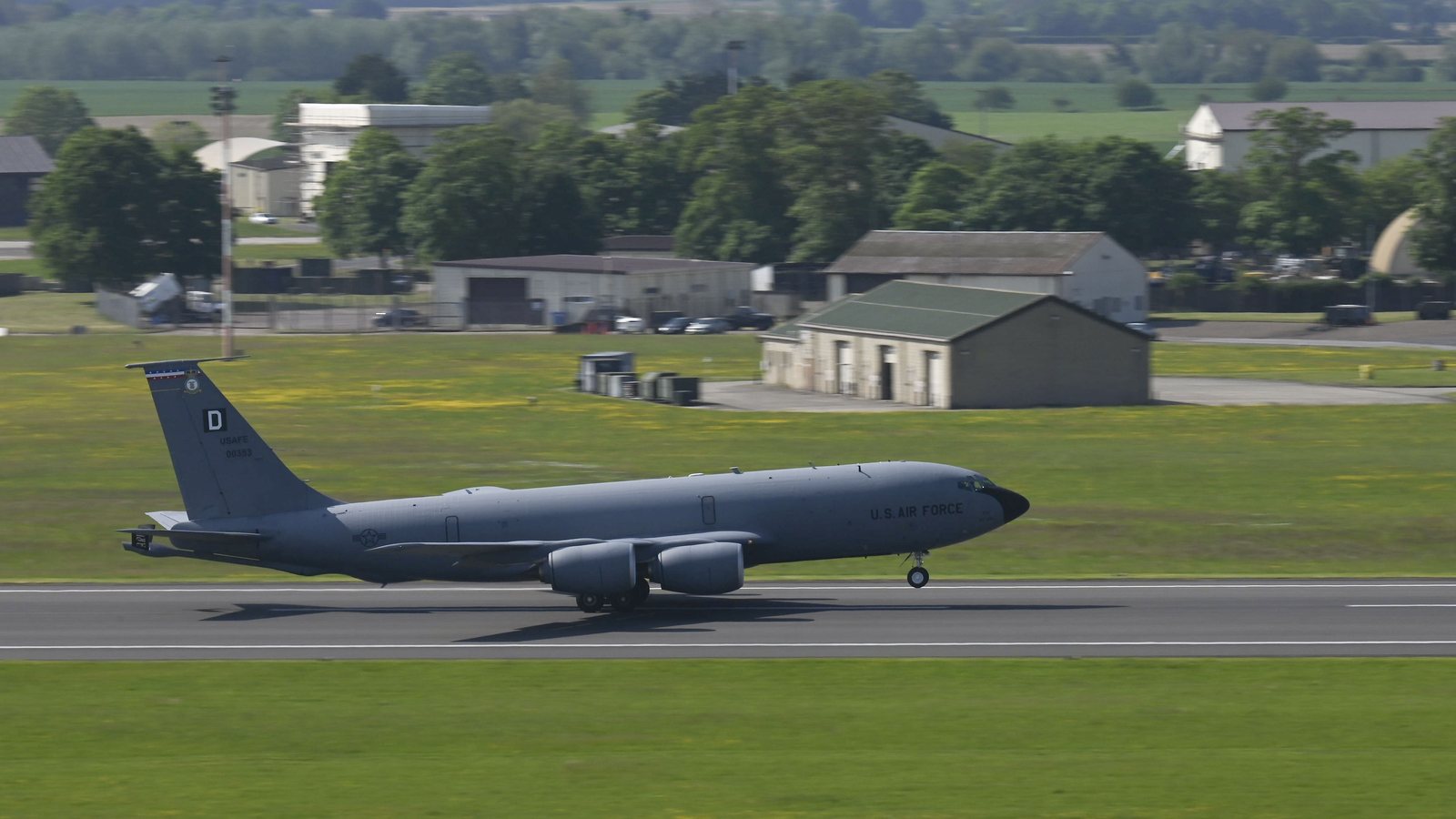
The clearest action came at RAF Mildenhall in Suffolk. On Nov. 9 and 10, at least 15 aircraft left the base, mostly KC-135 tankers, The War Zone reported. They went to Germany, Spain, Scotland and nearby RAF Lakenheath. The Wall Street Journal reported that both bases moved to FPCON Charlie, the second-highest US force protection level.
No one has given a reason on the record. US Air Forces in Europe said it would be “inappropriate to comment on matters of intelligence.” Britain’s Ministry of Defence said assets “move regularly according to operational requirements,” The National reported. Iran’s ambassador in London denied any plot.
The nuclear-base story is thinner. WION reported that Royal Marines had tightened security at Faslane and Coulport against drones, citing only “a new report.” We found no MoD statement confirming a new deployment. Guarding the Trident fleet at Faslane is already the standing job of 43 Commando Fleet Protection Group, the UK Defence Journal reported.
On the record, London has talked about drones in general. Incidents near UK defence sites doubled from 126 in 2024 to 266 in 2025, the Ministry of Defence said in February. In October, minister Luke Pollard promised Parliament “an additional £470 million” for security at military sites, the UK Defence Journal reported.
So far, the threat inside Britain has come from people, not missiles. US prosecutors this week charged three men over a September plot at RAF Fairford, as we reported.
Trump’s no-deal post reopens the question
Rezaei’s threat applies only if the US strikes again, and until this week Washington said it wouldn’t. On Nov. 9, Trump said escalation “won’t be necessary.” Secretary of State Marco Rubio also said major combat wasn’t needed, as we reported on Netanyahu’s push for new strikes.
Thursday’s post muddied that. “We don’t need a deal with Iran,” Trump wrote. “We’ve got their money, Hundreds of Billions of Dollars, and we’ve got their Strait!” He told Vance to focus on crime in Democratic-run cities instead, USA Today reported. A day earlier, the Journal had reported that Vance was weighing face-to-face talks with Rezaei.
The last US raid, on Iran’s Qeshm Island on Nov. 2, drew no Iranian fire at Europe. Britain’s next fixed date is Nov. 20, when two men charged over the Fairford incident are due at the Old Bailey in London.