
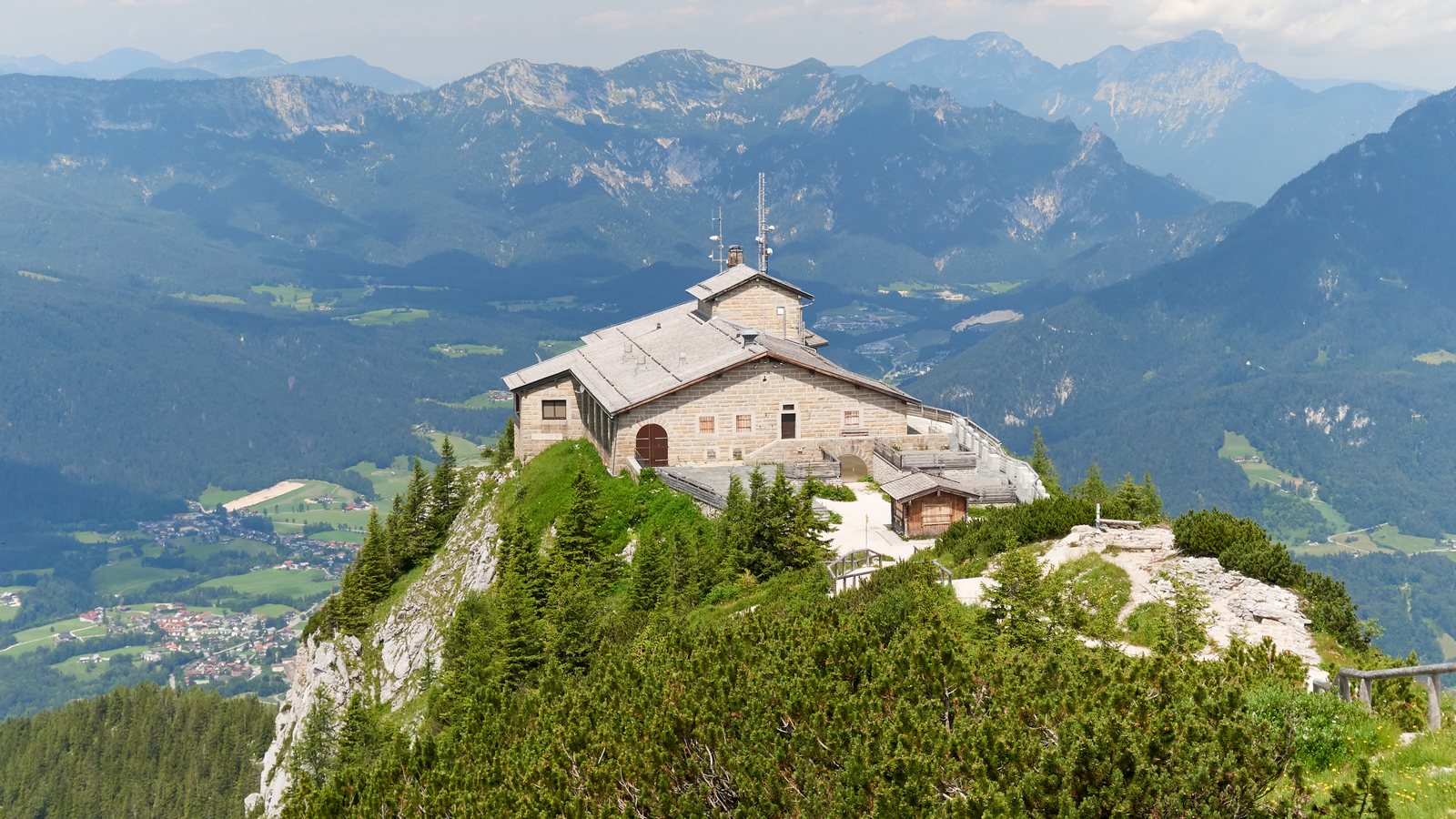

Fire has gutted the Kehlsteinhaus, the mountaintop teahouse built for Adolf Hitler and known to Americans as the Eagle’s Nest. Bavarian police say Friday night’s blaze left it “largely destroyed.” Officers arrested a 33-year-old German man on suspicion of arson, and a judge has sent him to a psychiatric hospital.
The fire ends a strange postwar arrangement. In 1952, Bavaria and the US occupation authorities blew up the ruins of Hitler’s nearby home. They wanted to stop it becoming a shrine.
The Eagle’s Nest, which had come through the war undamaged, became a restaurant instead. Its profits have gone to charity, and it drew tens of thousands of visitors a year, the German Press Agency reported. Bavaria now has to decide what, if anything, goes back on the summit.
What police say happened on the mountain
The building’s fire alarm went off at about 9:15 p.m. on Friday, October 23, according to Upper Bavaria South police. Volunteer firefighters could see flames on the way up. By the time they arrived, the whole building was burning.
The house sits at 1,834 meters (6,017 feet). Visitors ride a bus up a narrow road through five tunnels, then take an elevator cut into the rock.
Rain turned into the season’s first heavy snow, with strong wind. Crews had to pull back overnight after several hours, the Associated Press reported.
Police said about 200 firefighters, mountain rescuers, Red Cross staff and officers from six communities worked through the night. Police know of no injuries, and the restaurant had been closed that day, dpa reported.
Responders met a man on a motorcycle coming down the road and detained him at about 9:45 p.m. Police say he is a German citizen who lives in Berlin. Prosecutors told AP he has ties to the Berchtesgaden area.
A psychiatric expert’s brief assessment found he has a mental illness. A judge in Rosenheim then ordered him held in a secure psychiatric hospital.
Investigators are also examining a possible political motive, prosecutor Rainer Vietze said, according to dpa. He said that inquiry is at “the very beginning.” Police told AP they see no sign that anyone else took part.
Officers still can’t safely enter the ruin. An expert from the Bavarian State Criminal Police Office will join them in the coming days.
A teahouse Hitler seldom used
The Nazi official Martin Bormann drove the project, and workers built the house in 1937 and 1938. Despite a widely told story, it was not a gift for Hitler’s 50th birthday in 1939, the operator says on its history page. Hitler visited “extremely rarely,” it adds.
The real seat of power was lower down. Hitler expanded his house on the Obersalzberg into the Berghof. There, says the Obersalzberg Documentation Center, he made decisions “about persecution, war and genocide” with his inner circle. Göring, Bormann and Speer also had homes inside the sealed-off compound.
On April 25, 1945, the Royal Air Force bombed the Obersalzberg and destroyed most of its buildings. The Eagle’s Nest, roughly 3,000 feet above the Berghof on its own peak, wasn’t hit, according to the National WWII Museum.
Where the American story is true, and where it isn’t
The US hook here is real. US and French troops occupied the Obersalzberg on May 4, 1945, according to the Documentation Center. The US Army then ran the area as a recreation center for soldiers from across Europe until 1996.
The most famous American version needs a correction. Stephen Ambrose’s book Band of Brothers, which became the HBO series, carries the subtitle “From Normandy to Hitler’s Eagle’s Nest.” But by the National WWII Museum’s account, Easy Company and the 101st Airborne were not first.
Larry Decuers, a former curator, lays out the order in an article for the National WWII Museum. The 3rd Infantry Division’s 7th Infantry Regiment entered Berchtesgaden first, at about 4 p.m. on May 4. French troops of the 2nd Armored Division climbed to the Eagle’s Nest early the next morning.
The 101st’s lead element, the 2nd Battalion of the 506th Parachute Infantry Regiment, reached Berchtesgaden on the morning of May 5. It came last but stayed longest, Decuers writes.
Hollywood did the rest. The operator’s own site says the building’s use in US war films and series gave it “a prominence that it does not perhaps deserve.”
Why Bavaria blew up the Berghof but kept this house
In 1952 the Bavarian government and US occupation authorities blew up almost all of the Obersalzberg ruins, the Berghof among them. According to the Documentation Center, they feared the site would become a place of “pilgrimage” for Hitler’s admirers.
The Eagle’s Nest went the other way. It reopened to the public as a mountain restaurant on May 17, 1952, according to the operator. The state leased it to the local branch of the German Alpine Club.
The operator’s English-language page credits “the intervention of former Governor Jacob” with saving it from demolition. It gives no further detail, and we couldn’t find a fuller account of that decision.
The later arrangement is on record. In 1960 Bavaria set up a public foundation, the Berchtesgadener Landesstiftung. It gave the foundation the right to earn income from the house, its elevator and the road.
That income must go to charitable causes in the district, such as health care and schools. The state still owns the building. A Berchtesgaden tourism association manages it, and private tenants run the restaurant.
Read together, the records suggest a different logic for each building. A gutted residence where Hitler lived and governed risked becoming a shrine. A rarely used guesthouse with a famous view could earn money for local causes. It could also carry an exhibition about the Nazi era inside.
Rebuild, and how faithfully
Bavaria’s interior minister, Joachim Herrmann, has already said the state will restore the site. “We’re not going to leave a ruin there,” he told reporters in Berchtesgaden, AP reported. He said local officials, historians, preservationists and others would help decide how it looks. “It is important that we continue to do the work of remembrance,” he added.
That leaves the hard question open. A faithful copy of a Nazi-built teahouse is not the same thing as the 1938 original. A modern building on the same spot would change what visitors see. Leaving the shell standing is the option Herrmann has ruled out.
First, officials must work out which parts of the listed building they can save, the Berliner Zeitung reports.
The decision lands as Germans argue over the Nazi era in other ways. This spring brought a rush to a searchable Nazi Party membership database. And German courts still prosecute Holocaust denial, as a 95-year-old repeat offender’s sentencing showed in 2024.
The money is less of a worry. Herrmann has said the building is well insured and that insurance claims are already under review, the Berliner Zeitung reported. Bartl Wimmer, who chairs the Berchtesgaden tourism association that manages the site, said the damage “certainly runs into the millions.”
Herrmann expects a rebuild to take a long time and wants historians involved. No timeline or cost estimate exists yet.
For now, the house, its bus line and elevator are “completely closed until further notice,” the operator says. The Documentation Center lower on the mountain was not affected and is open as usual.
The next concrete step is the state criminal police expert’s inspection of the ruin in the coming days. Only then will investigators be able to say where and how the fire started.