
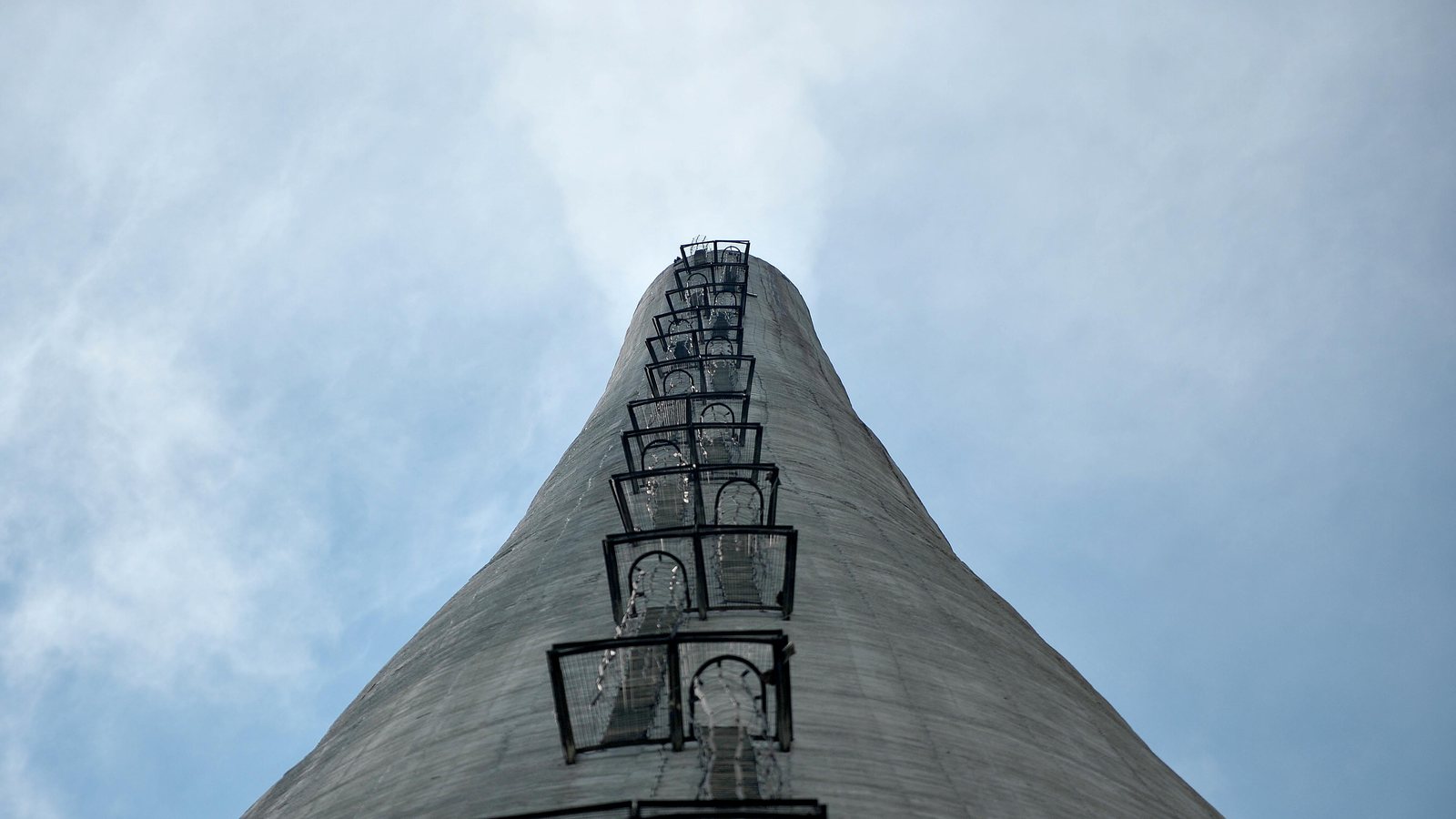

A human catapult built into the top of Europe’s tallest chimney fired Spanish wingsuit flyer Dani Román 100.36 meters (329 feet) into the air on November 5. The launch in Trbovlje, Slovenia, set a Guinness World Records title for the greatest height by human catapult. Minutes later Román and French skydiver Fred Fugen went up together and set a second one.
The stunt was a Red Bull project, supported by Prada Linea Rossa. The figures here come from Red Bull’s account of the launch, published November 9. Guinness World Records had not posted its own record pages when we checked on November 11.
Two launches from the rim of a 360-meter chimney
The catapult was not fired from the ground. It sat in the upper 60 meters (197 feet) of the 360-meter (1,181-foot) chimney at the former Trbovlje power station. It threw the jumpers out of the top, according to Red Bull’s Slovenian-language report.
The chimney, finished in 1976, is the tallest flue-gas stack in Europe. The coal plant beneath it closed in 2016, Wikipedia’s entry on the station notes.
Román, 35, went first and alone. He rose 100.36 meters after leaving the launch capsule, the record for greatest height by human catapult.
Then Román and Fugen, 47, launched side by side. Román rose 75.97 meters (249 feet) and Fugen 75.75 meters (248.5 feet). Their combined 151.72 meters (498 feet) set the record for greatest combined height by human catapult.
Both men then opened parachutes and landed. Between them they have made more than 32,000 parachute jumps, Red Bull says.
A spring-driven machine that took two and a half years
DD Squad, the Slovenian stunt and engineering crew also known as the Dunking Devils, designed and built the catapult. Red Bull says the project took two and a half years.
The Slovenian report gives the details the English version leaves out. The machine weighs six tonnes and runs on a two-tonne spring system. The crew hauled it up in smaller pieces and assembled it at the top of the chimney, which took about two months.
Before that, the team tested a 12-meter version on Sass Pordoi in the Italian Dolomites.
“This project became our life for two months,” DD Squad’s Gašper Novak told Red Bull Slovenia (our translation).
The jumpers stood in a capsule that took them from zero to 180 km/h (112 mph) in 2.15 seconds. At full power it put up to 4.2G on their bodies.
“It’s just ‘bam!’ You go from zero to 112mph in two or three seconds,” Román said. “In that capsule you cannot really move.”
Fugen said the launch was new even for him. Red Bull quotes him calling it “something you cannot train for, but we fully trust DD Squad.”
What the launch numbers add up to
Red Bull’s figures can be checked against each other with school physics, and they hold together. Here is our working.
The track length fits. 180 km/h is 50 meters per second. Reaching it in 2.15 seconds at a steady rate takes about 54 meters of track. That fits inside a 60-meter catapult.
The G-force fits. The same numbers give an average of about 23 meters per second squared. That is roughly 2.4 times gravity. A 4.2G peak is plausible, because the push is not even through the stroke and an average hides the peak.
The height fits, with drag taking a cut. With no air at all, a body leaving at 50 m/s would coast up about 127 meters (418 feet). Román made 100.36 meters, or about 79% of that.
A person in a jumpsuit is not streamlined, so losing a fifth of the climb to drag is no surprise. Red Bull did not publish an exit speed separate from the top speed, so treat this as an estimate.
The release point fits. Red Bull puts the highest point of the flights at 456.7 meters (1,498 feet) above ground. Subtract Román’s 100.36 meters and the release point comes out around 356 meters, just under the chimney’s 360-meter rim.
How it compares with the human cannonball
The closest record to it is the human cannonball. The Guinness mark for the greatest height achieved by a human cannonball is 27.12 meters (89 feet). David Smith Jr. set it in Riyadh, Saudi Arabia, in 2019.
Román went about 3.7 times as high. The big difference is the landing. A cannonball act ends in a net. Román and Fugen left the catapult about 350 meters above the valley floor and came down under parachutes.
The stunt fits a run of Red Bull stunts built around one site, like diver Molly Carlson’s leap from a freshly flipped iceberg. Endurance records look very different. Two Belgians ran 124 hours in a backyard ultra, and Karl Bushby walked home for 28 years.
Guinness has yet to post the two record pages
Torqued Magazine reported the same figures on November 9. Its lead image, it notes, is a frame from an action camera made with DD Squad.
The one missing piece is Guinness itself. Its site had no page for either catapult title on November 11. Until Guinness lists the two records, the official wording and figures rest on Red Bull’s account.