
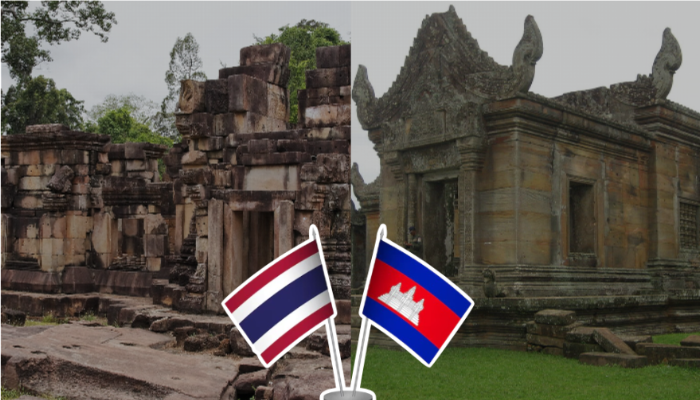
Quick Summary
- Cambodia and Thailand are fighting again over their disputed border, especially near the ancient Preah Vihear Temple.
- The temple sits in contested territory shaped by colonial-era maps and has long been a source of tension.
- A 1962 ICJ ruling gave the temple to Cambodia, but disagreements about surrounding land continue.
- Clashes reignited in May 2025 and escalated dramatically in July, with deaths on both sides and rising civilian casualties.
- The region’s stability and trade could suffer if the crisis deepens.
Clashes along the Thailand–Cambodia border have reignited a long-simmering territorial dispute, with at least nine people reported dead and hundreds more displaced. This fresh wave of violence centers around a historical flashpoint: the Preah Vihear Temple. But the roots of this conflict stretch back more than a century, shaped by colonial-era mapmaking, competing nationalist claims, and unresolved diplomatic efforts.
Here’s a detailed breakdown of why the two Southeast Asian neighbors are fighting again, and what’s at stake.
Where exactly are Cambodia and Thailand fighting?
The renewed fighting has erupted along multiple points of the 817-kilometer Thailand–Cambodia land border, particularly near two ancient temples in the Dângrêk Mountains. According to Thai military officials, combat zones span at least six locations, including areas near the 11th-century Preah Vihear Temple and another disputed site in Surin province, Thailand, opposite Cambodia’s Oddar Meanchey province.
Most of the current exchanges involve artillery, rocket fire, and targeted airstrikes, marking the worst escalation in over a decade. Thai fighter jets were launched from Ubon Ratchathani to strike Cambodian positions, while Cambodian artillery fire reportedly killed at least one Thai civilian and injured three others, including a child.
What is the Preah Vihear Temple, and why is it so controversial?
The Preah Vihear Temple is a UNESCO World Heritage Site perched atop a steep cliff in the Dângrêk range. Built in the 11th century during the height of the Khmer Empire, it is one of Cambodia’s most revered historical monuments. However, it sits on the edge of a highly contested stretch of borderland.
Why do both countries claim it?
- Colonial-era maps: The roots of the dispute go back to the early 20th century, when French colonial authorities—who then controlled Cambodia—produced a map that placed the temple within Cambodian territory. Thailand (then Siam) contested this placement, arguing the temple was north of the watershed line, which should have served as the border.
- ICJ ruling of 1962: Cambodia took the dispute to the International Court of Justice (ICJ), which ruled in its favor, awarding the temple itself to Cambodia. Thailand accepted the verdict but continued to claim the surrounding land, which was not explicitly delineated in the ruling.
- UNESCO listing in 2008: When Cambodia succeeded in having the temple recognized as a World Heritage Site, nationalist outrage surged in Thailand. The move was perceived as a territorial assertion, and it triggered violent clashes near the site, which lasted for years and peaked in 2011.
What has happened in the past decade?
Following the 2008–2011 border clashes, Cambodia again approached the ICJ in 2011 to clarify its earlier judgment. In 2013, the court reaffirmed that the temple and the immediate vicinity belonged to Cambodia. However, the ruling did not clearly define the surrounding area, and Thailand maintained that the buffer zone remained unresolved.
To address lingering tensions, the Joint Boundary Commission (JBC) was established in 2000 to demarcate the border. But progress has been slow. Talks have been intermittent, and the most recent scheduled meeting in Phnom Penh in June 2025 ended without a breakthrough.
What triggered the latest round of violence?
Although the border has seen intermittent skirmishes over the years, the current escalation can be traced to a deadly incident in May 2025, when a Cambodian soldier was killed during a confrontation. In response, Cambodia imposed economic sanctions, including banning imports of Thai goods such as produce, electricity, and even internet services, further straining bilateral ties.
Thursday’s clashes began after Cambodia reportedly fired artillery shells that landed inside Thai territory, killing a civilian and injuring others. Thailand retaliated with air strikes on Cambodian military positions.
Both nations have accused each other of firing the first shot, and each claims to be acting in self-defense.
Why does this conflict matter regionally?
The Thailand–Cambodia border tensions threaten to destabilize the broader Southeast Asian region, where economic integration and security cooperation have been long-term goals through organizations like ASEAN. Prolonged conflict could:
- Disrupt regional trade, especially as both nations are key exporters in sectors like agriculture and tourism.
- Jeopardize cross-border infrastructure projects supported by international partners.
- Undermine ASEAN’s already fragile ability to mediate internal conflicts.
Have there been international responses or mediation efforts?
So far, the international community has largely urged restraint without direct intervention. In past conflicts, ASEAN has tried to play a mediating role, but its charter limits the bloc’s ability to interfere in member states’ internal or bilateral disputes unless both parties agree.
The United Nations previously sent observers during the 2008–2011 clashes but has not yet responded to the current violence. It remains to be seen whether renewed ICJ involvement or third-party mediation can de-escalate the situation.
What could happen next?
While both nations have historically avoided full-scale war, the recent scale and intensity of the fighting suggest that diplomacy may not be enough this time. The key variables moving forward:
- Whether Thailand and Cambodia agree to reconvene the Joint Boundary Commission.
- If either side escalates air or ground operations near civilian zones.
- International pressure from ASEAN, the UN, or major trade partners to step in.
If the two countries fail to reach a new settlement over the status of the surrounding areas of Preah Vihear, history could repeat itself—at greater human and economic cost.