
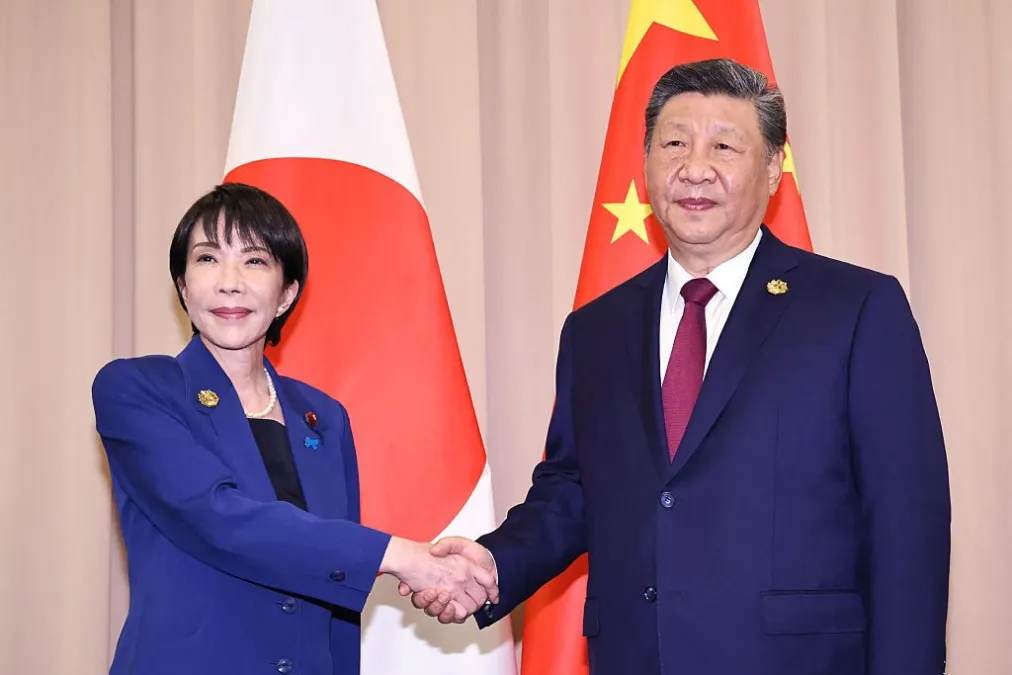
The China–Japan diplomatic standoff over Taiwan has escalated into the most serious confrontation between the two Asian powers in years. The trigger was a pointed remark by Japan’s new Prime Minister, Sanae Takaichi, referencing Tokyo’s potential military role if China attempted to absorb Taiwan forcefully.
China reacted with swift and sweeping countermeasures, travel warnings, airline cancellations, halted student exchanges, Coast Guard incursions, and cultural restrictions—pushing the bilateral relationship into dangerous territory.
This article breaks down what happened, why it matters, and what comes next, with a focus on geopolitical, economic, and security dimensions.
What triggered the China–Japan diplomatic clash?
On November 14, Prime Minister Takaichi was questioned in Japan’s parliament about possible “survival-threatening situations.”
In her response, she offered a hypothetical scenario:
- If China attempted to bring Taiwan completely under its control through military force,
- Or if US warships were attacked as they intervened to break a Chinese blockade,
Japan may be compelled to respond militarily under its 2015 security legislation.
For Beijing, the implication was clear: Tokyo was positioning itself to intervene on Taiwan’s behalf.
Why China saw Takaichi’s comment as a direct challenge
Beijing interprets any suggestion of foreign military involvement in Taiwan as a violation of its sovereignty claim.
Japan historically ruled Taiwan (1895–1945), and Beijing remains deeply sensitive to Tokyo’s role in regional security. Takaichi’s statement touched a nerve at the intersection of history, law, and nationalist politics in both countries.
What is a ‘survival-threatening situation’ in Japanese law?
Takaichi’s use of the term referenced a legal category defined under Japan’s 2015 security legislation, introduced under former PM Shinzo Abe.
The three conditions required
A situation qualifies if:
- A foreign country closely related to Japan comes under armed attack,
- The attack poses a clear danger to Japan’s survival and citizens’ rights,
- No other diplomatic or non-military means can prevent the threat.
Under such conditions, Japan’s Self-Defence Forces (JSDF) may engage in the “minimum necessary use of force” in collective self-defence—primarily alongside the United States.
Why this matters for Taiwan
Taiwan lies just 110 km from Japanese territory. Any conflict there could:
- Threaten Japanese trade routes,
- Pull in US forces stationed on Japanese soil,
- Trigger missile deployments within range of Japan.
For Tokyo, Taiwan isn’t a distant issue—it’s a direct national security contingency.
Where Taiwan is located and why its geography is crucial for Japan
Taiwan sits in a strategic corner of East Asia:
- 110 km east of China’s Fujian province,
- Just over 110 km south of Japan’s Ryukyu Islands,
- North of the Philippines,
- Anchoring the First Island Chain, key to regional security.
Taiwan’s location influences:
- Global trade (a major sea route for Japanese imports),
- Semiconductor supply chains,
- US–Japan defence coordination,
- China’s ability to project military power into the Pacific.
How China reacted to Takaichi’s remarks
Beijing responded with a multi-layered counteroffensive that encompassed diplomacy, security, the economy, and people-to-people exchanges.
1. Diplomatic pressure
- China demanded a full retraction of Takaichi’s “erroneous” statement.
- State media accused Tokyo of undermining the “One China” principle.
2. Security escalation near disputed islands
China’s Coast Guard launched “lawful patrol operations” near the Senkaku/Diaoyu Islands, disputed territory administered by Japan.
Japan reported chasing away multiple Chinese vessels—an escalation not seen in months.
3. Travel and airline disruptions
- China issued a travel advisory urging citizens to avoid Japan.
- Major airlines—Air China, China Southern, and China Eastern—offered free flight changes or full refunds for Japan-bound passengers.
This has raised concerns in Japan’s tourism sector during a crucial travel season.
4. Cultural and educational freeze
A symbolic yet impactful measure:
- Chinese distributors halted Japanese movie releases, including popular titles like Crayon Shin-chan and Cells at Work!
- China’s education ministry warned students about “risks” of studying in Japan.
5. Public sentiment shift
Online nationalism surged in China, with trending hashtags criticising Tokyo’s “interference in domestic affairs.”
This reflects the political cost for Beijing if it appears “soft” on Taiwan-related issues.
How Japan responded to China’s escalating measures
Japan took a measured but firm stance.
Tokyo refuses to retract the statement
Takaichi clarified her remark was hypothetical but stood by it, asserting that Japan must discuss real-world scenarios affecting national security.
Japanese officials labelled China’s reaction an “overreaction.”
Japan calls for dialogue, not confrontation
- Chief Cabinet Secretary Minoru Kihara said China’s travel warning was “incompatible” with building a stable relationship.
- Japan emphasized its adherence to the 1972 Japan–China Joint Statement, which acknowledges (but does not endorse) Beijing’s position on Taiwan.
Security agencies issue advisories
Japan urged its nationals in China to:
- Avoid crowded places,
- Stay alert,
- Report any incidents amid the deteriorating climate.
What happened during the Takaichi–Xi Jinping meeting at APEC?
Interestingly, the diplomatic clash contrasts sharply with the leaders’ meeting just weeks earlier at the APEC Summit in Gyeongju.
Key takeaways from the meeting
- Both leaders called for a “mutually beneficial and stable relationship.”
- They agreed to uphold the principles of the four China–Japan political documents.
- Xi reiterated the PRC’s claim that Taiwan is an “inalienable part of China.”
- Takaichi reaffirmed Japan’s commitment to the 1972 agreement.
Why did the tone shift so quickly
Although both sides are committed to stability, the Taiwan issue remains a zero-tolerance red line for Beijing.
Similarly, Japan under Takaichi is adopting a far more assertive security identity aligned closely with the US.
The rapid deterioration underscores how fragile China–Japan relations have become.
Why the China–Japan clash over Taiwan matters globally
This diplomatic war isn’t just a bilateral feud. It has implications far beyond East Asia.
1. A Taiwan crisis could trigger a multi-country conflict
- US forces stationed in Japan would be automatic players.
- Australia, South Korea, and the Philippines would face pressure to respond.
- Global semiconductor supply would be at risk.
2. China–Japan ties anchor regional economics
Together, their economies exceed $17 trillion. Prolonged tensions could affect:
- Supply chains,
- Tourism,
- Academic exchanges,
- Cross-border investment.
3. China’s coercive toolkit is expanding
The mix of travel bans, film suspensions, and student warnings mirrors earlier tactics used against South Korea and Taiwan.
This could redefine how China exerts pressure in future disputes.
4. Japan’s security posture is changing
Tokyo is moving away from its postwar pacifist image and toward a proactive defence role—especially under a nationalist leader like Takaichi.
This shift could influence Asian security architectures for years.
What to watch next
Key indicators of where the crisis is headed include:
- Whether China escalates activity around the Senkaku/Diaoyu Islands,
- Japan’s next steps in defence policymaking under Takaichi,
- Changes in military drills by China around Taiwan,
- US responses reinforcing its Japan alliance,
- Trade or technology restrictions from either side.
If both sides fail to manage the fallout, this could become the most consequential China–Japan confrontation since the 2012 Senkaku crisis.
TL;DR summary
- Japan PM Takaichi referenced a scenario where Japan might intervene militarily if China attacked Taiwan.
- China responded aggressively—travel bans, airline refunds, halted film releases, Coast Guard deployments.
- Japan refused to retract the remark and urged Beijing to avoid overreacting.
- The crisis comes just weeks after a seemingly positive Xi–Takaichi meeting.
- This confrontation could reshape Asia’s geopolitical landscape, especially if the Taiwan question escalates further.