
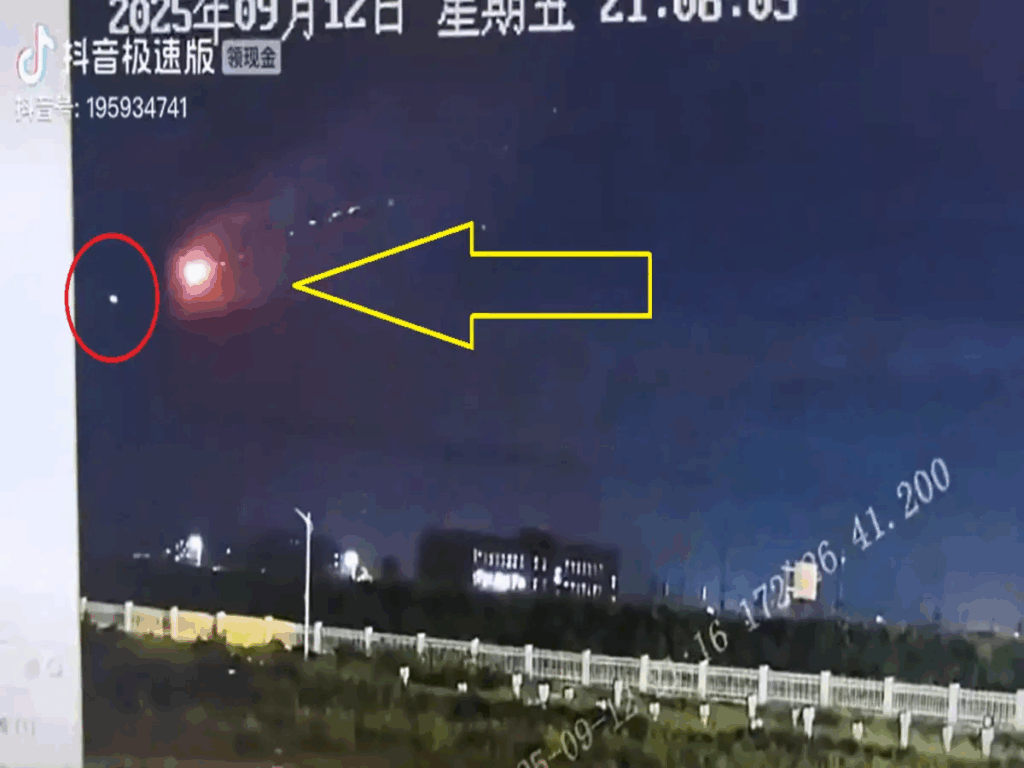
On the evening of September 12, residents of Weifang and Rizhao in China’s Shandong Province looked up to see a dramatic fireball streaking across the night sky. The luminous flash was followed by loud booms, and within hours, videos of the spectacle went viral across Chinese and international social media. The most sensational claim? That China had shot down a meteor with a missile.
Officials have denied this, and scientists remain skeptical, suggesting the event was most likely a natural meteor or space debris burning up in the atmosphere. Still, questions linger, and the story has captured global attention.
TL;DR:
A bright fireball was seen over Shandong, China, sparking rumors that it was shot down by a missile. Authorities deny this, and scientists say it was likely a meteor or space debris. No confirmed evidence of a missile intercept has been released.
What Happened Over Shandong?
Between 8:45 and 9:02 p.m. local time on September 12, a bright, fast-moving object appeared over eastern China. Witnesses described a streak of light followed by a sudden flash and two loud booms that shook windows. Multiple videos captured the fireball from different angles, intensifying online debate. Some clips seemed to show an ascending light that people interpreted as an interceptor missile.
The timing amplified speculation. China had issued live-fire warnings in the Yellow Sea and Bohai Sea around the same period, adding fuel to the theory that a missile interception test was underway.
Why the Speculation Took Off
The viral spread of the “China shot down a meteor” claim did not happen in a vacuum. Several factors made the narrative compelling:
- China’s planetary defence ambitions: The country has publicly discussed building systems to detect and potentially deflect hazardous asteroids.
- Military drills nearby: The live-fire notices raised suspicion of a defense connection.
- Public fascination: Stories of UFOs, meteors, and high-tech weapons spread quickly on social platforms.
- Ambiguous evidence: Video clips showed flashes and bangs without clear explanation, leaving room for multiple interpretations.
Scientific and Military Explanations
So, what could the Shandong fireball have been? Scientists and defense analysts point to several possibilities:
- Meteor / Fireball: The most likely cause. Meteors can produce bright flashes, fragment in the atmosphere, and create sonic booms that sound like explosions.
- Space Debris Re-entry: Man-made objects from orbit can produce similar fireball trails and break apart with explosive sounds.
- Missile Test: Possible, but unproven. An interceptor missile would explain an ascending streak, but no official confirmation has been given.
- Combined Event: A meteor coinciding with military activity, though this is a less likely coincidence.
Evidence for and Against a Missile Shoot-down
Here’s how the evidence stacks up:
| Evidence | Supports “Missile Intercept” | Supports “Meteor / Fireball” |
|---|---|---|
| Multiple videos of a bright object | Appears to show second ascending light | Consistent with natural meteors |
| Witnesses reported loud booms | Could be explosions from impact/intercept | Matches sonic booms from meteor airbursts |
| Live-fire warnings nearby | Suggests military exercises | Could be unrelated coincidence |
| No official confirmation | Weakens missile theory | Neutral but common in meteor events |
| Absence in meteor databases | Raises doubt about meteor classification | Could be underreporting |
What Authorities Have Said
The Weifang Emergency Management Bureau released a statement saying it had “no information” about any shoot-down. Chinese military authorities have issued no confirmation of an interception. International meteor monitoring organizations have not officially listed the Shandong fireball, but that may reflect a lack of available data rather than absence of the event.
What Remains Unclear
Despite the attention, key questions remain unanswered:
- Was any debris recovered on the ground? No reports have surfaced so far.
- Do radar or satellite logs confirm a missile launch? None have been made public.
- What was the exact timing between the visual flash and the booms? Precise measurements could clarify whether they were sonic booms or explosions.
- Was the object’s trajectory consistent with a meteor? Independent analysis is still pending.
How to Interpret Viral Fireball Events Responsibly
This is not the first time a natural atmospheric event has been misinterpreted as something extraordinary. When fireballs occur, videos and eyewitness accounts often lack context, creating space for speculation. Social media accelerates these narratives, especially when they align with pre-existing themes of military secrecy, UFOs, or planetary defense.
The responsible approach is to weigh evidence, consult scientific expertise, and recognize uncertainty until official data is available. Jumping to conclusions risks spreading misinformation.
How BreezyScroll Can Help and What You Should Do
At BreezyScroll, our role is to separate fact from rumor. Based on current evidence, there is no confirmation that China shot down a meteor with a missile. The most plausible explanation remains a natural meteor or space debris. However, the unanswered questions mean the story is not closed.
What you should do:
- Stay updated: Follow official scientific reports and announcements from monitoring organizations.
- Be cautious with viral claims: Treat dramatic social media posts as unverified until confirmed.
- Look for expert input: Astronomers and atmospheric scientists provide the best analysis in such cases.
The Shandong fireball shows how quickly a mystery can ignite global speculation. Whether it was space rock, space junk, or something more, the truth will depend on evidence, not assumption.