
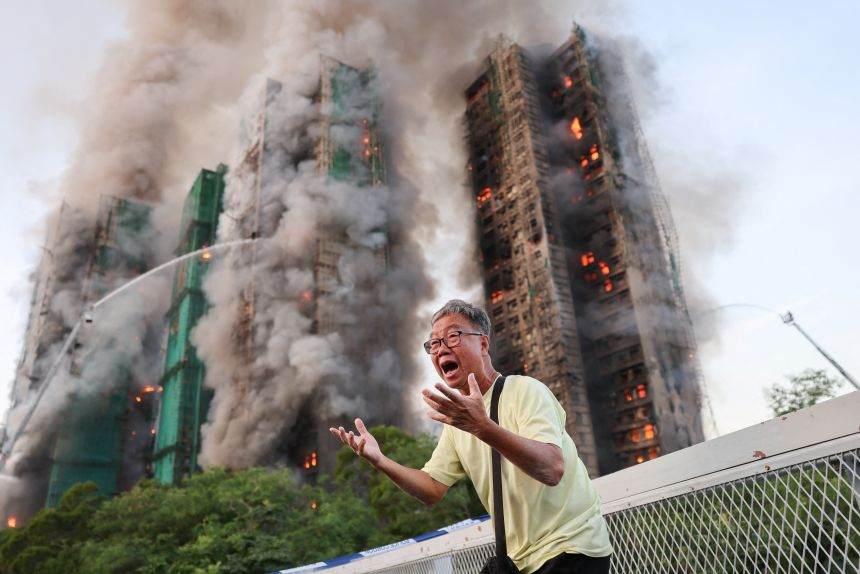
Hong Kong’s deadliest fire in decades has raised urgent questions about safety lapses, construction practices, and the possibility that a single cigarette may have played a role. The blaze at the Wang Fuk Court housing complex has now claimed at least 128 lives, with nearly 200 people still unaccounted for. As Hong Kong enters a period of national mourning, investigators are piecing together how the tragedy unfolded and whether human negligence amplified the destruction.
How did the Hong Kong fire unfold?
The fire broke out at the Wang Fuk Court residential complex in Tai Po, a cluster of buildings undergoing renovation. Within minutes, flames shot up the building’s exterior, fueled by scaffolding materials and flammable construction debris. Residents reported hearing no fire alarms while firefighters battled collapsing bamboo, toxic smoke, and rapid vertical fire spread.
Authorities confirmed that one firefighter died during the rescue operation. In the days that followed, search teams uncovered charred remains across multiple floors, underscoring the intensity of the blaze.
Why are investigators examining a viral smoking video
A circulating video posted by RT India shows a man smoking near the outer wall shortly before the blaze erupted. The clip triggered speculation that a carelessly discarded cigarette may have ignited nearby construction material.
What authorities have said about the smoking video
- Hong Kong police have not confirmed the video’s authenticity or relevance.
- No official link has been established between smoking and the ignition point.
- Investigators maintain that the fire’s exact cause remains under review.
While smoking-related fires are common worldwide, often linked to trash piles, packaging foam, or chemical residues, experts caution against drawing early conclusions. For now, the video remains a lead, not evidence.
What materials contributed to the rapid spread?
Early findings point to a combination of flammable elements that accelerated the Hong Kong fire.
Flammable construction materials on site
Security chief Chris Tang stated that the fire likely began on protective nets installed for renovation. These nets, along with foam boards used for insulation, burn quickly at high temperatures and drip molten material as they ignite.
Why does bamboo scaffolding make the situation worse
Bamboo scaffolding, widely used across Hong Kong, has strengths, but fire resistance is not one of them.
Key factors:
- Bamboo burns fast in dry conditions.
- Falling bamboo poles may have created secondary ignition points.
- The structure’s vertical layout can channel fire upward like a chimney.
These factors appear to have allowed flames to leap across multiple floors and into neighboring buildings, affecting six structures in the compound.
Why did the fire alarms fail?
Multiple residents reported that alarms did not activate. Failed detection systems in high-rise buildings are catastrophic because they delay evacuation and give fires time to mature.
Possible reasons behind the malfunction may include:
- Disabled systems during renovation
- Damaged wiring due to construction work
- Outdated or untested fire alarm units
- Power supply interruptions
Hong Kong authorities have not disclosed which factor applied. However, the failure is now under special scrutiny by regulators and corruption investigators.
Why Hong Kong’s anti-corruption agency is involved
Hong Kong’s Independent Commission Against Corruption (ICAC) has arrested eight individuals linked to the renovation project. Additionally, three workers were detained for allegedly leaving foam packaging materials at the fire site—materials that may have acted as kindling.
ICAC typically intervenes when:
- Tendering processes are compromised
- Safety compliance documentation is falsified
- Contractors use substandard materials
- Inspections are bypassed through bribery
The arrests suggest investigators are exploring whether systemic lapses, not just an accident, amplified the disaster.
How China is responding to the Hong Kong fire
The Hong Kong fire has triggered a broader response from mainland authorities. China’s State Council Work Safety Committee launched a national inspection campaign targeting major hazards in high-rise buildings.
Key focus areas:
- Flammable façade materials
- Fire alarm reliability
- Renovation-related fire risks
- Emergency access routes
- Structural vulnerabilities in older public housing
This reflects a growing recognition across China that high-rise fire risks increase sharply during renovation periods, when protective nets, insulation foam, and heavy scaffolding are all present.
Why high-rise fires spread so quickly
To provide deeper context beyond the incident, here’s what typically causes high-rise fires to intensify:
Chimney effect
Tall structures allow hot air to rise rapidly, pulling flames upward at dangerous speeds.
Flammable façade systems
Certain façade insulations—especially foam-based varieties—burn at high temperatures and release toxic smoke.
Scaffolding and renovation debris
Loose packaging, dust, discarded plastic, and foam create an environment where small sparks can escalate.
Alarm failures or delays
Every minute lost in initial detection can double the fire’s spread.
What we still don’t know about the Hong Kong fire
Despite multiple leads, several questions remain open:
- What exactly triggered the first spark?
- How quickly did the protective net catch fire?
- Were safety inspections properly conducted before renovation?
- Did residents receive any prior warnings about fire risks on scaffolding?
- Are all missing persons accounted for, or will the death toll rise further?
Until fire reconstruction experts analyse the building debris and recreate the ignition timeline, the cause will remain speculative.
What this tragedy means for Hong Kong’s housing future
The Hong Kong fire has revived long-standing concerns about safety standards in aging public housing estates, many of which rely on:
- bamboo scaffolding
- foam insulation boards
- netted exteriors during upgrades
It also exposes the vulnerability of residents in densely packed urban constructions, where a single lapse can lead to mass casualties.
Urban planners warn that Hong Kong must move toward:
- fire-resistant façade materials
- mandatory alarm audits during renovation
- stricter contractor supervision
- transparent safety compliance reporting
- phased renovation plans that reduce debris buildup
This tragedy, while devastating, could become a turning point for fire safety reform not just in Hong Kong but across other high-rise cities in Asia.
TL;DR
- The Hong Kong fire killed at least 128 people; nearly 200 are missing.
- A viral smoking video is being examined, but has not been confirmed as the cause.
- Flammable construction materials, foam boards, and bamboo scaffolding fueled rapid fire spread.
- Fire alarms reportedly failed to activate.
- ICAC has arrested eight people linked to the renovation project.
- China launched a nationwide inspection of high-rise building fire hazards.
- Many questions remain, including the exact ignition source.