
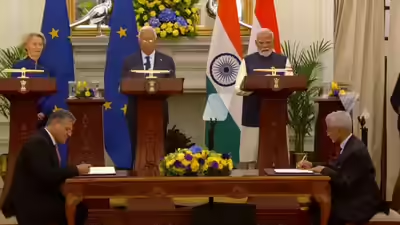
The newly announced India–EU Free Trade Agreement (FTA) is being billed as the “mother of all trade deals”—and not without reason. Once implemented, the agreement will integrate a market of nearly two billion people and account for roughly a quarter of global GDP, reshaping trade flows at a time when protectionism and tariff wars are back in fashion.
Confirmed by Prime Minister Narendra Modi this week, the deal marks the conclusion of negotiations that were revived in 2022 after a nine-year freeze. For India and the European Union alike, it is the largest and most ambitious trade pact either side has ever signed.
What Is the India–EU Free Trade Agreement?
The India–EU FTA is a comprehensive trade pact covering goods, services, investment, intellectual property, and regulatory cooperation.
At its core, the agreement aims to:
- Slash tariffs on the vast majority of goods traded between India and the EU
- Open services markets on both sides
- Simplify customs procedures
- Create more predictable rules for businesses operating across borders
According to official EU details, tariffs will be eliminated or reduced on nearly 97 percent of EU exports to India, while Indian exporters will gain preferential access to 97 percent of EU tariff lines, covering 99.5 percent of trade value.
Why Is the India–EU Trade Deal Being Called Historic?
A Market of Unprecedented Scale
The agreement brings together:
- India, the world’s fastest-growing major economy
- The European Union, one of the largest single markets globally
Together, they represent:
- About 25 percent of global GDP
- Over 1.9 billion consumers
- Roughly one-third of global trade, by some estimates
This scale alone makes the FTA geopolitically and economically significant.
Ending Nearly a Decade of Stalemate
Negotiations were first launched in 2007, stalled in 2013, and only restarted in June 2022. The conclusion signals renewed political will on both sides to deepen economic ties despite global uncertainty.
How Does the Deal Benefit the European Union?
For the EU, India represents one of the few large markets where long-term demand growth remains strong.
Key Gains for EU Exporters
Under the agreement:
- 96.6 percent of EU goods exports will see tariffs eliminated or reduced
- European companies could save up to €4 billion annually in duties
- EU exporters gain a competitive edge in a market of 1.4 billion people
Specific benefits include:
- Preferential access for EU financial and maritime service providers
- Faster, simpler customs procedures
- Stronger protection for EU intellectual property, including trademarks
- A dedicated chapter supporting small and medium-sized EU businesses
What Gets Cheaper for Indian Consumers?
One of the most visible effects of the India–EU FTA will be on prices for imported European goods.
Big Tariff Cuts on European Products
Over time, India will reduce or eliminate duties on a wide range of EU goods:
- Cars: Tariffs fall from up to 110 percent to as low as 10 percent
- Wines: Duties drop from 150 percent to about 20 percent
- Processed foods: Tariffs on items like pasta and chocolate fall from 50 percent to zero
Several EU agri-food products are also set to become cheaper as tariff barriers come down.
How Will Indian Exporters Gain from the FTA?
Indian businesses stand to benefit significantly once the agreement is operational, expected in early 2027 after regulatory approvals.
Immediate and Long-Term Benefits
Key provisions include:
- Immediate duty elimination for 70.4 percent of tariff lines, covering 90.7 percent of India’s exports
- Zero tariffs on 93 percent of Indian goods within seven years
- Partial tariff cuts or quotas for about six percent of goods
- Some sensitive sectors, such as autos and agriculture, kept out of full tariff elimination
The EU’s average tariff rate on Indian goods will fall from 3.8 percent to just 0.1 percent.
Sectors Set to Gain the Most
Tariffs will be cut to zero on major Indian exports, including:
- Marine products
- Chemicals
- Plastics and rubber
- Leather and footwear
- Textiles and apparel
- Base metals
- Gems and jewelry
These are largely labor-intensive sectors, where Indian exporters do not directly compete with European manufacturers.
Why This Deal Matters in a Trump-Era Trade Landscape
The timing of the India–EU FTA is no accident.
A Counterweight to US Tariffs
The agreement comes as both India and the EU grapple with tariff-heavy US trade policies under President Donald Trump:
- The US imposed 25 percent tariffs on Indian imports, plus additional penalties linked to India’s oil trade with Russia
- EU steel and aluminum exports to the US also faced 25 percent duties
- A mid-2025 US–EU framework settled on a 15 percent tariff to avoid a broader trade war
Against this backdrop, the India–EU FTA acts as a strategic hedge, reducing dependence on the US market and signaling a commitment to open trade.
How Big Is India–EU Trade Today?
Even before the FTA:
- The EU was India’s largest trading partner
- Trade in goods reached $135 billion in 2023–24
The new agreement is expected to significantly expand these numbers, especially as global companies look to “derisk” supply chains amid geopolitical tensions.
The Political Messaging Behind the Deal
Both sides have framed the agreement as more than an economic pact.
Prime Minister Modi described it as:
“A perfect example of a partnership between two major economies… representing 25 percent of global GDP.”
EU Commission President Ursula von der Leyen called it:
“The mother of all deals… a free trade zone of two billion people.”
Leaders also emphasized shared values such as democracy and the rule of law, positioning the FTA as a strategic partnership, not just a commercial one.
What Comes Next?
While the deal has been announced, several steps remain:
- Legal text finalisation
- Ratification by EU institutions and member states
- Domestic approvals within India
If timelines hold, implementation could begin in 2027, setting the stage for a major shift in global trade patterns.
TL;DR: Why the India–EU FTA Is a Big Deal
- It creates one of the world’s largest free trade zones
- Tariffs on most goods will be slashed on both sides
- Indian exporters gain major access to EU markets
- European goods become cheaper for Indian consumers
- The deal serves as a counterweight to US protectionism
In a fractured global trade environment, the India–EU FTA sends a clear message: large economies are still willing to bet on openness—when the stakes are high enough.