
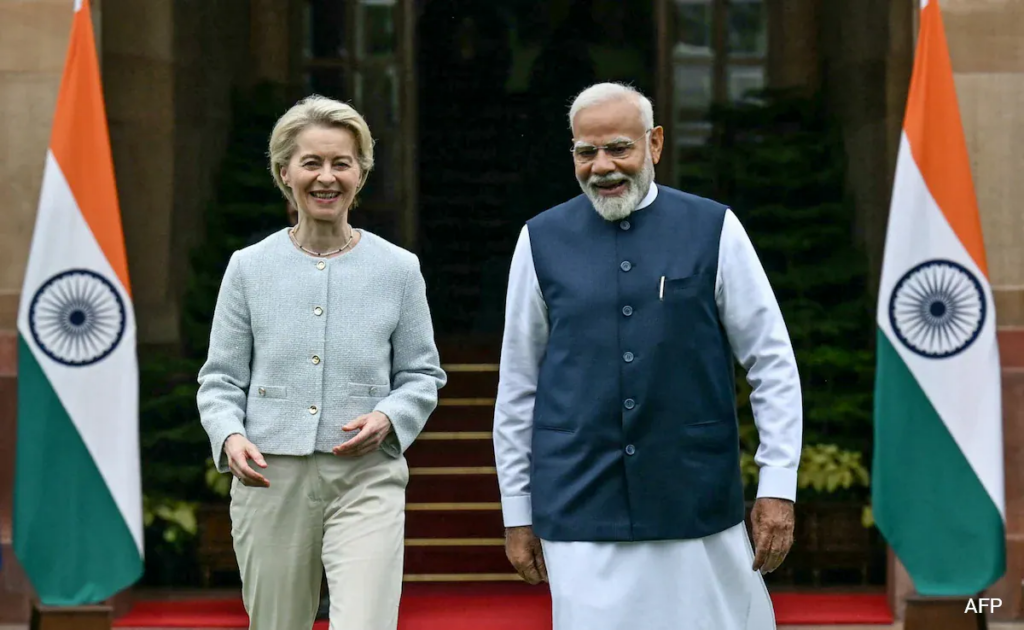
India and the European Union are poised to announce a landmark free trade agreement that could reshape their economic and strategic relationship for decades. Expected to be unveiled at a high-level summit in New Delhi, the deal goes far beyond tariffs and market access, signalling a broader political and security alignment at a time of global uncertainty triggered by shifting US policies, geopolitical conflicts, and supply chain disruptions.
Here is a clear, 10-point breakdown of why the India–EU free trade deal matters and what it is expected to change.
TL;DR
- India and the EU are close to finalising a historic free trade agreement
- The deal covers trade, defence, worker mobility, technology, and climate
- It could create a combined market of nearly two billion people
- Talks were first launched in 2007 and revived in 2022
- The agreement reflects a strategic shift amid global geopolitical uncertainty
1. A free trade agreement with strategic weight
The proposed India–EU Free Trade Agreement is not just about reducing tariffs. Officials on both sides describe it as a qualitative leap in bilateral ties, designed to anchor a long-term strategic partnership. Alongside trade, discussions cover defence cooperation, climate action, digital governance, and the strengthening of a rules-based global order.
This breadth sets the agreement apart from traditional FTAs, positioning it as a geopolitical statement as much as an economic one.
2. A market of two billion people
European Commission President Ursula von der Leyen has described the deal as being on the cusp of creating a combined market of nearly two billion people, accounting for close to a quarter of global GDP.
For businesses, this would mean expanded access, diversified supply chains, and reduced reliance on a narrow set of global markets at a time when protectionism is rising elsewhere.
3. Leaders at the centre of the summit
The agreement is expected to be announced during a summit hosted by Indian Prime Minister Narendra Modi. He is hosting von der Leyen along with European Council President Antonio Costa.
Both European leaders were also chief guests at India’s Republic Day celebrations, underlining the symbolic and diplomatic weight attached to the partnership.
4. Defence and security move to the forefront
A major outcome of the summit is expected to be the unveiling of a new Security and Defence Partnership between India and the EU. This framework aims to deepen cooperation in areas such as maritime security, cyber defence, and joint military readiness.
For India, this represents a step toward diversifying defence partnerships beyond traditional suppliers. For the EU, it offers a foothold in the Indo-Pacific, a region of growing strategic importance.
5. Access to the EU’s defence financing programmes
The Security and Defence Partnership is also expected to open the door for Indian companies to participate in the EU’s SAFE program, or Security Action for Europe.
Here’s a breakdown of what SAFE involves:
| Element | Details |
|---|---|
| Total funding | €150 billion |
| Objective | Speed up EU defence readiness |
| Participation | EU members and select partners |
| Opportunity for India | Defence manufacturing and collaboration |
This could create new opportunities for Indian defence firms to integrate into European supply chains.
6. Worker mobility becomes a key pillar
Another significant outcome expected from the summit is a memorandum of understanding on facilitating the mobility of Indian workers to Europe. The framework would support legal pathways for skilled professionals, students, and workers.
Several EU countries, including France, Germany, and Italy, already have migration and mobility partnerships with India. The new framework aims to scale and harmonise these efforts across the bloc.
7. Talks delayed, but not abandoned
India and the EU first launched negotiations for a free trade agreement in 2007. However, talks were suspended in 2013 due to differences over market access, intellectual property rights, and regulatory standards.
Negotiations were formally relaunched in June 2022, reflecting changing global realities and a renewed sense of urgency on both sides.
8. Shared interests despite differences
While India and the EU do not align on every global issue, including aspects of the Russia–Ukraine war, officials emphasize that both sides share core interests. These include support for a stable international order, respect for sovereignty, and secure global trade routes.
The agreement is seen as a way to institutionalise cooperation even where political views diverge.
9. Trade ties are already on an upward trajectory
Economic ties between India and the EU have strengthened steadily over the past few years. The EU is already India’s largest trading partner in goods.
For the 2024–25 financial year:
- Total trade stood at around $136 billion
- Indian exports were valued at approximately $76 billion
- Imports from the EU amounted to about $60 billion
The FTA is expected to accelerate this growth by reducing trade barriers and improving regulatory alignment.
10. A response to shifting global geopolitics
The timing of the deal is significant. Europe is seeking to reduce its dependence on both the United States and China, while India is positioning itself as a reliable economic and strategic partner in a fragmented global order.
US President Donald Trump’s trade policies and broader geopolitical unpredictability have added urgency to diversification efforts on both sides.
What this deal could mean going forward
If finalised as expected, the India–EU free trade agreement would mark one of the most ambitious partnerships either side has entered into. Its success will depend on implementation, political will, and the ability to balance economic openness with domestic priorities.
For now, the agreement stands as a signal that both India and Europe are betting on deeper cooperation as a hedge against an increasingly uncertain world.