
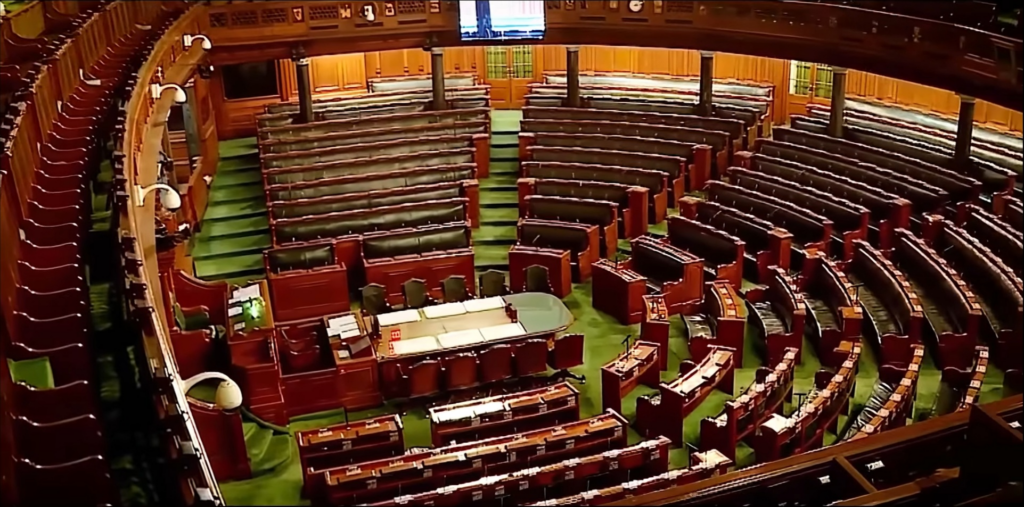
India is attempting one of the most consequential political overhauls in decades. At the center is a proposed constitutional amendment, the women’s reservation bill, that promises to reserve one-third of seats in Parliament and state assemblies for women. But the reform is tied to a much larger and more contentious move: redrawing the country’s electoral map.
The government says this is about representation and equity. Critics argue it’s also about power and timing.
What Is the Women’s Reservation Bill in India?
The proposed law, officially called the Nari Shakti Vandan Adhiniyam, seeks to reserve 33% of seats for women in the following:
- The Lok Sabha (lower house of Parliament)
- State legislative assemblies
Today, women hold only about 14% of seats in India’s 543-member Lok Sabha. If implemented, the reform would push that number closer to global averages.
Prime Minister Narendra Modi has described the bill as a “historic” step that would reshape governance by bringing more women into decision-making roles.
Why It Matters
- India already has similar quotas in local governance (village councils and municipalities), where women’s participation has increased significantly.
- Expanding this to national and state levels could shift political priorities, representation, and policymaking.
Why Is Delimitation Linked to the Reform?
This is where the controversy begins.
The implementation of the women’s quota is tied to delimitation—the process of redrawing electoral constituencies based on population data.
Key facts:
- India last carried out delimitation based on the 1971 census
- The process has been frozen for decades to avoid regional imbalances
- The new proposal links seat reservation to a fresh delimitation based on the 2011 census
This means:
- The total number of Lok Sabha seats could increase from 543 to around 850
- Constituency boundaries would be redrawn across the country
Why tie the two together?
The government argues that
- A larger Parliament is needed to accommodate reservations fairly
- Delimitation ensures equal representation based on population
Critics say:
- The linkage unnecessarily complicates a straightforward gender reform
- Women’s reservation could be implemented without redrawing constituencies
How Could the Redraw Change India’s Political Balance?
Delimitation isn’t just a technical exercise; it has real political consequences.
The core issue: population differences
India’s Constitution allocates seats based on population. But population growth has not been uniform across states.
- Northern states have higher population growth
- Southern states have lower fertility rates and slower growth
If seats are redistributed based on updated population data:
- Northern states could gain more seats
- Southern states could lose relative influence
Why are southern states concerned
States like Tamil Nadu, Kerala, and Karnataka:
- Have better health and education indicators
- Have controlled population growth more effectively
Leaders argue they are being penalized for success.
M. K. Stalin has called the proposal a “historic injustice,” framing it as a federal imbalance rather than just an electoral update.
What Does “Pro-Rata” Allocation Mean and Why Is It Controversial?
The government has suggested that seats will be redistributed on a pro rata basis, meaning
- Each state’s share of seats increases proportionally
The concern:
Experts say the formula is unclear.
Without transparency:
- Larger states could still gain disproportionate influence
- Smaller or slower-growing states may see reduced political weight
Expert concerns include:
- Lack of clarity on seat allocation formulas
- Potential mismatch between parliamentary seats and state assembly representation
- Federal imbalance between regions
Why Is the Timing Raising Questions?
The bill was introduced during a special parliamentary session, close to an election cycle.
Opposition parties argue:
- The timing suggests political calculation
- Major structural reforms should involve broader consultation
They also point out:
- The ruling coalition lacks the two-thirds majority required
- The passage depends on support from smaller parties and opposition factions
The government, however, has urged all parties to avoid politicizing what it calls a national reform.
What Are the Challenges in Implementing Women’s Reservation?
Even if the bill passes, execution will be complex.
Key questions:
- Which constituencies will be reserved?
- Will reserved seats rotate over time?
- How will this interact with existing SC/ST reservations?
India already reserves seats for:
- Scheduled Castes (SC)
- Scheduled Tribes (ST)
Adding a gender quota on top creates overlapping categories that must be carefully balanced.
Why this is tricky:
- Reserving seats affects political careers and party strategies
- Rotation of seats could disrupt continuity in representation
- Identifying constituencies fairly requires clear criteria
Why Use the 2011 Census Instead of New Data?
Another major criticism is the reliance on 2011 census data.
Critics argue:
- The data is outdated (over a decade old)
- A new census is expected soon
- Decisions of this scale should use current numbers
Government’s position:
- Waiting for new data would delay implementation beyond 2029
- The reform has already been pending for decades
This reflects a broader trade-off:
- Speed vs. accuracy
What’s at Stake Politically and Socially?
This isn’t just about representation—it’s about the structure of Indian democracy.
Potential benefits:
- Greater gender representation in policymaking
- More inclusive governance
- Alignment with global democratic norms
Potential risks:
- Regional imbalance between the north and the south
- Political friction over seat redistribution
- Implementation challenges are delaying actual impact
TL;DR
- India’s women’s reservation bill proposes 33% seats for women in Parliament and state assemblies
- Implementation is tied to delimitation based on the 2011 census
- Parliament could expand to ~850 seats
- Southern states fear losing influence due to lower population growth
- Key concerns include timing, lack of clarity, and outdated data
- The reform could reshape India’s political landscape—but faces major hurdles