
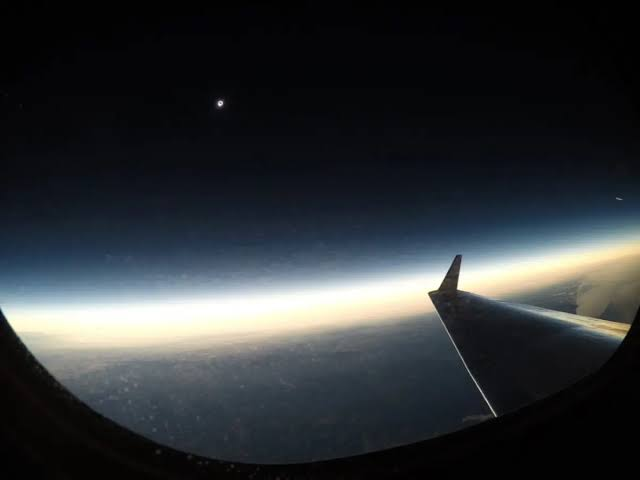
The August 12 total solar eclipse will create a spectacular celestial event across parts of the Northern Hemisphere, but two NASA aviators will experience something most people on the ground cannot: an unusually long period of totality from 50,000 feet.
While totality on the ground will last as long as 2 minutes and 18 seconds at some locations, the NASA eclipse-chasing aircraft is expected to remain inside the Moon’s shadow for nearly three minutes. That extra time could give scientists a rare opportunity to observe the Sun’s outer atmosphere in detail.
The difference comes down to motion. The aircraft will fly along the path of the eclipse, effectively staying inside the moving shadow for longer than a stationary observer on Earth.
Why will the August 12 solar eclipse last longer for NASA’s aircraft?
A total solar eclipse occurs when the Moon passes directly between Earth and the Sun and completely blocks the Sun’s visible disk.
The Moon’s shadow does not remain fixed over one location. It races across Earth’s surface as the Moon moves through the sky, creating a narrow path where totality can be observed.
For someone standing on the ground, the period of complete darkness is therefore limited by how quickly that shadow moves across their location.
The NASA aircraft will use a different strategy.
The WB-57 research plane will fly at approximately 50,000 feet along the eclipse’s path. By moving in the same general direction as the shadow, the aircraft can remain within the region of totality for longer.
The Moon’s shadow is expected to travel across the ocean at more than 3,200 kilometers per hour, while the aircraft will cruise at roughly 740 kilometers per hour.
That does not mean the plane is moving faster than the shadow. Instead, its carefully planned flight path allows the aircraft to intersect the shadow in a way that extends the amount of time researchers can observe totality.
What will the eclipse look like from 50,000 feet?
For the NASA team, the transition into totality could be dramatically different from what observers experience on the ground.
Cary Klemm, a sensor equipment operator at NASA’s Johnson Space Center who has previously participated in eclipse missions, described the transition as extremely sudden.
From above the clouds, the sky can remain bright until the Moon’s shadow arrives.
Then the change happens rapidly.
The aircraft can suddenly be surrounded by darkness while the surrounding sky remains largely unobstructed by clouds. Temperatures can also fall as sunlight disappears.
For the researchers inside the aircraft, the sudden loss of natural light is more than a visual spectacle. It creates a unique environment for scientific observations of the Sun.
Why is NASA chasing the eclipse from an aircraft?
The main objective is not simply to get a better view.
The WB-57 aircraft is equipped with four cameras capable of capturing images of the Sun at different wavelengths. The instruments will take multiple images every second as the aircraft follows the eclipse.
Researchers are particularly interested in structures in the Sun’s outer atmosphere that become easier to study during totality.
These include solar prominences, enormous arcs of plasma extending from the Sun’s surface, as well as extremely energetic phenomena associated with the Sun’s magnetic activity.
What are solar prominences?
Solar prominences are large structures made primarily of plasma that can extend far above the Sun’s visible surface.
They are shaped and controlled by the Sun’s magnetic fields and can remain suspended above the surface for extended periods.
During a total solar eclipse, the Moon blocks the overwhelming brightness of the solar disk, allowing certain features around the edge of the Sun to become much easier to observe.
What are nanoflares?
Researchers are also interested in tiny but powerful bursts of energy known as nanoflares.
Although individual nanoflares are far less energetic than the Sun’s largest eruptions, their combined effect could help explain one of the biggest mysteries in solar physics: why the Sun’s corona is dramatically hotter than its surface.
The Sun’s visible surface is approximately 6,000 degrees Celsius, while its corona can reach temperatures above 1 million degrees Celsius.
That counterintuitive temperature difference has puzzled scientists for decades.
Understanding how energy moves through the Sun’s atmosphere could improve scientists’ understanding of solar activity and help explain how the corona reaches such extreme temperatures.
Why does the Moon’s shadow move so fast?
The darkness experienced during a total solar eclipse is actually the result of a moving shadow.
As the Moon orbits Earth and Earth rotates, the Moon’s umbra sweeps across the planet’s surface.
The speed varies depending on the location and geometry of the eclipse.
During the August 12 eclipse, parts of the Moon’s shadow will move across the Arctic region and surrounding areas at speeds exceeding 3,200 kilometers per hour.
That is why totality can last only a few minutes even though the Moon takes much longer to move completely across the Sun from an astronomical perspective.
Where will the August 12 total solar eclipse be visible?
The eclipse’s path of totality will cross parts of the Arctic, Greenland and Iceland before reaching areas of Europe.
Parts of Spain and Portugal are also expected to experience totality.
For observers inside the path, the sky will become dramatically darker during the brief period when the Moon completely covers the Sun.
Outside the path of totality, observers may still see a partial eclipse, but they will not experience the same sudden darkness produced when the Sun’s entire visible disk disappears.
The event is particularly notable for Europe because it will be the first total solar eclipse visible from mainland Europe since 1999.
Why does an aircraft give scientists an advantage?
An aircraft offers researchers several advantages over a stationary ground-based observatory.
First, it can fly above most clouds, eliminating one of the biggest obstacles to eclipse observations.
Second, it can move strategically along the eclipse path rather than remaining fixed at one location.
Third, instruments mounted on an aircraft can capture observations from an altitude of roughly 50,000 feet, giving researchers a different viewing geometry from ground-based telescopes.
The combination of altitude, mobility and specialized cameras makes an eclipse-chasing aircraft a powerful scientific platform.
What makes a total solar eclipse scientifically valuable?
A total solar eclipse does more than create a few minutes of darkness.
When the Moon blocks the Sun’s bright surface, scientists can observe parts of the solar atmosphere that are normally overwhelmed by sunlight.
That creates a natural experiment.
Researchers can study the corona, prominences, and other structures while the Sun’s brightest part is temporarily hidden.
Modern spacecraft continuously monitor the Sun, but eclipse observations remain valuable because specialized instruments can examine the solar environment from a different perspective and at wavelengths that reveal specific physical processes.
What will the NASA pilots actually experience?
For the two NASA aviators aboard the WB-57, the most striking moment may be the speed of the transition.
One moment, the aircraft will be flying above the clouds under bright sunlight.
Then the Moon’s shadow will sweep across the aircraft’s location, producing an abrupt change in illumination.
The experience has been described by previous eclipse researchers as an eerie transition, with the surrounding environment suddenly demanding artificial lighting and instruments becoming more prominent inside the aircraft.
For the scientists, however, those few minutes are valuable observation time.
Every additional second inside totality gives their cameras another opportunity to capture changes in the Sun’s atmosphere.
The bigger significance of the August 12 eclipse
For millions of people, the August 12 total solar eclipse will be a rare chance to watch the Moon temporarily erase the Sun from the daytime sky.
For NASA researchers, it is also a moving laboratory.
The WB-57’s flight path is designed to stretch the period of totality beyond what a stationary observer can experience. The result will be nearly three minutes of darkness for the airborne research team, along with a stream of high-speed observations of the Sun.
That extra time may sound small, but in solar physics, a few additional seconds can mean more images, more measurements, and a better look at processes that are normally hidden by the Sun’s intense brightness.
The eclipse is therefore more than a dramatic sky show. It is a carefully timed scientific opportunity, with NASA essentially putting the laboratory on wings.