
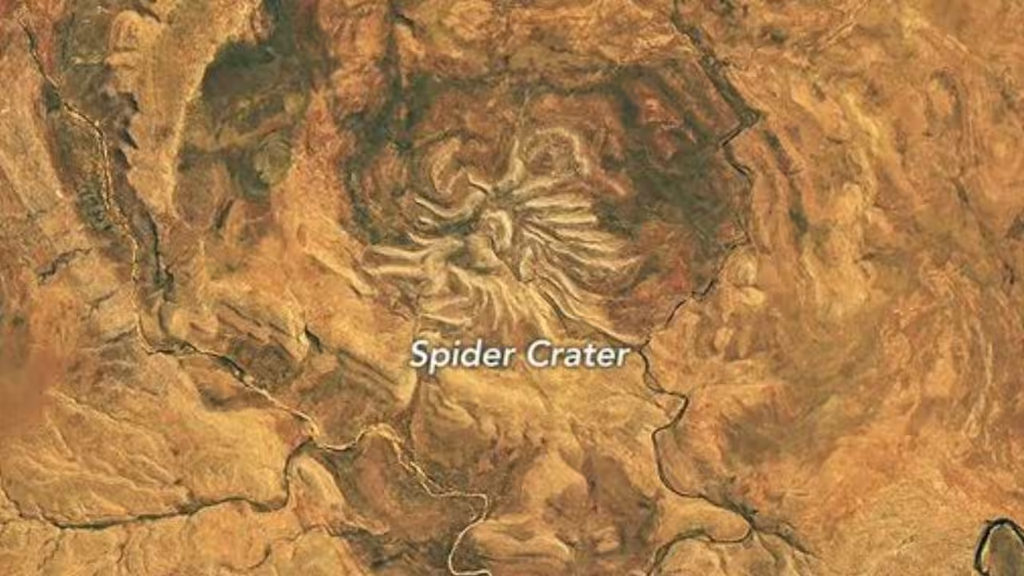
A bizarre geological formation in the Australian outback is drawing attention after NASA released a new satellite image showing a massive impact crater with tentacle-like ridges spreading from its center. Known as Spider Crater, the formation lies in the remote Kimberley region of Western Australia and preserves evidence of a violent collision that occurred hundreds of millions of years ago.
Captured by NASA’s Landsat 9 satellite on September 20, 2026, the image reveals an unusual pattern of pale rock formations surrounded by reddish terrain. From space, the ridges resemble the legs of a giant spider, giving the ancient geological structure its distinctive name.
Despite its unusual appearance, the formation is not the result of volcanic activity or an unexplained natural phenomenon. Scientists have identified it as an ancient meteorite impact structure that has been reshaped by geological processes over an immense period.
A giant crater with spider-like ridges
Spider Crater spans approximately 13 by 11 kilometres, making it a substantial geological feature hidden within Western Australia’s rugged landscape.
Its most striking characteristic is the network of ridges radiating outward from a central uplift. The spider-like pattern extends across roughly four kilometres, while the raised central dome itself is considerably smaller.
NASA explains that these features developed during the original impact and were subsequently exposed by erosion. Different layers of sandstone weather at different rates, allowing the tougher rock ridges to remain prominent while softer surrounding material wears away.
The result is a landscape that appears almost deliberately sculpted when viewed from above. Its unusual shape becomes especially striking in satellite imagery, where the pale ridges contrast sharply with the surrounding red and brown terrain.
How scientists solved the crater’s mystery
For decades after the structure was discovered, its origin remained uncertain. Some early explanations suggested that volcanic processes had created the unusual geological pattern.
The breakthrough came in the 1970s, when geologists identified distinctive features associated with high-energy impacts. Among the most important discoveries were shatter cones, cone-shaped rock formations with characteristic grooves that develop when intense shock waves pass through rock.
These formations provided compelling evidence that Spider Crater had been struck by a meteorite or asteroid. Researchers also examined heavily deformed sedimentary rock layers, which supported the impact explanation.
Subsequent laboratory investigations of minerals, including shocked quartz and zircon crystals, have provided further opportunities to study the collision and reconstruct aspects of the impact process.
Together, these findings established Spider Crater as an important geological record of an ancient extraterrestrial collision.
An impact that could be 900 million years old
The precise age of Spider Crater remains uncertain. Geological estimates place its formation between approximately 900 million and 600 million years ago, during the Neoproterozoic era.
That period predates the emergence of complex modern ecosystems and includes intervals associated with some of Earth’s most extensive ancient ice ages.
However, the crater’s estimated age does not establish a direct connection between the impact and any particular climate event. More precise dating would be necessary to determine exactly when the collision occurred and how it related to other geological changes.
The uncertainty surrounding its age also reflects the difficulty of reconstructing events from structures that have endured hundreds of millions of years of erosion and geological alteration.
Why the crater is best seen from space
Spider Crater lies in a remote part of the Kimberley region, where rugged terrain makes access challenging. Satellite observations offer scientists a valuable way to study its overall structure and understand how its unusual ridges fit together.
The latest Landsat 9 image provides a broad view of the crater and the surrounding landscape. Earlier images captured by other Earth-observing satellites have also helped researchers examine its central uplift, rock formations and erosion patterns in greater detail.
These observations demonstrate how satellite imagery can reveal geological structures that might be difficult to recognise from ground level.
Australia has other ancient impact structures
Spider Crater is one of several major impact structures found across Australia. Another notable example is Yarrabubba in Western Australia, estimated to be approximately 2.29 billion years old. The Acraman impact structure in South Australia is estimated to date to around 590 million years ago.
These sites preserve evidence of collisions that occurred at different stages of Earth’s history. By studying their rocks, scientists can investigate the physical effects of impacts and improve their understanding of how such events have shaped the planet.
Spider Crater is particularly distinctive because erosion has exposed its central uplift and radiating sandstone ridges, creating a formation that resembles an enormous spider frozen into the desert landscape.
NASA’s latest image offers a striking view of this ancient structure, but the scientific story extends beyond its unusual appearance. Beneath its spider-like outline lies a geological record of a powerful collision and the slow processes that transformed the resulting crater over hundreds of millions of years.