
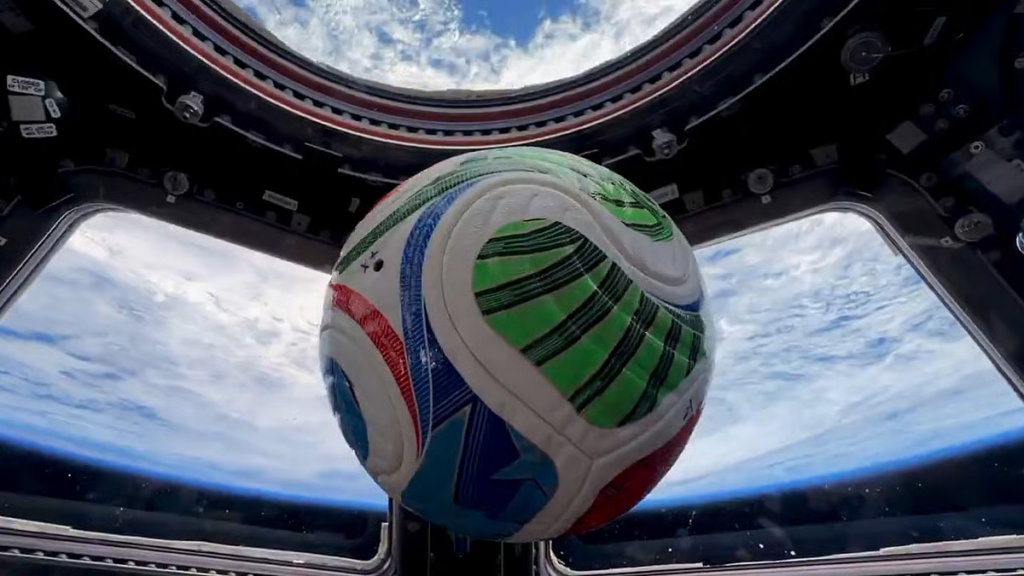
The United States men’s national soccer team has received an unusual source of motivation for its FIFA World Cup 2026 campaign: the Moon.
NASA Administrator Jared Isaacman has pledged that if Team USA wins the 2026 FIFA World Cup, the space agency will send a soccer ball to the Moon on a future lunar mission. The symbolic gesture, announced during an event outlining NASA’s plans for a permanent lunar presence, would celebrate what would be the first men’s World Cup title in U.S. history while paying tribute to one of the most memorable moments from the Apollo era.
What did NASA announce?
During an event discussing NASA’s long-term plans for lunar exploration, Administrator Jared Isaacman offered an unexpected incentive for the U.S. men’s national team.
He said that if Team USA lifts the FIFA World Cup trophy, NASA will ensure a soccer ball accompanies a future mission to the Moon.
Addressing the players, Isaacman said:
“That’s the challenge, okay, so Team USA, get the job done. We’re going to get the soccer ball there.”
Although the promise is largely symbolic, it links one of the world’s biggest sporting events with NASA’s next era of lunar exploration.
How would NASA send a soccer ball to the Moon?
According to NASA officials, the soccer ball would not require a dedicated mission.
Instead, it would likely fly as a lightweight symbolic payload aboard a future lunar mission carrying scientific instruments and equipment for NASA’s planned Moon base.
Carlos Garcia-Galan, NASA’s program manager for the lunar base initiative, said the ball is small and light enough to be accommodated on a future mission if the United States wins the tournament.
He also joked that NASA’s plans now depend entirely on the U.S. men’s team.
Why is NASA making this promise?
The proposal serves as both a celebration of sport and a tribute to space exploration history.
NASA has often used cultural moments to engage the public with its missions, and the World Cup provides one of the largest global audiences imaginable.
The announcement also reflects the growing excitement surrounding NASA’s Artemis-era ambitions, which aim to establish a sustained human presence on and around the Moon.
Rather than launching a scientific instrument, the soccer ball would become a symbolic reminder of a historic sporting achievement.
The Alan Shepard connection
NASA’s idea draws inspiration from one of the most famous moments in lunar exploration.
During the Apollo 14 mission in 1971, astronaut Alan Shepard secretly brought a makeshift golf club and two golf balls to the Moon.
Before leaving the lunar surface, Shepard took several swings, creating what became one of the most iconic images in space exploration history.
Isaacman referenced that moment while unveiling the proposal, suggesting NASA hopes to build on Shepard’s legacy by sending a soccer ball instead.
Has NASA celebrated the World Cup before?
Yes.
Although this proposal is unique, NASA has previously embraced the excitement surrounding the FIFA World Cup.
Past initiatives have included:
- Sending an official FIFA soccer ball to the International Space Station.
- Sharing World Cup celebrations from astronauts living aboard the orbiting laboratory.
- Highlighting how astronauts follow major sporting events while in space.
The latest pledge extends that tradition by connecting football with humanity’s return to the Moon.
What would it mean if Team USA wins?
A U.S. victory would already be historic.
The United States men’s national team has never won the FIFA World Cup.
By contrast, the U.S. women’s national team is one of the sport’s most successful programs, with four World Cup titles.
If the men’s team captures the 2026 championship, it would:
- Win its first FIFA World Cup.
- Become the first U.S. men’s team to achieve the feat.
- Trigger NASA’s symbolic Moon mission pledge.
- Add another memorable chapter to the country’s sporting history.
Where does Team USA stand in the tournament?
The United States entered the knockout rounds after winning Group D.
Its campaign has generated significant excitement, particularly because the 2026 FIFA World Cup is being co-hosted by:
- The United States
- Canada
- Mexico
Playing on home soil has fueled hopes that the U.S. men’s team could produce its deepest World Cup run in history.
Whether those hopes ultimately lead to a championship remains to be seen, but NASA has already made clear what would happen if they do.
Why does this announcement matter?
Although no scientific objectives are tied to the soccer ball itself, the announcement highlights how space agencies increasingly use major cultural events to inspire public interest in exploration.
NASA has long blended science with storytelling, connecting its missions to moments that resonate beyond the scientific community.
A soccer ball on the Moon would symbolize not only sporting success but also a new chapter in lunar exploration during the Artemis era.
The bigger picture
NASA’s pledge to send a soccer ball to the Moon if Team USA wins the FIFA World Cup is unlikely to influence the outcome on the field, but it offers a memorable intersection of sports and space exploration.
By linking a potential World Cup triumph with humanity’s return to the Moon, NASA has created a symbolic challenge that celebrates both athletic ambition and scientific achievement.
Whether Team USA ultimately lifts the trophy or not, the announcement reflects the agency’s broader effort to make its lunar missions part of popular culture as preparations continue for a sustained human presence beyond Earth.
TL;DR
- NASA says it will send a soccer ball to the Moon if the U.S. men’s team wins the 2026 FIFA World Cup.
- NASA Administrator Jared Isaacman made the pledge during a lunar exploration event.
- The soccer ball would travel aboard a future Moon mission supporting NASA’s lunar base program.
- The idea honors Apollo 14 astronaut Alan Shepard, who famously hit golf balls on the Moon in 1971.
- Team USA has never won the men’s FIFA World Cup.