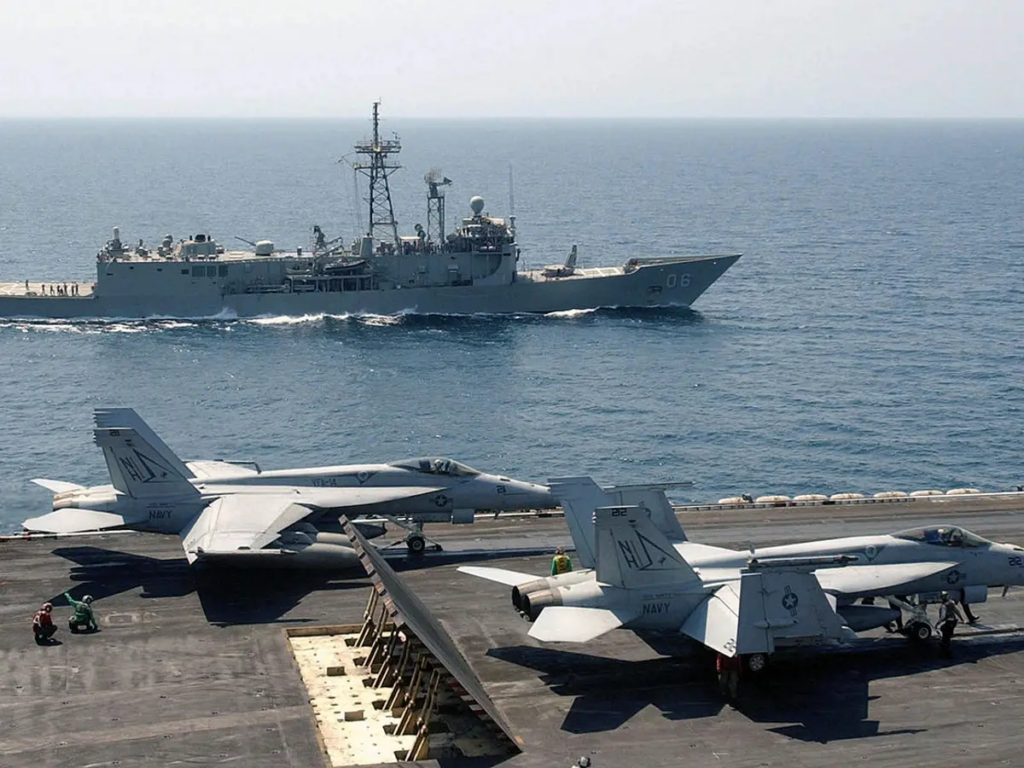
Landing a fighter jet on an aircraft carrier is already one of the most dangerous maneuvers in military aviation. Now imagine doing it at more than 150 mph on a moving runway barely longer than a city block, while carrying thousands of pounds of fuel and weapons across a pitching ocean deck. That’s where the US Navy’s “Max Trap” rule comes in.
A recent spotlight on operations aboard the USS Abraham Lincoln has drawn attention to a little-known but critical aviation protocol that forces naval pilots to dump expensive jet fuel before landing. The reason is simple: aircraft that are too heavy risk catastrophic failure during carrier landings.
The procedure may look wasteful from the outside, but for naval aviators, it’s a carefully calculated trade-off between fuel costs and preventing the destruction of fighter jets worth more than $100 million each.
What does “Max Trap” mean?
“Trap” is Navy slang for an arrested landing on an aircraft carrier, where a jet hooks one of several steel cables stretched across the deck.
“Max Trap” refers to the maximum safe landing weight allowed for a specific aircraft during those carrier recoveries.
For example:
- Boeing F/A-18E/F Super Hornet aircraft operating from the USS Abraham Lincoln reportedly must weigh under 44,000 pounds before landing
- Lockheed Martin F-35C Lightning II jets have a slightly higher threshold of roughly 46,000 pounds
If the aircraft exceeds those limits, the impact forces during landing can become dangerously high.
Why are carrier landings so brutal on aircraft
Carrier aviation compresses physics into a tiny strip of steel floating in open water.
Unlike conventional airport runways that stretch for thousands of feet, aircraft carriers provide only a few hundred feet for jets to stop after touchdown.
The landing happens incredibly fast
Fighter jets approach the carrier deck at speeds exceeding 150 mph.
The moment the tailhook catches an arresting cable:
- The aircraft goes from high speed to zero in seconds
- The landing gear absorbs enormous shock
- The arresting system experiences extreme tension
- The airframe undergoes violent stress forces
The stopping distance is astonishingly short.
A carrier deck gives pilots roughly 350 feet to stop completely, shorter than the length of many commercial parking lots.
Too much weight can become catastrophic
An overweight aircraft increases kinetic energy dramatically.
That can lead to:
- Landing gear collapse
- Structural airframe damage
- Snapped arresting cables
- Deck accidents
- Loss of aircraft overboard
In worst-case scenarios, a failed carrier landing can destroy both the jet and portions of the carrier deck operation itself.
Why pilots often return heavier than expected
Many naval missions launch with:
- Air-to-air missiles
- Guided bombs
- External fuel tanks
- Extra mission equipment
If combat conditions change or targets are not engaged, pilots may return with much of that payload still attached.
Weapons create a major weight problem
Modern precision weapons are extremely heavy.
Some guided bombs weigh the following:
- 1,000 pounds
- 2,000 pounds
- Or more per weapon
That means a fighter returning without firing its weapons can remain significantly above the “Max Trap” threshold.
Because pilots cannot simply discard expensive unused munitions into the ocean, fuel becomes the only adjustable variable.
Why does fuel dumping become necessary
To reduce weight quickly, naval aircraft use fuel dump systems designed specifically for emergency or operational recovery situations.
These systems can release thousands of pounds of fuel in just minutes.
How the process works
The aircraft vents fuel from designated outlets while flying at a safe altitude and distance from the carrier group.
According to aviation experts:
- The fuel disperses rapidly in the atmosphere
- Much of it evaporates before reaching the ocean surface
- The procedure is a tightly regulated operation
The process is costly, but the Navy views it as preferable to risking a multi-million-dollar aircraft and pilot.
The economics behind dumping jet fuel
On paper, deliberately dumping fuel sounds wildly inefficient.
But military aviation economics operate differently from commercial airline calculations.
The math heavily favors safety
A single Lockheed Martin F-35C Lightning II can cost well over $100 million, depending on configuration and support systems.
Meanwhile, a failed carrier landing could result in the following:
- Loss of the aircraft
- Pilot injury or death
- Damage to the carrier
- Disruption of flight deck operations
- Loss of classified systems
Compared to those risks, dumped fuel becomes an acceptable operational expense.
The Navy essentially treats fuel dumping as an insurance policy written in vapor trails.
Why aircraft carriers create unique engineering challenges
Aircraft carriers are floating airbases, but unlike land runways, they move constantly with the ocean.
That means pilots must account for the following:
- Wind shifts
- Deck motion
- Sea state
- Night visibility
- Mechanical timing
- Ship speed
Arresting cables do extraordinary work
Carrier arresting systems use high-tensile steel cables connected to hydraulic or advanced energy-absorbing systems below deck.
When a jet hooks the cable:
- The system absorbs massive kinetic energy instantly
- The aircraft experiences brutal deceleration
- Timing precision becomes critical
If the aircraft is too heavy, the entire system faces exponentially greater strain.
Why the USS Abraham Lincoln is back in focus
The renewed attention on “Max Trap” procedures comes as the USS Abraham Lincoln continues operating in strategically sensitive regions amid elevated global tensions.
Carrier strike groups remain central to:
- US naval power projection
- Rapid-response military operations
- Air superiority missions
- Maritime security patrols
That operational tempo means carrier-based fighters frequently launch with full combat payloads, making recovery weight management even more important.
Fuel dumping is rare in commercial aviation but common in military operations
Commercial passenger jets can also dump fuel under emergency circumstances, particularly after taking off with full fuel loads and needing to land unexpectedly.
But the military context is different.
Naval fighters:
- Operate from tiny decks
- Carry combat payloads
- Face stricter landing weight requirements
- Encounter more aggressive maneuvering stresses
For carrier aviators, fuel dumping is not unusual. It is simply part of managing survival inside one of aviation’s harshest environments.
The bigger takeaway behind the “Max Trap” rule
The phrase “Max Trap” may sound like technical military jargon, but it represents something very straightforward: physics always wins.
No amount of pilot skill can fully overcome the laws of momentum and force when a heavy jet slams onto a moving carrier deck at highway speeds.
So when Navy pilots dump fuel before landing, they are not wasting resources. They are shaving off danger, pound by pound, before attempting one of the hardest landings on Earth.