
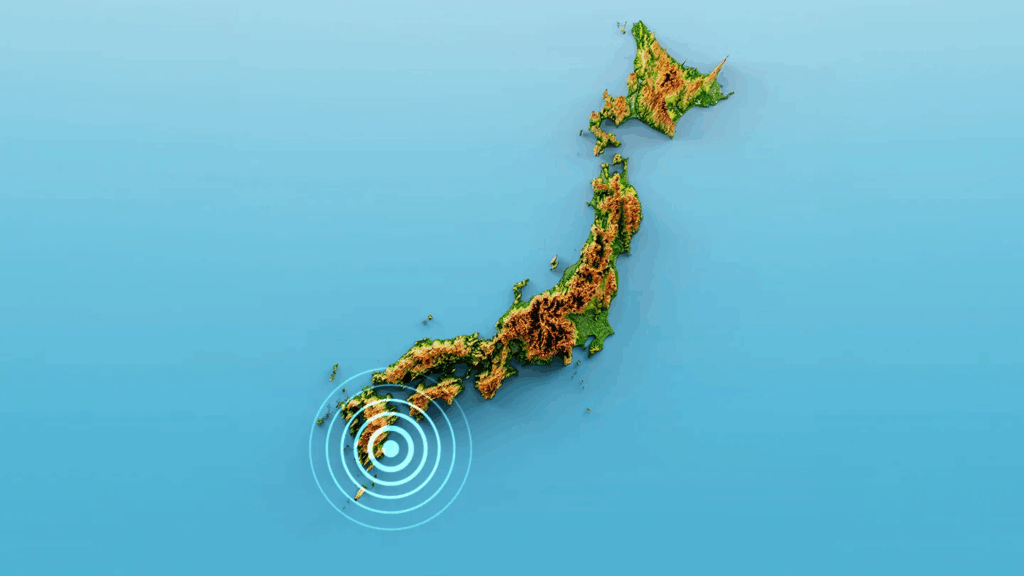
Japan has issued its first-ever megaquake warning under a revamped Earthquake Early Warning System introduced in 2022. The alert was triggered after a 7.5-magnitude quake struck northern Japan, prompting authorities to warn residents about the possibility of a much larger follow-up earthquake (magnitude 8.0 or higher). While a megaquake is not guaranteed, the alert remains active for at least a week and is designed to give communities more time to prepare.
What Is a Megaquake, and Why Is Japan Issuing a Warning?
A megaquake is a massive seismic event measuring magnitude 8.0 or greater. These are extraordinarily powerful quakes capable of producing large tsunamis, collapsing critical infrastructure, and causing widespread, long-lasting disruptions.
Japan issued a megaquake warning after a 7.5-magnitude earthquake struck on December 8. Under the country’s updated system, a quake of magnitude 7.0 or higher in certain subduction zones, such as near the Japan Trench or Chishima Trench, can signal that a much larger “mainshock” may follow.
This is the first time Japan has activated its highest-tier alert since updating its system in 2022.
How Japan’s Earthquake Early Warning System Works
Japan is one of the most seismically active nations in the world, so early alerts are a critical part of public safety. The country has used an earthquake early warning system since around 2007, operated by the Japan Meteorological Agency (JMA).
What the Original System Did
The legacy system provides near-instant alerts when shaking starts, giving residents a few seconds to brace, seek cover, or stop critical operations like trains.
What Changed in 2022?
In December 2022, the JMA and the Headquarters for Earthquake Research Promotion (HERP) introduced a significant upgrade. The new component is known in English as the “Hokkaido–Sanriku-offshore Aftershock Earthquake Alert Information” system.
It’s essentially a foreshock-based prediction tool. When a strong quake hits specific offshore regions, the system evaluates seismic patterns to gauge the probability of a much larger event occurring shortly after.
Why a Foreshock Matters
In major subduction zones, a powerful initial quake can be a foreshock—a warning shot before a much bigger rupture. The new system aims to provide hours to days of extra preparation time, rather than mere seconds.
When Does the Megaquake Alert Get Triggered?
The updated system activates when:
- A magnitude 7.0 or higher earthquake strikes designated subduction zones.
- The quake occurs in high-risk offshore trenches such as:
- Japan Trench
- Chishima (Kuril) Trench
Once triggered, authorities issue a precautionary megaquake alert, advising residents to prepare for the possibility — not the certainty — of a much larger seismic event.
How Long Does the Warning Last?
The alert remains effective for at least one week, though it can be extended based on ongoing seismic activity.
What the Public Is Told to Do After a Megaquake Warning
Japan’s emergency advisory focuses on immediate, practical steps. After this week’s alert, residents were urged to:
- Review local tsunami and earthquake evacuation routes.
- Secure heavy furniture and appliances inside the home.
- Gather emergency supplies, including:
- Food and water (several days’ worth)
- Flashlights and portable chargers
- Portable toilets or sanitation kits
- Keep medications, documents, and valuables in an easily accessible “go bag.”
These warnings are intentionally precautionary because predicting earthquakes remains extremely difficult, even with advanced modeling.
What Makes the 2022 Megaquake System Different?
Most global early alert systems provide seconds of warning once an earthquake has already begun. Japan’s new approach is different, and more ambitious.
Key Improvements
- Predictive element: It looks for signs that a bigger quake may follow.
- Longer lead time: Instead of seconds, residents may get hours or days to prepare.
- Focus on megaquakes: It specifically targets magnitude 8.0+ events, which are rare but catastrophic.
Why This Matters for Japan
Northern Japan sits near two of the world’s most active subduction zones. Past events, including the 2011 Tōhoku earthquake and tsunami, demonstrated how devastating massive offshore quakes can be.
This new system aims to reduce casualties by getting ahead of the curve.
Is It Perfect? No.
Earthquake prediction still involves uncertainty. Japan stresses that:
- A megaquake might not occur.
- Warnings are meant to promote preparedness, not panic.
Why Japan’s Megaquake Warning Matters Globally
Japan’s move has wide relevance because:
1. It’s a Test Case for Predictive Seismic Warnings
If the foreshock-based model proves useful, other quake-prone countries, including the U.S. West Coast, Chile, and Indonesia, may adopt similar systems.
2. It Confronts the Limits of Earthquake Science
By issuing a precautionary public alert, Japan acknowledges the difficulty of predicting “the big one” but chooses transparency over silence.
3. It Highlights a Growing Preparedness Culture
Japan’s systems often set global standards for disaster readiness. This alert underscores the value of public drills, hazard education, and continuous infrastructure upgrades.
Should People Be Worried? Experts Say: Stay Alert, Not Afraid
Authorities emphasize that:
- A megaquake is possible, not guaranteed.
- The warning is not a prediction but a scientific risk assessment.
- Preparedness steps are routine for residents of high-risk areas.
Still, the alert serves as a serious reminder of the seismic reality facing northern Japan.
Final Thoughts: A New Era in Earthquake Awareness
Japan’s first megaquake warning marks a turning point in how countries communicate seismic risk. By tying alerts to foreshocks, the updated system aims to buy precious time before a potentially catastrophic event.
Whether a megaquake actually follows this 7.5-magnitude tremor remains unknown. But Japan’s approach shows a commitment to readiness, and a recognition that when it comes to earthquakes, time is the most valuable resource.