
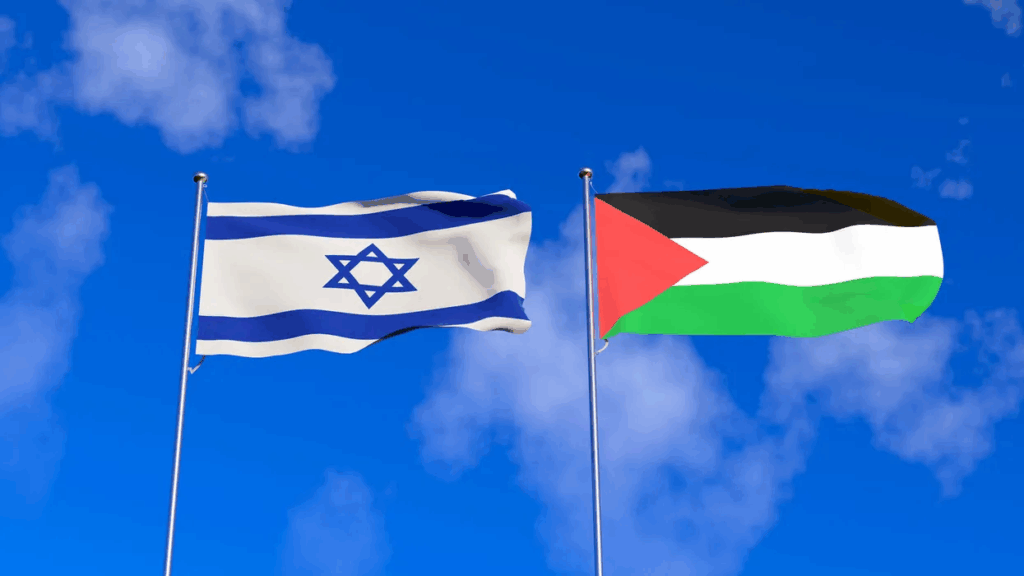
Why the 2-state solution is back in focus
The two-state solution, long considered the most viable path to peace in the Middle East, has re-emerged as a central issue at the 2025 United Nations General Assembly (UNGA). France and Saudi Arabia are spearheading a new push for Palestinian statehood, framing it as the only way to end the cycle of war and occupation.
The latest momentum comes amid an ongoing Gaza war and renewed fears of West Bank annexation. Yet, with Israel and the United States firmly opposed, the key question is whether global recognition of Palestine can translate into real political change.
Growing international recognition of Palestine
Momentum for Palestinian statehood has accelerated in recent months:
- Britain, Canada, and Australia formally recognized Palestine on Sunday.
- France is expected to follow suit during UNGA week.
- India reiterated its long-standing support for a two-state solution.
- Nearly 150 countries worldwide have already recognized Palestine diplomatically.
UN Secretary-General António Guterres underscored the urgency:
“Without a two-state solution, there will be no peace in the Middle East.”
The renewed diplomatic efforts also revolve around the “New York Declaration,” a nonbinding UN resolution that outlines a roadmap for Palestinian statehood based on pre-1967 borders.
Israel and US opposition
Israel’s leadership remains firmly against Palestinian statehood. Prime Minister Benjamin Netanyahu has vowed to block any move toward a two-state arrangement, threatening retaliation if unilateral recognition advances.
“If unilateral actions are taken against us, it simply invites unilateral actions on our part,” Netanyahu warned after meeting US Secretary of State Marco Rubio.
Key sticking points include:
- West Bank settlements: Over 500,000 Israeli settlers now live across the West Bank.
- East Jerusalem: Officially annexed by Israel, making it central to Israeli claims.
- US stance: Washington has blocked Palestinian officials from attending the UNGA, underscoring its opposition to a Palestinian state.
The US position aligns closely with Netanyahu’s coalition, which is openly pushing for West Bank annexation, a move most analysts say would make a viable Palestinian state impossible.
The French-Saudi peace proposal
France and Saudi Arabia unveiled a new phased roadmap, described as a “last chance” framework for peace:
- Immediate ceasefire in Gaza.
- Release of hostages and Israeli withdrawal.
- Hamas disarmament and transfer of authority to an independent Palestinian Authority-aligned body.
- Deployment of international peacekeepers.
- Reconstruction of Gaza, backed by international funding.
- Regional integration, including Saudi Arabia normalizing ties with Israel.
While the plan mirrors past frameworks, it introduces stronger Arab-European cooperation. Whether Hamas, Israel, or the US will accept it remains uncertain.
Why the prospects remain bleak
Despite the diplomatic momentum, the political and territorial realities make progress difficult:
- Gaza devastation: Ongoing war has displaced much of the population, creating a humanitarian crisis.
- West Bank control: Israel maintains military authority, while settlements expand.
- Political deadlock: Hamas refuses to recognize Israel; the Palestinian Authority has lost credibility among its own people.
- Greater Israel vision: Netanyahu and parts of his coalition openly advocate permanent Israeli control “west of the Jordan River,” sidelining Palestinian sovereignty.
Past peace talks — from the 1990s Oslo Accords to US-led efforts in the 2010s- have all collapsed. Analysts warn that unless Israel reverses annexation plans, the two-state solution may remain a diplomatic slogan rather than a realistic outcome.
Why this moment matters
The renewed debate is not just symbolic. If more Western countries recognize Palestine, especially major powers like France, it could:
- Put pressure on Israel diplomatically.
- Trigger sanctions or aid conditions tied to settlement expansion.
- Shift global opinion in favor of Palestinian statehood.
But without US backing, the push faces a structural roadblock. Washington remains Israel’s most important ally, providing both military and diplomatic cover.
TL;DR
At UNGA 2025, France and Saudi Arabia are leading a renewed push for a two-state solution, with Britain, Canada, and Australia recognizing Palestine. Yet, Israel and the US strongly oppose Palestinian statehood, and realities on the ground, from West Bank settlements to Gaza’s devastation, make peace elusive.