
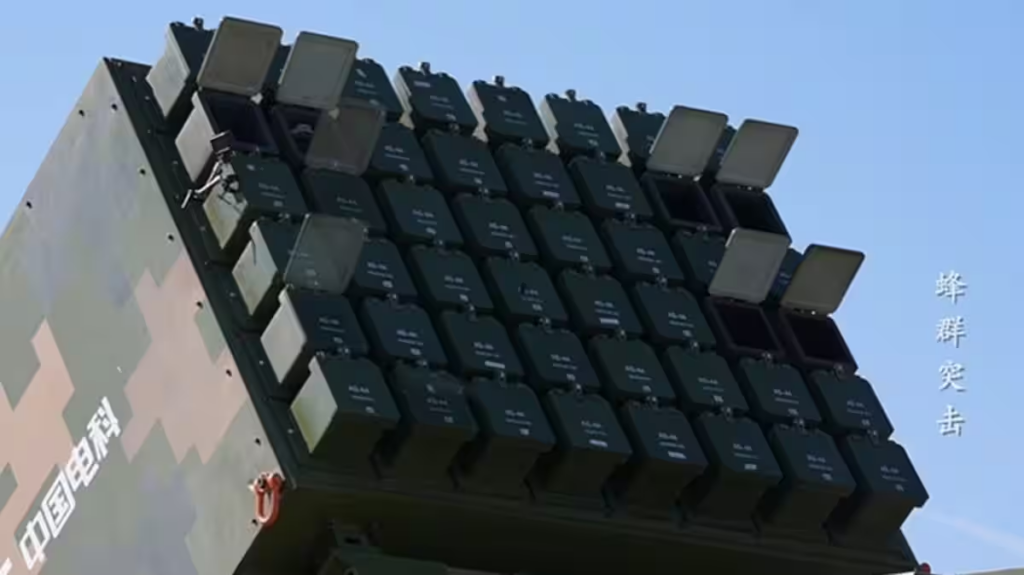
In late March 2026, the People’s Liberation Army (PLA) showcased a new piece of military hardware that signals where warfare is headed next: the Atlas drone swarm system. At first glance, it looks like another mobile weapons platform. But beneath that exterior is something more consequential—a networked system designed to deploy dozens of drones in coordinated, semi-autonomous operations.
The unveiling raises a bigger question: Is this just another technological milestone, or the beginning of a new kind of security challenge for countries like India—and potentially the wider world?
What is China’s Atlas Drone Swarm System?
The Atlas system is a mobile, vehicle-mounted drone deployment and control platform designed to launch and manage large numbers of unmanned aerial vehicles (UAVs) simultaneously.
At its core, Atlas is built around three components:
- Swarm-2 combat vehicle (drone launcher)
- Command vehicle (control hub)
- Support vehicle (logistics and maintenance)
Together, they function as a compact, mobile battlefield network.
Unlike traditional drone systems, which often require multiple operators and fixed bases, Atlas centralizes control. A single operator can reportedly coordinate up to 96 drones at once, turning one vehicle convoy into a self-contained airpower unit.
How does the Atlas drone swarm system work?
Rapid deployment at scale
The system’s defining feature is speed and volume.
- Each drone launches at intervals of under three seconds
- A full swarm of 96 drones can be deployed in about five minutes
- The Swarm-2 vehicle alone can carry 48 fixed-wing drones
This isn’t just about launching drones, it’s about overwhelming a target quickly.
Coordinated swarm intelligence
Once airborne, the drones operate as a coordinated unit rather than isolated machines.
Capabilities include:
- Adaptive formations (defensive clusters or attack patterns)
- Task distribution (different drones performing different roles)
- Autonomous adjustments based on battlefield conditions
This is where Atlas stands apart. It’s not just a launcher, it’s a system designed for collective behavior.
Multi-role payloads
Each drone can be configured for specific missions:
- Reconnaissance (electro-optical surveillance)
- Electronic warfare (signal disruption)
- Precision strikes
- Communication relay
This flexibility means a single swarm can conduct multiple mission types simultaneously.
How does Atlas compare to other drone swarm programs?
China is not alone in exploring swarm warfare.
The U.S., through the Defense Advanced Research Projects Agency, has experimented with swarm systems under programs like OFFSET and the Perdix micro-drones. These demonstrated the feasibility of deploying large numbers of small drones in coordinated operations.
China has also explored similar concepts, including the “Jiu Tian” drone mothership, reportedly capable of releasing over 100 drones in mid-air.
What distinguishes Atlas is not just scale but integration:
- Fully mobile system (vehicle-mounted)
- Centralized control architecture
- Rapid deployment capability in a battlefield setting
In simple terms, others have tested swarms. Atlas is closer to operationalizing them.
Who is behind the Atlas system?
The system is developed by China Electronics Technology Group Corporation (CETC), a major state-owned defense electronics firm deeply embedded in China’s military-industrial ecosystem.
CETC plays a key role in:
- Military communications systems
- Electronic warfare technologies
- AI-driven defense platforms
Its work aligns with China’s broader civil-military integration strategy, which blends commercial innovation with military development.
Why does the Atlas drone swarm system matter?
A shift toward “intelligentized warfare”
China’s military doctrine increasingly emphasizes what it calls “intelligentized warfare”—a phase beyond information warfare, where AI, autonomy, and networked systems dominate.
Atlas fits squarely into this vision:
- AI-assisted coordination
- Reduced human involvement
- Faster decision cycles
This changes not just how wars are fought but how quickly they unfold.
Saturation attacks become more feasible
One of the most concerning aspects is the system’s ability to conduct saturation attacks.
In practical terms:
- Air defense systems can track only a limited number of targets at once
- A swarm of dozens of drones can overwhelm those systems
- Even low-cost drones can neutralize expensive defenses
This flips the traditional cost equation of warfare.
Lower barriers to high-impact attacks
Compared to fighter jets or missile systems, drone swarms are
- Cheaper to produce
- Easier to deploy
- Harder to detect and intercept
If exported or replicated, this technology could proliferate quickly.
Is Atlas a security concern for India?
For India, the implications are immediate and geographic.
Border dynamics and terrain challenges
India shares a long, sensitive border with China across high-altitude terrain. Drone swarms could be particularly effective in such environments:
- Difficult terrain limits traditional troop movement
- Radar coverage can be inconsistent
- Swarms can exploit gaps quickly
Air defense strain
India’s air defense systems are designed primarily for aircraft and missiles—not dozens of small, fast-moving drones acting in coordination.
This raises operational questions:
- Can existing systems effectively track swarm behavior?
- Are counter-swarm technologies sufficiently developed?
Asymmetric escalation risks
Drone swarms enable high-impact, low-cost strikes, which can complicate escalation dynamics.
A limited drone attack could:
- Cause significant disruption
- Avoid triggering full-scale retaliation
- Create ambiguity about intent
This makes conflict management more difficult.
What about global security risks?
The concerns extend well beyond India.
Proliferation and export uncertainty
China has not officially confirmed whether Atlas will be exported. But historically, Chinese defense systems have reached international markets.
If Atlas—or similar systems—becomes available globally:
- Non-state actors could gain access
- Smaller militaries could leapfrog capabilities
- Regional conflicts could escalate faster
Urban warfare implications
Drone swarms are particularly suited for urban environments:
- Navigating dense infrastructure
- Conducting surveillance in real time
- Coordinating attacks in confined spaces
This raises concerns about future conflicts moving deeper into civilian areas.
Electronic warfare vulnerabilities
Swarm systems rely heavily on communication networks. That creates both strengths and weaknesses:
- Strong coordination enables complex operations
- But signal disruption or hacking could neutralize or hijack swarms
This opens a new front in cyber and electronic warfare.
What comes next?
The Atlas system is still in a demonstration phase, with no confirmed battlefield deployment. But the direction is clear: militaries are moving toward networked, autonomous systems operating at scale.
For policymakers and defense planners, the challenge is twofold:
- Adaptation: Develop counter-swarm technologies and doctrines
- Regulation: Consider international norms for autonomous weapons
TL;DR
- China’s Atlas drone swarm system can deploy up to 96 coordinated drones from a mobile platform
- It emphasizes speed, autonomy, and multi-role operations
- The system reflects a broader shift toward AI-driven, networked warfare
- It poses potential risks for India’s border security and global military stability
- The biggest concern: low-cost, high-impact swarm attacks becoming widely accessible