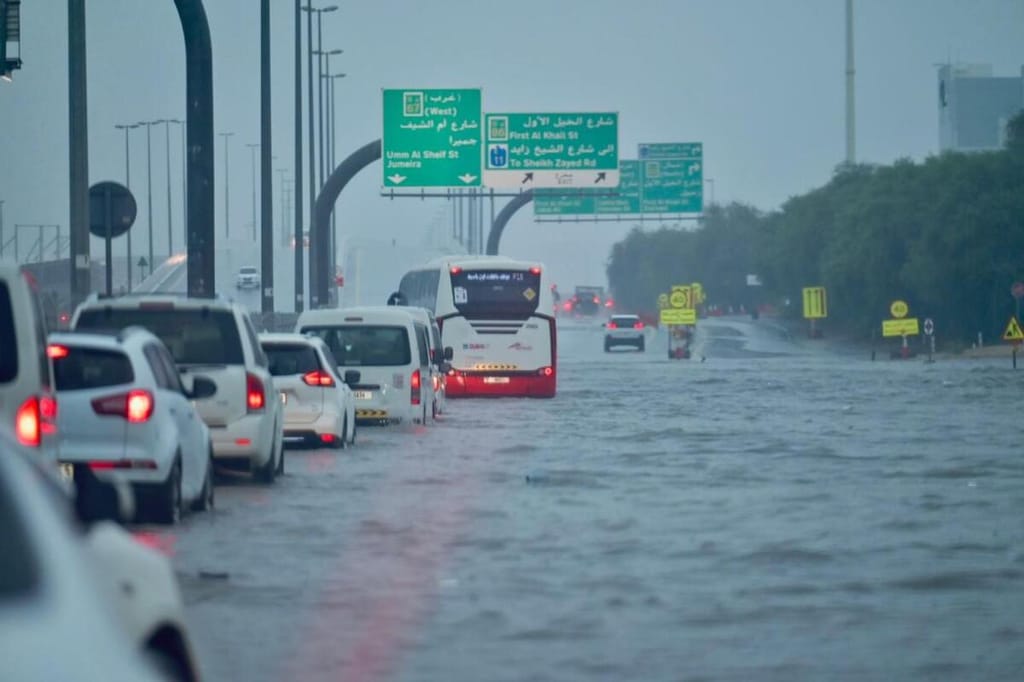
Dubai, famed for its arid climate and scorching heat, was hit by torrential rain on Tuesday, resulting in severe flooding across the desert nation. The unexpected deluge not only slowed the bustling city’s regular pace but also raised concerns about the growing impact of climate change on extreme weather occurrences in the region. In the United Arab Emirates (UAE), annual rainfall averages less than 200 millimeters. With summer temperatures reaching up to 50 degrees Celsius, the UAE’s water resources are under enormous strain, exacerbated by its reliance on groundwater sources.
To fight this critical issue, the UAE has pioneered new solutions, one of which is creating artificial rain using cloud seeding, a type of weather modification that increases precipitation.
What is cloud seeding?
The UAE has been generating ‘artificial rain’ through ‘cloud seeding’, which is aimed at increasing precipitation by stimulating the condensation process in clouds. ‘Seeding agents’ (in this case, fine salt coated with titanium oxide) that trigger rainfall are introduced in clouds via specialized aircraft. The process may have caused excessive rainfall and flooding in Dubai, as per meteorologists
Cloud seeding is a technique that involves injecting “seeding agents” into clouds to induce condensation and cause rainfall. The process begins with weather forecasters at the NCM monitoring atmospheric conditions and finding appropriate clouds for seeding based on precipitation patterns.
In 1982, the UAE conducted its first test of cloud seeding. By the early 2000s, the Gulf nation’s artificial rain program had been strengthened through collaboration scientific and technical research with the National Center for Atmospheric Research (NCAR) in Colorado, USA, Witwatersrand University in South Africa, and NASA.
The UAE’s Rain Enhancement Program (UAEREP), led by the Emirates’ National Centre of Meteorology (NCM), spearheads the effort.
The scientists behind this study studied the physical and chemical properties of the UAE’s atmosphere, particularly aerosols and pollutants, and their impact on cloud formation. The goal was to find an effective chemical to enhance cloud development and hence increase rainfall.
Once suitable clouds have been identified, specialized aircraft armed with hygroscopic flares take to the skies. These flares, which are installed on the aircraft’s wings, include salt-based components. When the flares reach the target clouds, they deploy and release the seeding agent.
The salt particles serve as nuclei around which water droplets condense, eventually growing heavy enough to fall as precipitation in the form of rain.
“The NCM has established a national network of 86 automatic weather stations (AWOS) for weather monitoring, six weather radars covering the entire UAE, and one upper air station. The Centre has also created climate databases and assisted in the development of high precision Numerical Weather Predictions and simulation software in the UAE,” the UAEREP’s description of the process reads.
Despite the potential benefits of cloud seeding, there have been questions raised concerning its environmental impact
“At present, the NCM operates four Beechcraft King Air C90 aircraft from Al Ain Airport equipped with the latest technologies and devices employed for cloud seeding and atmospheric research.”
Despite the potential benefits of cloud seeding, there have been questions raised concerning its environmental impact and the safety of the seeding substances used. In response, the NCM has implemented measures to safeguard the safety and sustainability of its activities.
Unlike some other countries’ cloud seeding operations, which use silver iodide, a crystal-like substance that has caused environmental concerns, the UAE’s program does not use toxic chemicals. Instead, it uses natural salts as seeding agents.