
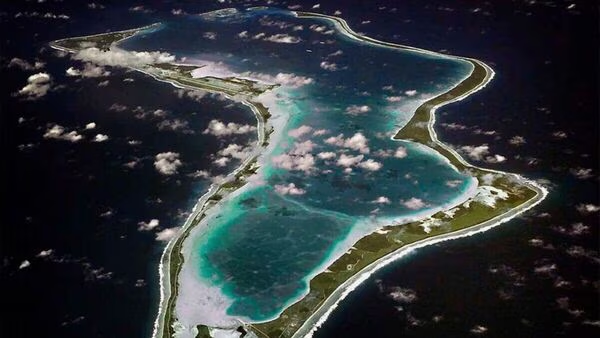
Within a conflict already thick with escalation, Iran’s reported attempt to strike a US-UK base nearly 4,000 kilometers away has shifted the conversation from regional skirmishes to long-range deterrence. The target, Diego Garcia, sits deep in the Indian Ocean, far beyond the range Iran has publicly acknowledged in the past.
Even though the missiles failed to hit their mark, the attempt itself may be more important than the outcome. It raises a simple but unsettling question: has Iran quietly extended its strike reach far beyond what it has previously claimed?
What happened in the Iran-Diego Garcia missile strike?
Iran reportedly launched two intermediate-range ballistic missiles toward Diego Garcia, a joint US-UK military installation.
According to US officials:
- One missile failed mid-flight
- The second was intercepted by a US SM-3 missile defense system
- No casualties or damage were reported
On paper, it looks like a failed attack. In strategic terms, it may be something else entirely: a test signal.
Why is the Iran-Diego Garcia missile strike significant?
It challenges Iran’s stated missile limits
For years, Iranian officials maintained that their missile range was capped at around 2,000 km. That ceiling was framed as a deliberate policy choice, not a technical limitation.
This incident suggests one of three possibilities:
- Iran has developed longer-range systems quietly
- It has modified existing missiles beyond known specifications
- Or it is testing capabilities it has not yet officially declared
Each scenario carries different implications, but all point to a broader reach than previously assumed.
It expands the geographic scope of the conflict
Most Iranian strikes have historically focused on:
- Gulf-region bases
- Israeli territory
- Nearby maritime routes like the Strait of Hormuz
Targeting Diego Garcia shifts the battlefield outward into the Indian Ocean, a zone previously considered relatively insulated from direct Iranian strikes.
What missile might Iran have used?
Khorramshahr-4 in focus
US officials and defense analysts suspect Iran may have used the Khorramshahr-4 missile, though this has not been officially confirmed.
The Khorramshahr-4 stands out for several reasons:
- Estimated range: potentially over 4,000 km
- Payload capacity: over one ton
- Fuel type: liquid-fueled
- Warhead options: includes possible cluster munitions
If this missile was indeed used, it would mark its first known combat deployment.
Why the Khorramshahr-4 matters
Unlike many solid-fuel missiles that prioritize quick launch, liquid-fueled systems like this one often trade speed for payload and range.
That makes the Khorramshahr-4 less about rapid response and more about:
- Strategic targeting
- Long-distance deterrence
- High-impact payload delivery
How does missile defense factor into this?
The interception of one missile by an SM-3 system is a reminder that missile defense remains a critical layer in modern warfare.
What is the SM-3?
The SM-3 (Standard Missile-3) is designed to:
- Intercept ballistic missiles in space
- Destroy targets through kinetic impact rather than explosives
- Operate as part of the Aegis Ballistic Missile Defense system
Its successful use here suggests:
- US defenses in the region are active and effective
- Iran’s long-range capabilities may still face significant countermeasures
However, missile defense is not foolproof. Even a partial success rate can be enough to alter strategic calculations.
Why is Diego Garcia such a critical target?
Strategic importance of Diego Garcia
Diego Garcia is not just another base. Its value lies in its location and capabilities.
It serves as:
- A hub for long-range bombers
- A support base for nuclear submarines
- A logistics center for operations across the Middle East and Indo-Pacific
Its isolation makes it both secure and strategically vital. That combination is precisely why it would be an attractive target.
A base at the crossroads of geopolitics
The island also sits at the center of ongoing political discussions. The United Kingdom has explored transferring sovereignty of the Chagos Islands to Mauritius while maintaining military access.
That debate intersects with military strategy, raising questions about:
- Long-term basing rights
- Regional influence
- Future US-UK coordination
How does this fit into the broader Middle East conflict?
The attempted strike comes amid an intensifying conflict involving Iran, the United States, and Israel.
Recent developments include:
- Joint US-Israeli airstrikes on Iranian targets
- Iranian retaliation against US bases and regional infrastructure
- Disruptions in the Strait of Hormuz, a key global energy chokepoint
Roughly 20% of global oil and LNG flows through that narrow passage. Any escalation affecting it has global economic consequences.
UK policy shift adds another layer
The UK has reportedly expanded permissions for US forces to use British bases for offensive operations against Iranian missile infrastructure.
This marks a shift from defensive posture to active participation in degrading Iran’s capabilities.
That move may have influenced Iran’s decision to demonstrate long-range strike potential.
What does this tell us about Iran’s military strategy?
The attempted strike suggests a shift toward signaling rather than immediate battlefield success.
Key strategic takeaways
- Deterrence messaging: Even a failed long-range strike shows intent and capability
- Range ambiguity: Keeping adversaries uncertain about actual limits
- Target diversification: Expanding beyond regional targets
- Psychological impact: Forcing adversaries to rethink what is “out of reach”
In modern conflict, perception often matters as much as precision.
TL;DR
- Iran attempted a 4,000 km missile strike on Diego Garcia
- Both missiles failed, but the attempt itself is significant
- The Khorramshahr-4 missile is a likely candidate
- The strike challenges Iran’s previously stated 2,000 km range limit
- Diego Garcia’s strategic importance makes it a high-value target
- The move signals a broader shift in Iran’s military posture