
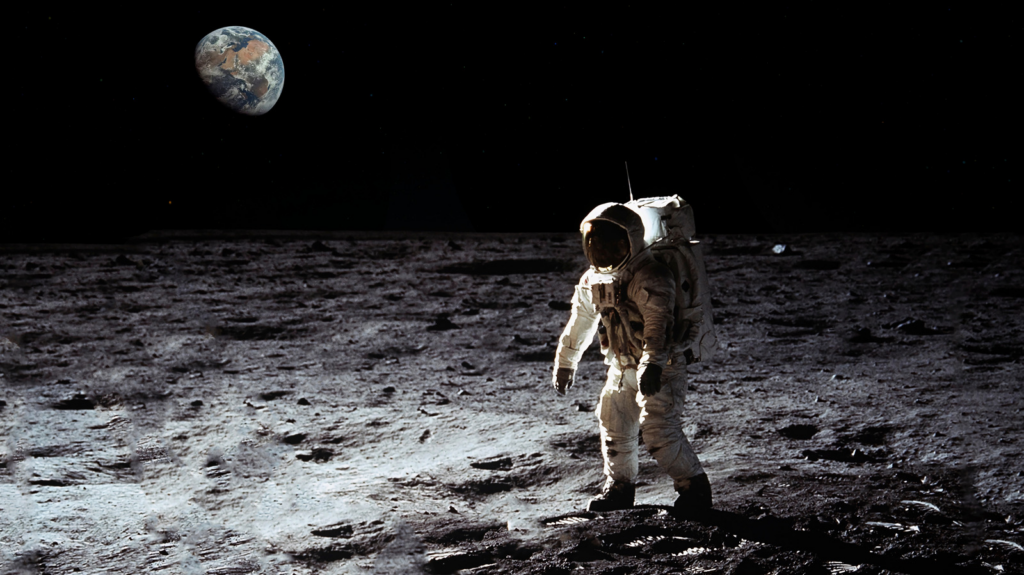
Between 1969 and 1972, 12 humans walked on the Moon. Then, abruptly, the missions stopped. For more than half a century, no astronaut has returned to the lunar surface—a gap that has fueled skepticism, conspiracy theories, and a persistent question: If we did it once, why didn’t we do it again?
The short answer is not mystery or deception, but politics, money, priorities, and risk. The long answer explains not only why the Apollo era ended, but also why NASA’s Artemis program is now trying to restart lunar exploration, very differently this time.
How many people actually went to the Moon?
Between Apollo 11 and Apollo 17, NASA landed six missions on the lunar surface. Each carried two astronauts who walked on the Moon, conducted experiments, and collected samples. In total:
- 12 astronauts walked on the Moon
- Missions ran from 1969 to 1972
- The Moon landings ended with Apollo 17 in December 1972
No human has left low-Earth orbit since.
Did the US stop going to the Moon after beating the Soviet Union?
The political goal was already achieved
The Apollo program was never just about exploration. It was a Cold War strategy.
When President John F. Kennedy announced the Moon goal in 1961, the United States was losing the space race. The Soviet Union had already:
- Launched the first satellite (Sputnik)
- Sent the first human (Yuri Gagarin) into space
Landing humans on the Moon was a way to decisively demonstrate American technological and scientific dominance.
By 1969, that objective was accomplished—on live television, in front of the world.
Once the geopolitical point had been made, enthusiasm in Washington faded. Lawmakers began asking an uncomfortable question: Why keep spending billions to do the same thing again?
How expensive was the Apollo program?
The cost was staggering even by today’s standards
Apollo was one of the most expensive scientific projects in history.
- Original cost: ~$25.8 billion (1970s dollars)
- Adjusted for inflation: Over $260 billion today
At its peak, NASA consumed about 4.5% of the entire US federal budget. Today, it receives less than 0.5%.
By the early 1970s, the US was dealing with:
- The Vietnam War
- Inflation and economic stress
- Growing domestic social unrest
Funding repeated Moon missions became politically untenable.
Why did NASA shift away from deep-space exploration?
From the Moon to low-Earth orbit
After Apollo, NASA changed its strategy. Instead of brief, high-risk trips to the Moon, the agency focused on continuous human presence in space.
That shift produced:
- The Space Shuttle, designed to be reusable
- Long-term research missions
- The construction of space stations
- A dramatic expansion of satellites for communication, weather, and defense
Low-Earth orbit offered more scientific return per dollar—and far less political risk—than repeated lunar landings.
Did NASA really “lose” the technology to go back?
Not the knowledge the infrastructure
A common claim is that NASA “lost” the technology to return to the Moon. That’s misleading.
What was lost was the industrial ecosystem that made Apollo possible.
- The Saturn V rocket—still the most powerful rocket ever flown—was no longer built
- Specialized factories were dismantled
- Contractors moved on to other work
- Engineers retired without successors trained on lunar hardware
Rebuilding that capability from scratch is not simple—or cheap.
Modern rockets are designed with different goals: reusability, automation, and sustainability, not brute-force lunar landings.
Were the Apollo missions dangerous?
Extremely—by today’s standards
Apollo astronauts accepted risks that would be unacceptable under modern safety rules.
- Limited computing power
- Minimal redundancy
- Little margin for error
- Several near-catastrophic failures (Apollo 1, Apollo 13)
The missions succeeded—but barely, in some cases.
As expectations around astronaut safety evolved, NASA became more cautious. That caution slowed progress but also prevented potential disasters.
Why is NASA going back now with Artemis?
A different mission, a different philosophy
The Artemis program is not Apollo 2.0.
Instead of short visits, Artemis aims to:
- Establish a sustained human presence on and around the Moon
- Test technologies for Mars missions
- Use the Moon as a long-term scientific and strategic platform
Artemis missions are designed to be:
- More automated
- Safer
- Internationally collaborative
- Sustainable over decades, not years
What is Artemis 2?
Artemis 2 is scheduled to be the first crewed mission beyond Earth orbit since Apollo. The plan includes:
- A crew of four astronauts
- A flyby of the Moon (no landing)
- Full testing of life-support, navigation, and safety systems
- Return to Earth after a lunar flyby
The mission is intended as a systems check before future landings.
Did humans really land on the Moon?
Yes, and the evidence is overwhelming
Moon-landing denial often relies on the question, “Why didn’t we go back?” But history answers that question without resorting to conspiracy.
Independent confirmation includes:
- Moon rocks are studied worldwide
- Retroreflectors still used for laser measurements
- Thousands of photographs and hours of telemetry
- Tracking by rival nations during the Cold War
The reason humans didn’t return isn’t secrecy—it’s cost, politics, and priorities.
The real lesson of Apollo
Apollo proved what humanity could do under intense political pressure and unlimited funding. Artemis is about what humanity can sustain over time.
Going back to the Moon was never about repeating history. It’s about building something that lasts.
TL;DR
- 12 humans walked on the Moon between 1969 and 1972
- Apollo ended due to politics, cost, and shifting priorities
- NASA shifted focus to low-Earth orbit and space stations
- The infrastructure for Moon missions was dismantled, not “lost.”
- Apollo missions were extremely risky
- Artemis aims for sustainable, long-term lunar exploration
- Humans are preparing to leave Earth orbit again—this time for the long haul