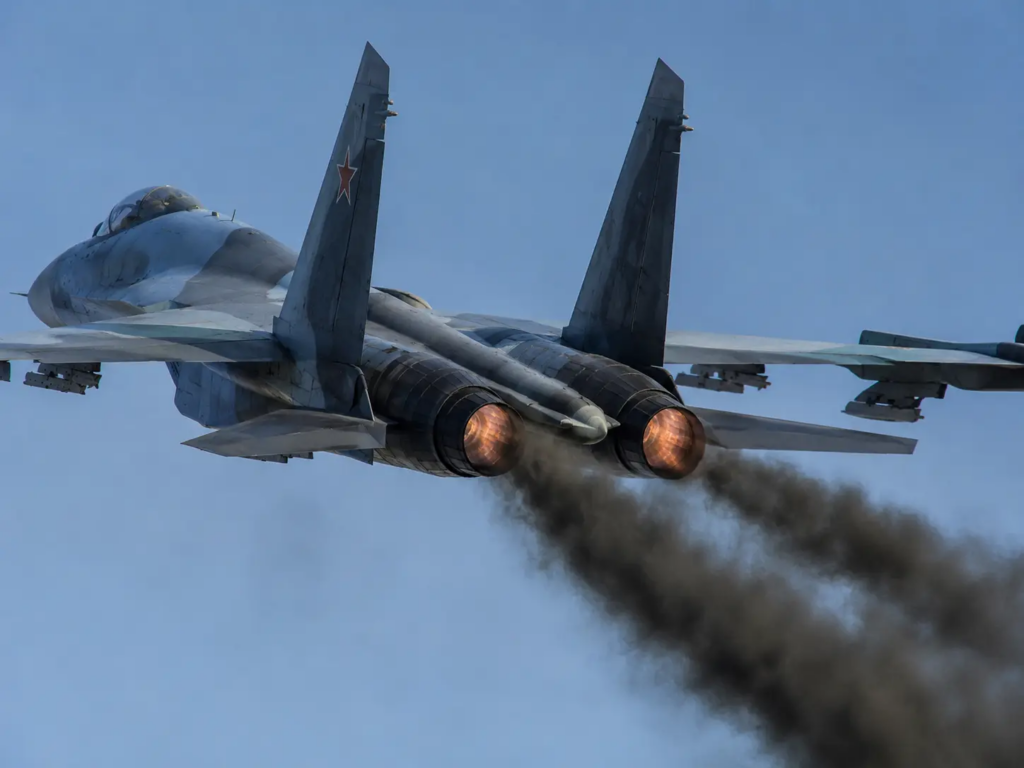
For decades, aviation enthusiasts and military observers have noticed a striking difference between many Russian and American fighter jets: Russian aircraft often leave behind visible black smoke trails, while their US counterparts typically fly with little to no visible exhaust.
The phenomenon has less to do with maintenance standards and more to do with engineering choices made during the Cold War. In many cases, the smoky exhaust seen behind older Russian fighters is the result of deliberate design trade-offs that prioritised reliability and performance under combat conditions.
Although newer Russian engines have reduced the issue significantly, the characteristic dark trails remain a familiar sight on many legacy aircraft.
Why Do Some Russian Fighter Jets Produce Visible Smoke?
The primary reason lies in how certain older Soviet-era jet engines burn fuel.
Aircraft such as the Mikoyan MiG-29 are powered by twin Klimov RD-33 turbofan engines, which were designed during the Cold War with a strong emphasis on combat reliability.
The Over-Rich Fuel Mixture Strategy
To reduce the risk of engine stalls during aggressive aerial maneuvers, the RD-33 engine often operates with a fuel-rich mixture.
In simple terms, more fuel is injected into the combustion chamber than can be completely burned with the available oxygen.
This approach helps maintain stable engine operation during sudden throttle changes and high-stress combat maneuvers, but it comes with a side effect: incomplete combustion.
How Does Incomplete Combustion Create Smoke?
When excess fuel enters the combustion chamber, not all of it combines with oxygen and burns efficiently.
Carbon Particles Become Visible Exhaust
Inside the engine, extremely high temperatures break down some of the unburned kerosene through a process known as thermal cracking.
This process creates tiny carbon particles, commonly known as soot.
The engine then expels these particles through the exhaust nozzle, creating the dark smoke trails that can be seen behind the aircraft.
Unlike water vapor condensation trails (contrails), these exhaust plumes consist largely of carbon-based particles generated during incomplete combustion.
Why Don’t Most Modern US Fighter Jets Produce Similar Smoke?
The United States largely addressed the issue decades ago after analyzing combat experiences during the Vietnam War.
Military planners recognized that visible smoke could reveal an aircraft’s position and compromise its survivability in air-to-air combat.
Advanced Fuel Injection Systems
Beginning in the 1970s, American engine manufacturers introduced more sophisticated combustion technologies.
Engines such as the Pratt & Whitney F100 incorporated advanced air-blast fuel injectors that atomize fuel into extremely fine droplets before combustion.
This allows fuel and air to mix more thoroughly, resulting in:
- More complete combustion
- Reduced soot production
- Improved fuel efficiency
- Lower visible emissions
As a result, modern US fighter aircraft typically produce little visible smoke during normal operation.
Is Smoke a Tactical Disadvantage?
Yes—particularly in visual-range combat.
Easier Detection by Enemy Pilots
A dark exhaust trail can make an aircraft significantly easier to spot against the sky.
In favorable conditions, opposing pilots may visually detect a smoking aircraft from more than 10 kilometers away, even without radar assistance.
During the Cold War, when many aerial engagements still relied heavily on visual identification, this visibility could become a serious disadvantage.
The smoke effectively acts as an aerial breadcrumb trail, revealing an aircraft’s location and direction of travel.
Impact on Air Combat
Visible exhaust can:
- Increase the chance of visual detection
- Make tracking easier during dogfights
- Reduce the element of surprise
- Aid enemy pilots in maintaining visual contact
However, Soviet designers often considered these drawbacks acceptable compared with the benefits of improved engine stability and reliability.
Why Didn’t Soviet Engineers Eliminate the Smoke Earlier?
The answer lies in differing military priorities.
Reliability Over Refinement
Soviet aircraft design traditionally emphasized:
- Mechanical simplicity
- Ease of maintenance
- Ruggedness
- Operation from austere airfields
- Reliability in demanding conditions
Engineers frequently accepted certain inefficiencies if they improved durability and combat readiness.
The visible exhaust from engines such as the RD-33 was therefore not viewed as a critical flaw but rather as a manageable consequence of a broader engineering philosophy.
Have New Russian Engines Solved the Problem?
To a large extent, yes.
Modern Russian engine manufacturers have introduced improvements that significantly reduce smoke emissions.
RD-33MK and Other Upgrades
Newer engines such as the Klimov RD-33MK feature redesigned combustion chambers and improved fuel-management systems.
These modifications allow fuel to burn more completely, reducing soot formation and visible exhaust.
Many modern Russian aircraft therefore produce considerably less smoke than their Cold War-era predecessors.
However, large numbers of older aircraft remain in service around the world, meaning the distinctive dark trails are still commonly observed during exercises, demonstrations, and operational flights.
Is Visible Smoke a Sign of Poor Maintenance?
Not necessarily.
One of the most common misconceptions is that smoky exhaust indicates an engine malfunction or inadequate maintenance.
In reality, visible smoke on many older Russian fighters is often a normal characteristic of the engine’s design.
While maintenance issues can certainly contribute to excessive smoke in any aircraft, the phenomenon is primarily linked to combustion design rather than mechanical neglect.
The Bigger Picture: Engineering Trade-Offs in Military Aviation
The contrast between Russian and American fighter exhaust highlights a broader reality of military aviation: every aircraft design involves compromises.
US manufacturers prioritized cleaner combustion and reduced visual signatures.
Soviet designers often prioritised engine reliability during extreme combat manoeuvres, even if that meant accepting visible exhaust.
Neither approach was inherently right or wrong. Each reflected different operational requirements, technological capabilities, and military doctrines of the era.
As modern engine technology advances, however, the gap has narrowed considerably, and newer Russian fighters are far less likely to leave behind the dramatic smoke trails that once became their defining visual signature.
TL;DR
- Older Russian fighter jets often produce visible smoke because their engines run fuel-rich mixtures to improve reliability during combat maneuvers.
- Excess fuel can burn incompletely, creating carbon particles that appear as black exhaust.
- US military aircraft largely eliminated the problem after the Vietnam War through advanced fuel-injection technology.
- Visible smoke can make aircraft easier to detect and track during aerial combat.
- Newer Russian engines, including the RD-33MK, feature improved combustion systems that significantly reduce smoke emissions.
- The smoke is generally an engineering trade-off rather than a sign of poor maintenance.