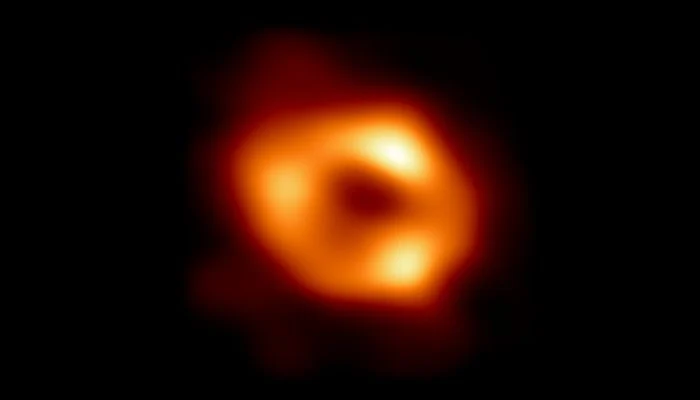
Astronomers have discovered an extraordinary star near the center of the Milky Way that reaches speeds of about 25,000 kilometers per second—roughly 8.5% of the speed of light—as it swings close to the galaxy’s supermassive black hole, Sagittarius A*. The star, designated S301, completes an orbit in about 8.7 years and comes closer to the black hole than any other known star.
The discovery, made by researchers at the Max Planck Institute for Extraterrestrial Physics (MPE) and the GRAVITY+ collaboration, could give astronomers an unusually direct way to measure how fast Sagittarius A* spins. The results were reported in Nature, while MPE released supporting material on August 19, 2026.
What makes S301 particularly valuable is not simply its speed. Its highly elongated orbit takes it into a region where the rotation of the black hole should leave a measurable imprint on the fabric of spacetime.
Why is S301 moving so fast around Sagittarius A*?
S301 follows a highly eccentric, elongated orbit around Sagittarius A*. For most of its journey, the star remains much farther from Sagittarius A*. But as it approaches its closest point, known as pericenter, the black hole’s immense gravity accelerates it dramatically.
At its peak, S301 reaches approximately 25,000 km/s, or around 8%–8.5% of the speed of light.
Its closest approach is just over 12 astronomical units (AU) from Sagittarius A*. One astronomical unit is the average distance between Earth and the Sun, so S301 gets to roughly the distance between the Sun and Saturn.
That is extraordinarily close on the scale of the Galactic Center.
S301’s orbit also undergoes a gradual rotation, producing a rosette-like path. This is an effect known as Schwarzschild precession, caused by the curvature of spacetime around the black hole. Astronomers have already observed this relativistic effect in other stars near Sagittarius A*.
But S301 offers something new.
How can S301 reveal whether Sagittarius A* is spinning?
A black hole’s rotation does more than make the black hole spin in place. According to general relativity, a rotating massive object drags the surrounding spacetime with it.
This phenomenon is called frame dragging, or the Lense-Thirring effect.
An easy way to picture it is to imagine a heavy object rotating in a flexible fabric. The rotation does not simply affect the object itself; it twists the surrounding fabric. Near a rapidly rotating black hole, the effect becomes much stronger.
S301 passes close enough to Sagittarius A* that its orbit should be affected by this frame dragging. Each close passage can therefore leave a tiny change in the star’s trajectory.
The challenge is that the change is extremely small.
MPE estimates that, after several years, the predicted paths for a rotating and non-rotating Sagittarius A* could differ by roughly the scale of Earth’s orbit around the Sun. That sounds enormous, but across the roughly 26,000-light-year distance to the Galactic Center, detecting such a difference requires extraordinary precision.
Why the star is effectively a natural experiment
Astronomers cannot simply photograph a black hole’s surface and measure its rotation. A black hole does not have a visible solid surface, and the region around its event horizon is governed by extreme gravitational physics.
Instead, researchers can watch objects moving through its gravitational field.
Stars such as S301 function as test particles: their positions and velocities provide information about the gravitational environment around Sagittarius A*. By measuring how the orbit changes, scientists can test predictions made by general relativity and potentially determine the black hole’s spin.
That makes S301 more than an unusual fast-moving star. It is effectively a cosmic measuring instrument.
What is special about S301’s orbit?
S301 has an orbital period of approximately 8.7 years, making it one of the tightest-known stellar orbits around Sagittarius A*.
Its orbit is also extremely eccentric. This matters because an elongated orbit repeatedly brings the star into the strongest part of the black hole’s gravitational field.
The closer the star gets, the more pronounced relativistic effects become.
Researchers therefore have several advantages when studying S301:
- Short orbital period: Astronomers do not have to wait decades for repeated observations.
- Extreme eccentricity: The star repeatedly approaches the region where relativistic effects are strongest.
- Very high velocity: Its motion makes relativistic corrections more significant.
- Close pericenter: The star enters a region where frame dragging may be measurable.
- Long-term tracking: Small changes can accumulate over successive passages.
MPE says S301 approaches Sagittarius A* closer than any previously known star and could allow scientists to constrain the black hole’s rotation within the next decade.
Could S301 have been stolen from a binary star system?
The star’s unusual orbit may also preserve clues about its past.
Researchers suggest S301 may once have been part of a binary star system—two stars gravitationally bound to each other. As such a system passed close to Sagittarius A*, the black hole’s tidal forces could have disrupted it.
This scenario is known as the Hills mechanism.
In a simplified version of the process:
- A binary system approaches the supermassive black hole.
- Sagittarius A* exerts a much stronger gravitational pull on the two stars than they exert on each other.
- The binary is torn apart.
- One star becomes tightly bound to the black hole.
- The other can be flung outward at extremely high speed.
S301’s highly eccentric orbit is consistent with the possibility that it was the captured member of such a disrupted binary. Researchers are interested in finding the hypothetical companion because its discovery could provide a stronger test of this origin scenario. (ResearchGate)
This does not mean astronomers have established that S301 definitely came from a binary. It remains an interpretation of the star’s trajectory and should be presented as such.
Why does measuring the black hole’s spin matter?
Determining the spin of Sagittarius A* would be more than another measurement in an astronomical catalog.
It would provide a powerful test of Einstein’s general theory of relativity in one of the most extreme environments available to astronomers.
One important prediction concerns the Kerr metric, the mathematical description of spacetime around a rotating black hole.
Another is the no-hair theorem. In simplified terms, the theorem predicts that an astrophysical black hole can be completely characterized by a small number of fundamental properties, principally its mass, angular momentum and electric charge. For an effectively uncharged black hole such as Sagittarius A*, measuring its mass and spin places strong constraints on its gravitational field.
S301 could therefore become a tool for testing whether the behavior of spacetime near Sagittarius A* matches these predictions.
How did astronomers detect such a faint star?
Finding S301 was itself a technical achievement.
The star is faint and sits in one of the most crowded regions of the sky. Much brighter stars surround Sagittarius A*, making the signal from S301 difficult to isolate.
Researchers used observations from the GRAVITY instrument at the European Southern Observatory’s Very Large Telescope Interferometer (VLTI). GRAVITY combines light collected by multiple telescopes to achieve extremely high angular resolution.
The MPE team developed new data-analysis techniques to extract S301’s faint signal from the surrounding stellar environment. The resulting measurements allowed researchers to reconstruct its orbit and determine that the star ventures exceptionally close to Sagittarius A*.
When will scientists get the best chance to measure the effect?
The key moment will come during S301’s closest approach to Sagittarius A*.
According to the research timeline provided in the source material, the star is expected to reach pericenter toward the end of 2031. That passage should produce the strongest measurable influence of the black hole’s spin on its trajectory.
Astronomers will then compare the observed path with increasingly precise predictions for how the star should move around a rotating black hole.
Future observations will be particularly important. The GRAVITY instrument can continue tracking the star’s position, while instruments planned for the European Southern Observatory’s Extremely Large Telescope could provide additional spectroscopic measurements of its motion. MPE says these observations could help constrain Sagittarius A*’s spin over the coming decade.
What could S301 tell us about the Milky Way’s central black hole?
S301 gives scientists an unusual opportunity because it combines three things that are rarely available together: proximity, speed and a short orbital period.
If its orbit changes exactly as predicted, researchers will gain a new measurement of the relativistic environment around Sagittarius A*. If the observed motion differs from theoretical predictions, that discrepancy could prompt further investigation into the black hole’s environment or the underlying physics.
The goal is not to prove that black holes are mysterious objects. It is to turn an extreme cosmic environment into a laboratory.
Astronomers have already used stellar orbits around Sagittarius A* to establish the presence and mass of the Milky Way’s central supermassive black hole. The star S2, for example, has provided important measurements of relativistic effects and follows a much longer orbit.
S301 takes that experiment closer to the limit.
The next decade could be decisive
S301 will continue circling Sagittarius A*, returning repeatedly to the region where the black hole’s gravitational influence is strongest.
Each passage gives astronomers another opportunity to compare theory with observation.
The most important result may therefore not come from S301’s discovery itself, but from what happens after years of tracking. If scientists can measure the tiny orbital changes caused by frame dragging, they could obtain one of the clearest direct measurements yet of a supermassive black hole’s rotation.
And if astronomers eventually find the star’s hypothesized former binary companion racing through the Milky Way, they may also gain a second piece of evidence for how S301 ended up in this extraordinary orbit.
For now, S301 is doing something remarkably useful: flying through the most extreme gravitational neighbourhood in our galaxy and carrying information about the black hole back to Earth.
TL;DR
- S301 is a newly identified star orbiting Sagittarius A*, the Milky Way’s central supermassive black hole.
- It reaches about 25,000 km/s, or roughly 8%–8.5% of the speed of light.
- Its closest approach is just over 12 AU, approximately the Sun-Saturn distance.
- S301 completes an orbit in about 8.7 years.
- Its close passage could make the Lense-Thirring frame-dragging effect measurable.
- Tracking that effect could allow astronomers to determine the spin of Sagittarius A*.
- Its highly eccentric orbit may indicate that S301 was once part of a binary system disrupted by the black hole.
- The star’s closest approach around 2031 could be especially important for testing these predictions.