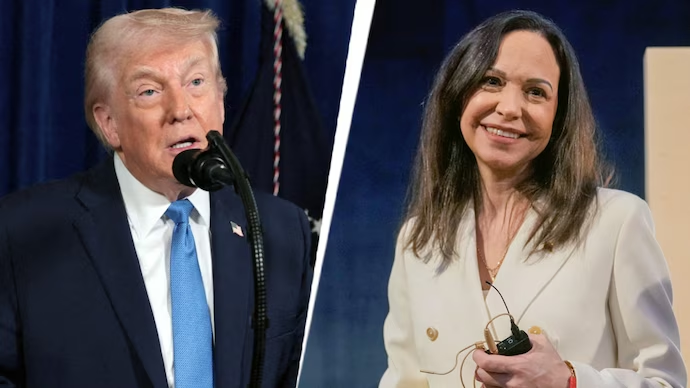
Within hours of Venezuelan opposition leader Maria Corina Machado saying she wanted to share her Nobel Peace Prize with US President Donald Trump, the Norwegian Nobel Institute stepped in with a blunt clarification: Nobel prizes cannot be transferred, shared, or retroactively reassigned. Once announced, the decision is final, forever.
The episode, while procedural on the surface, opens a wider window into how the Nobel Peace Prize works, why its rules matter, and what this moment reveals about Venezuela’s turbulent politics and Trump’s unconventional global role.
This article explains the rules behind the Nobel Peace Prize, the political context driving Machado’s gesture, and why the Institute’s response was inevitable.
What is the Nobel Peace Prize, and who controls it?
The Nobel Peace Prize is unique among the Nobel awards, both in spirit and structure.
Unlike the science and literature prizes, which are awarded by Swedish institutions, the Peace Prize is decided by the Norwegian Nobel Committee, a five-member body appointed by Norway’s parliament. The committee operates independently of the Norwegian government, but its authority over the prize is absolute.
Once the committee announces a winner:
- The decision cannot be reversed.
- The prize cannot be split beyond what was announced.
- The prize cannot be transferred or “dedicated” in a legal sense to another person.
The Norwegian Nobel Institute, which serves as the committee’s secretariat, emphasized this point after Machado’s comments, saying the award decision “stands for all time.”
Why this rigidity matters is often overlooked—but it’s central to the Nobel brand.
Why are Nobel Prizes intentionally non-transferable
Alfred Nobel’s will, which governs the prizes, was written to prevent political bargaining, post-award pressure, or symbolic reassignments. If winners could later share or redirect awards:
- Governments could coerce laureates.
- Political alliances could retroactively reshape decisions.
- The committee’s independence would be weakened.
In short, the rules protect the prize from becoming a diplomatic bargaining chip.
What exactly did Maria Corina Machado say?
Machado, a leading figure in Venezuela’s opposition movement, said she wanted to share her Nobel Peace Prize with Trump following US actions targeting Venezuelan President Nicolás Maduro.
Speaking to Fox News host Sean Hannity, Machado framed the award as belonging not just to her, but to Venezuelans broadly.
“I certainly would love to be able to personally tell him that we believe—the Venezuelan people, because this is a prize of the Venezuelan people—certainly want to give it to him and share it with him,” she said.
Her remarks were symbolic, not procedural. But symbolism matters, especially when it involves the Nobel Peace Prize.
The political message behind the dedication
Machado’s statement wasn’t about prize mechanics. It was about signaling alignment.
By invoking Trump, she aimed to:
- Credit US pressure for weakening Maduro’s grip on power.
- Reinforce international backing for Venezuela’s opposition.
- Elevate Trump’s role as decisive in confronting Maduro.
For Machado, Trump’s administration represented action where diplomacy had stalled.
Why Trump is central to this story
Trump’s involvement in Venezuela has been unusually direct by US standards.
Under his leadership, the US supported efforts that culminated in the capture of Nicolás Maduro, who faces drug trafficking charges in New York. Trump has since backed Delcy Rodríguez, Maduro’s former vice president, as acting president, a move that reshaped Venezuela’s political landscape overnight.
In response to Machado’s comments, Trump offered measured praise.
He described her as a “very nice woman” but questioned her level of domestic support inside Venezuela. At the same time, he said her interest in sharing the Nobel Peace Prize would be a “great honor.”
This dual response, a compliment mixed with skepticism, is typical of Trump: personal warmth paired with political leverage.
Why the Nobel Institute had to step in
The Norwegian Nobel Institute’s clarification was not optional. It was necessary.
When public figures suggest altering the meaning or ownership of the prize, silence can be misread as consent. By issuing a clear statement, the Institute reaffirmed three principles:
- The committee alone determines recipients.
- Laureates cannot modify the award’s legal status.
- Political developments after the announcement are irrelevant.
This isn’t the first time the Institute has drawn such a line. Past laureates have attempted to redirect prize money, dedicate awards to movements, or frame prizes as collective property. While personal symbolism is allowed, institutional change is not.
Why this matters beyond Nobel rules
At a deeper level, this episode highlights how global awards are increasingly pulled into geopolitical narratives.
For Venezuela, the Nobel Peace Prize is not just recognition, it’s legitimacy. For Machado, tying that legitimacy to Trump strengthens her international posture, especially with conservative and US-aligned audiences.
And for Trump, the association reinforces a self-crafted image: the dealmaker who succeeds where institutions fail.
And for the Nobel Committee, this is exactly the scenario its rules were designed to prevent—where a peace prize becomes a proxy battleground for contemporary power struggles.
What this says about Venezuela’s political moment
Venezuela is in a fragile transition. Maduro’s legal troubles in the US, the installation of an acting president, and the opposition’s search for international backing have created a rare opening.
Machado’s gesture reflects urgency. By elevating Trump, she underscores a belief shared by many Venezuelans: that external pressure, not internal negotiation, forced change.
But that strategy carries risks.
- It ties Venezuela’s future to a single foreign leader.
- It alienates international actors who view US involvement skeptically.
- It blurs the line between national recognition and personal diplomacy.
Can a Nobel Peace Prize ever be symbolically shared?
Yes—but only informally.
Laureates can say their work reflects collective effort. They can donate prize money. They can thank allies, governments, or movements. What they cannot do is redefine the award itself.
Machado can praise Trump.
She can credit US actions.
She can even dedicate her acceptance speech to him.
But the Nobel Peace Prize will remain, in every legal and historical sense, hers alone.
Why the rules are unlikely to change
The Nobel Committee has little incentive to loosen its framework.
Changing the rules would:
- Invite lobbying after every controversial award.
- Undermine public trust in the process.
- Turn Nobel announcements into provisional decisions.
In an era where institutions are already under strain, predictability is the Nobel Prize’s greatest defense.
TL;DR
Maria Corina Machado’s wish to share her Nobel Peace Prize with Donald Trump was symbolic, not procedural. The Norwegian Nobel Institute quickly clarified that Nobel prizes cannot be transferred, shared, or altered after announcement. The episode underscores how global awards intersect with high-stakes politics, particularly amid Venezuela’s fragile transition and Trump’s outsized role in recent events.