
Quick Summary
Microsoft is facing a rare employee rebellion over its contracts with Israel. The company sought FBI help to monitor protests, suspended and fired dissenters, and tightened event security. But activists continue to disrupt events, stage sit-ins, and pressure executives, raising big questions about tech’s role in war and the limits of workplace activism.
Why are Microsoft employees protesting?
For more than a year, Microsoft has been facing an internal revolt from employees demanding that the company cut business ties with Israel over its war in Gaza. The movement, led by a group calling itself No Azure for Apartheid, accuses Microsoft of enabling human rights abuses through contracts that provide cloud computing and artificial intelligence services to the Israeli military.
While the company denies its products are used to harm civilians, the accusations have sparked sustained protests, resignations, and public disruptions that have pushed Microsoft into a rare political firestorm.
Microsoft’s crackdown: surveillance, suspensions, and the FBI
Bloomberg reports that Microsoft has taken extraordinary measures to contain the unrest:
- Contacting the FBI: Internal documents show Microsoft sought intelligence from the Federal Bureau of Investigation on potential pro-Palestinian protests targeting the company.
- Flagging internal communications: Emails containing words like “Gaza” were reportedly monitored, and some protest-related posts were deleted.
- Disciplinary action: Several employees were suspended or fired after disrupting company events or staging protests on corporate property.
- Event security: Ahead of its annual Build developer conference, Microsoft coordinated with local police, installed airport-style checks, and banned activist signage inside venues.
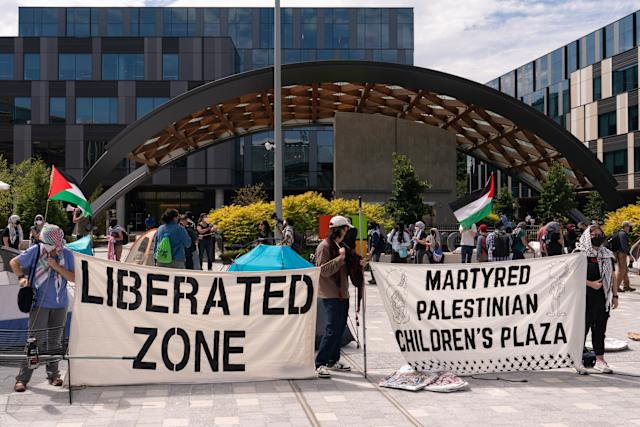
Despite these measures, protests have continued, often spilling beyond company walls. In recent weeks, activists declared a “liberated zone” outside Microsoft’s Redmond headquarters, pitched tents, and staged sit-ins before being dispersed by police.
High-profile disruptions inside Microsoft
Employee dissent, once confined to internal message boards, burst into public view at Microsoft’s 50th anniversary celebration earlier this year.
- Two engineers, Vaniya Agrawal and Ibtihal Aboussad, staged back-to-back protests during speeches by top executives, including CEO Satya Nadella and AI chief Mustafa Suleyman. Their actions, broadcast online, went viral and drew global attention.
- Another employee, Joe Lopez, stood on a chair during Nadella’s keynote at the Build conference, accusing Microsoft of “perpetuating war crimes.” He was removed by security and later fired.
- Protests have even reached the homes of Nadella and President Brad Smith, with demonstrators in kayaks chanting from nearby waters.
These dramatic acts of defiance highlight the unusual persistence of employee activism at Microsoft, even as job insecurity and crackdowns across the tech sector have quieted similar movements elsewhere, such as at Google.
What Microsoft says about its Israel contracts
The controversy intensified after reports in The Guardian and other outlets suggested that Israel’s military surveillance agency had intercepted millions of Palestinian phone calls, allegedly storing them on Microsoft servers and using the data to select bombing targets.
Microsoft denies wrongdoing. The company says an internal investigation found no evidence its products were used to harm civilians or that Israel violated its terms of service.
Brad Smith, Microsoft’s president, has emphasized that:
- Customers must comply with international human rights law.
- Microsoft’s terms of service prohibit using its software to violate human rights.
- The company will “take steps” if a customer is found in violation.
At the same time, Smith has drawn a line: internal discussion is permitted, but disruptions and vandalism, particularly by non-employees, are treated as law enforcement matters.
Why this matters: the collision of tech, politics, and protest
Microsoft has long enjoyed a reputation for avoiding major political and ethical controversies compared to peers like Meta and Google. That relative stability is now under strain as one of the world’s most valuable companies is pulled into the global debate over Israel’s war in Gaza.
The stakes are high:
- For employees: The protests test the limits of workplace activism in a tightening job market. Organizers admit only a few hundred staffers are involved, but even this small faction has disrupted major corporate events.
- For Microsoft: Its image as a responsible global actor is at risk if it is seen as suppressing free expression or enabling military abuses.
- For the tech industry: Microsoft’s tactics—turning to federal law enforcement and aggressively managing protests—could set a precedent for how other firms handle internal dissent on political issues.
Where the movement goes from here
Protesters in No Azure for Apartheid say their goal is to force Microsoft to end its contracts with Israel, an outcome that would be unprecedented for a U.S. technology giant. They have vowed to continue demonstrations, citing inspiration from university campus occupations earlier this year.
Still, they face uphill challenges. Many employees remain silent, wary of retaliation. Public sympathy for corporate activism has also waned under the Trump administration’s crackdown on pro-Palestinian demonstrations.
Yet the persistence of this movement suggests Microsoft cannot easily escape the crossfire of one of today’s most divisive geopolitical issues. Whether the company doubles down on discipline or reconsiders its defense contracts may determine not just its internal stability, but also its reputation in the broader public eye.