
Elizabeth Holmes is back in the spotlight, but this time she is not pitching a revolutionary blood-testing machine or defending Theranos on a courtroom stage.
A new documentary, “You Can See Everything,” gives viewers an unusually intimate look at Holmes in the weeks before she reported to federal prison in 2023. The film, directed by Nathan Fielder and Lance Oppenheim, was kept largely secret for three years before its surprise premiere at the Telluride Film Festival on September 6.
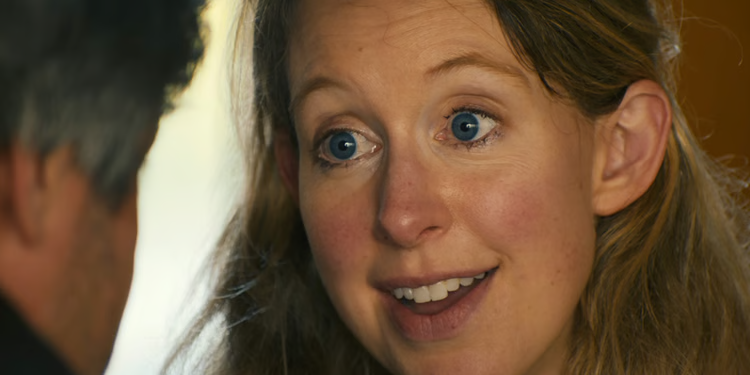
A24 released the first trailer shortly afterward, showing Holmes sitting across from Fielder and repeatedly insisting that she is being completely honest with him.
The result is not a conventional true-crime documentary. Early reviews describe it as an increasingly strange examination of Holmes, her family, her determination to maintain her version of events and the filmmakers’ own struggle to understand what they were witnessing.
Why did Elizabeth Holmes let filmmakers into her home?
The documentary begins 34 days before Holmes was due to surrender to federal authorities.
According to the film’s synopsis, Holmes invited the filmmakers to document her daily life because she wanted an opportunity to be understood beyond the public image created by the Theranos scandal and her criminal conviction.
Holmes and her partner, Billy Evans, embraced what the filmmakers described as “radical transparency,” effectively opening their home and personal lives to the cameras.
The project was supposed to provide a closer look at a woman whose public reputation had already been shaped by years of news coverage, courtroom testimony and documentaries.
Instead, Fielder and Oppenheim found themselves questioning whether they were seeing Holmes as she really was.
What does the trailer reveal about Holmes?
The teaser is built around an uncomfortable conversation between Holmes and Fielder.
Looking directly at him, Holmes insists that she is not the person the public believes her to be and says she has no reason to deceive him.
“I don’t have anything to deceive you on. Of course I’m not deceiving you,” she tells him in the trailer.
Fielder responds by asking whether she is “being real” with him.
Holmes answers emphatically that she is “always being real.”
The camera then pulls back, revealing Holmes’ baby nearby in a bouncer, abruptly turning an intense interrogation-like moment into an ordinary scene of family life.
That contrast appears to capture the strange tone of the documentary itself.
Who directed ‘You Can See Everything’?
The film was co-directed by Nathan Fielder and Lance Oppenheim.
Fielder is best known for projects such as “Nathan for You,” “The Rehearsal” and the HBO series “The Curse,” works that frequently blur the boundary between documentary, comedy, performance and reality.
Oppenheim is a documentary filmmaker whose work often focuses on unusual personalities and intensely personal environments.
Their combination makes the Holmes project particularly unconventional. Rather than simply recounting the Theranos scandal, they appear to have turned their own attempt to understand Holmes into part of the story.
How long were the filmmakers working on the documentary?
The project was made over roughly three years.
Although filming began around the time Holmes was preparing to enter prison, the documentary continued long after she was incarcerated.
The filmmakers’ access changed substantially once Holmes entered prison. Evans became their principal connection to Holmes and eventually took on a larger role in managing her affairs and communicating with the production.
That extended production period transformed the film from a snapshot of Holmes’ final days outside prison into a much broader examination of her life and the people around her.
Why did the film premiere in secret?
Telluride Film Festival organizers went to extraordinary lengths to protect the documentary’s surprise.
The film occupied a mystery screening slot that had been kept secret from festivalgoers. Attendees were required to place their phones in security pouches, and the audience was warned that security staff would be watching for unauthorized devices.
The effort worked.
The audience did not know it was about Holmes until Fielder and Oppenheim walked onto the stage before the screening.
That secrecy also protected the documentary’s major twists, which reviewers have urged audiences not to spoil for others.
What happens after Holmes goes to prison?
The documentary changes considerably once Holmes begins serving her sentence.
Before prison, the filmmakers have direct access to Holmes, Evans and their children. Afterward, that access becomes indirect.
Evans becomes an important intermediary, while the film increasingly explores the filmmakers’ evolving relationship with the people they are documenting.
According to the Los Angeles Times, Evans eventually attempted to exert greater control over the project, creating tension between him and Fielder. Holmes and Evans have not seen the finished film.
That development appears to be one of the reasons the documentary moves beyond a straightforward portrait of Holmes.
Is ‘You Can See Everything’ a traditional documentary?
Not really.
Reviewers have described the 174-minute film as a hybrid of documentary, psychological portrait, reality television and performance.
The filmmakers appear to deliberately blur the distinction between what is spontaneous and what is staged. The movie reportedly includes elaborate reenactments involving an actress portraying Holmes, further complicating the question of what viewers are actually seeing.
That approach fits Fielder’s broader filmmaking style, in which his presence inside a story becomes part of the story itself.
Here, the central question is not simply “Who is Elizabeth Holmes?”
It is also “What happens when someone who has spent years controlling a public narrative gives filmmakers extraordinary access to her private life?”
What did Nathan Fielder say about filming Holmes?
Fielder has acknowledged that he remains uncertain about exactly what happened during the production.
After the Telluride screening, he said he was still “struggling to this day to understand exactly what I experienced.”
He described a disconnect between his immediate impression of Holmes and his awareness of her history.
That tension became the engine of the film.
Rather than resolving the question of whether Holmes is sincere, manipulative or some combination of the two, the documentary appears to leave the filmmakers wrestling with that uncertainty themselves.
Who is Elizabeth Holmes?
Holmes founded Theranos in 2003 and became one of Silicon Valley’s most celebrated young entrepreneurs.
She claimed Theranos had developed technology capable of performing a broad range of medical tests using only tiny amounts of blood.
The company attracted billions of dollars in investment and partnerships with major corporations before investigative reporting exposed serious problems with its technology and business practices.
Theranos collapsed, and Holmes was ultimately convicted of defrauding investors.
She was sentenced to more than 11 years in federal prison.
Why was Holmes sentenced to prison?
A federal jury convicted Holmes in 2022 on four counts involving conspiracy and wire fraud against Theranos investors.
Prosecutors argued that Holmes and other executives misled investors about the company’s technology, business relationships and financial condition.
The conviction marked the dramatic end of her transformation from Silicon Valley wunderkind to one of the most notorious figures in the technology industry.
Holmes has continued to maintain that she is innocent, including in her first interview from prison with PEOPLE in 2025.
Where is Elizabeth Holmes now?
Holmes is serving her sentence at Federal Prison Camp Bryan in Texas.
Her original sentence of more than 11 years was later reduced through good-conduct credit, according to PEOPLE. She is currently expected to remain incarcerated until 2031.
Her imprisonment also changed the documentary itself.
The woman once capable of controlling the narrative around one of Silicon Valley’s most celebrated startups could no longer simply walk into a television studio or hold a press conference.
That made the filmmakers’ access to her private world all the more unusual.
Does the documentary show Elizabeth Holmes admitting wrongdoing?
No.
The trailer instead emphasizes the opposite.
Holmes repeatedly insists that she is “real” and has nothing to deceive Fielder about. Those statements are presented as part of the filmmakers’ broader investigation into how Holmes understands herself and how she believes others perceive her.
The documentary does not change the legal record surrounding Theranos.
Holmes remains a convicted fraudster under US law, regardless of how she characterizes herself in the film.
Why is the documentary generating so much attention?
The Theranos story has already been told through books, podcasts, news investigations and Hulu’s 2022 drama series “The Dropout,” starring Amanda Seyfried.
“You Can See Everything” takes a completely different route.
Instead of recreating the past, it puts the convicted founder herself at the center of the camera and allows viewers to watch her interact with filmmakers who know exactly what happened to Theranos.
That creates an unusual psychological tension.
The audience knows the history. Holmes knows the audience knows the history. Fielder knows the audience knows it. And the documentary appears to ask what happens when all of those layers collide in the same room.
What is the movie’s biggest twist?
The filmmakers are deliberately keeping much of the film’s structure secret.
The documentary reportedly evolves from an intimate observational portrait into something much more surreal, including reenactments and increasingly complicated questions about who is controlling the story.
That transformation is reportedly one of the reasons Telluride organizers went to such lengths to keep the film’s identity and contents secret.
Even Fielder has encouraged audiences to see the movie without knowing where it goes.
When will ‘You Can See Everything’ be released?
A24 plans to release “You Can See Everything” theatrically in October 2026.
The company has not treated the film as a conventional documentary rollout. Its first public screening happened without advance announcement, and the trailer was released immediately after the Telluride premiere.
That means audiences outside Telluride will soon get a chance to see the film for themselves without relying solely on the increasingly strange reports emerging from the festival.
Why this may be the strangest Elizabeth Holmes story yet
Elizabeth Holmes has spent years at the center of a debate about deception, ambition and credibility.
“You Can See Everything” turns that debate into the method of the film itself.
She says she is being completely honest. The filmmakers try to determine whether they believe her. Then the documentary complicates that relationship until even Fielder says he remains unsure what he experienced.
That makes the movie less about uncovering one final secret about Theranos and more about examining the psychology of belief.
Holmes wants to be seen.
The filmmakers want to see everything.
The title promises exactly that. The real question is whether anyone, including the people holding the cameras, can be certain of what they are seeing.