When Kim Kardashian stepped onto the carpet at the 2026 Met Gala, the reaction was immediate. Cameras flashed, social media erupted, and fashion watchers once again found themselves dissecting every detail of one of the night’s most talked-about looks.
But the real surprise was not the sculpted tangerine breastplate itself. It was where the piece was finished: an auto body shop.
For a fashion event synonymous with couture houses, hand embroidery, and luxury ateliers, Kardashian’s futuristic armor-like ensemble, arriving from a space more associated with repairing cars than dressing celebrities, added an unexpected twist to fashion’s biggest night.
The look blended pop art, industrial craftsmanship, and sci-fi aesthetics into a single statement piece, reinforcing how celebrity fashion increasingly borrows from technology, architecture, and even automotive design.
Why Kim Kardashian’s Met Gala outfit stood out
Kardashian’s appearance marked her 13th Met Gala, and by now, audiences expect spectacle. Yet this year’s outfit managed to feel different even by her standards.
Created in collaboration with creative director Nadia Lee Cohen, costume specialists Whitaker Malem, and British pop artist Allen Jones, the ensemble leaned heavily into a futuristic, AI-inspired visual language.
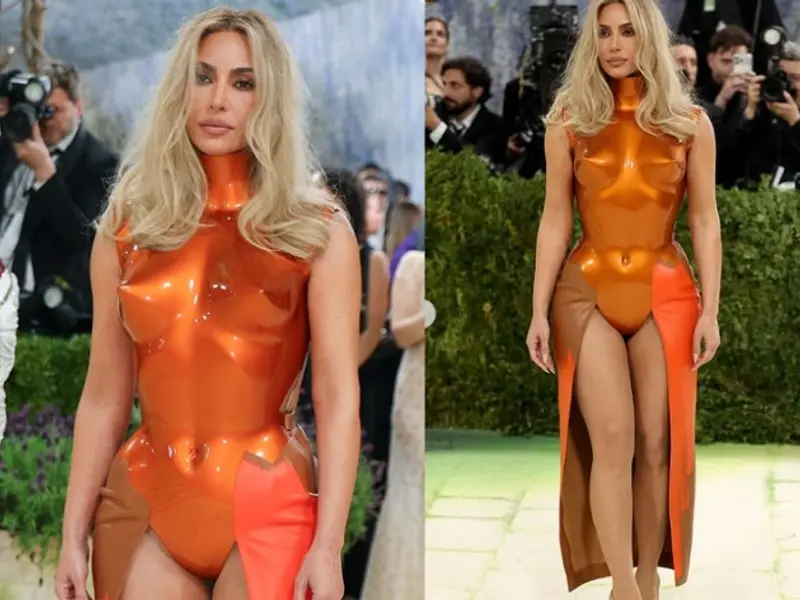
The centerpiece was a glossy fibreglass breastplate sculpted to match Kardashian’s silhouette. The design featured exaggerated contours, a sharply defined waist, and a sculpted navel that gave the outfit the appearance of wearable art rather than traditional fashion.
She paired the structured top with a leather train and muted beige heels, balancing the metallic, almost robotic feel of the upper half with softer styling choices.
The result looked somewhere between retro-futurism and comic-book armor, fitting neatly into this year’s theme, “Fashion Is Art.”
How the outfit was made in an auto body shop
The most unusual detail behind the look emerged after the event, when Allen Jones revealed that the breastplate was painted and finished inside an auto body shop.
That choice was less random than it sounds.
Fiberglass is commonly used in automotive work because it is lightweight, durable, and easy to mold into curved shapes. Those same qualities make it useful for experimental fashion pieces that need to hold dramatic forms without becoming impossible to wear.
According to Jones, the process took roughly three weeks from start to finish. The team sourced the fibreglass material, shaped the structure, and then used automotive painting techniques to achieve the glossy finish seen on the red carpet.
The connection between automotive craftsmanship and couture is growing stronger across fashion. Designers increasingly use industrial materials, including resin, chrome finishes, molded plastics, and 3D-printed components, to create garments that photograph well and stand out in the age of viral social media.
For Kardashian’s outfit, the car-shop finish gave the breastplate a polished, almost machine-made texture that traditional fabric techniques may not have achieved as effectively.
The vintage inspiration behind the futuristic design
Despite its futuristic appearance, the outfit actually drew from decades-old artwork.
Jones explained that the piece repurposed a cast originally created in either 1967 or 1968. That detail adds another layer to the look because it connects modern celebrity fashion to the experimental pop art movement of the late 1960s.
Allen Jones became known for provocative sculptures and furniture-art hybrids during that era, often exploring the relationship between the human body, commercial culture, and objectification. Bringing one of those older molds into a modern fashion event created a bridge between vintage art and contemporary celebrity culture.
Initially, the concept involved a full-body cast. Eventually, the design shifted toward a bodysuit-and-breastplate combination tailored specifically for Kardashian.
That evolution reflects how Met Gala fashion often operates: part runway design, part performance art, and part engineering challenge.
Why industrial fashion is becoming more common
Kardashian’s look is part of a wider shift happening in high fashion.
Luxury fashion is no longer confined to textiles alone. Designers increasingly pull inspiration from:
- Automotive manufacturing
- Robotics
- Artificial intelligence aesthetics
- Space-age architecture
- Industrial materials
- Digital rendering and 3D modeling
This approach works particularly well at events like the Met Gala because the goal is not everyday wearability. The objective is cultural impact.
Outfits are now designed with multiple audiences in mind:
- Red carpet photographers
- Social media platforms
- Meme culture
- Fashion critics
- Short-form video audiences
A sculpted fibreglass breastplate instantly performs better in that environment than a traditional gown because it creates a visual people stop scrolling for.
In many ways, Kardashian’s outfit reflected the modern internet-era reality of celebrity fashion: clothing is no longer just clothing. It is content.
How Kim Kardashian styled the look
While the breastplate carried most of the visual weight, Kardashian kept the rest of her styling intentionally restrained.
She debuted blonde hair for the evening and opted for relatively minimal makeup compared to some of her previous Met Gala appearances. That decision allowed the structure and color of the outfit to remain the focal point.
Interestingly, Kardashian arrived without a celebrity date, despite ongoing public attention surrounding her relationship with Lewis Hamilton. Instead, she attended alongside members of the Kardashian-Jenner family, including her sisters and mother Kris Jenner.
The family’s continued dominance at the Met Gala highlights how the event has evolved beyond fashion into a broader entertainment and media spectacle.
Why the Met Gala remains fashion’s biggest cultural stage
The Met Gala is no longer simply a fundraiser for the Costume Institute at Metropolitan Museum of Art. It has become one of the most influential visual culture events in the world.
Celebrity outfits are analyzed in real time across TikTok, Instagram, YouTube, and fashion publications. A successful look can dominate online conversation for days.
That pressure pushes designers and celebrities toward increasingly unconventional materials and concepts.
Kardashian’s auto-body-shop-crafted ensemble perfectly captured that shift. It combined celebrity branding, industrial design, nostalgia, and internet-ready spectacle into one highly engineered moment.
The irony is hard to miss: one of the world’s most photographed fashion looks was perfected using techniques more commonly associated with custom cars than couture gowns.
And that may be exactly why it worked.
What Kardashian’s look says about the future of fashion
Fashion’s boundaries are expanding rapidly.
As technology, manufacturing, and digital culture continue to merge, designers are experimenting with materials and production methods once considered outside the fashion world entirely.
Kardashian’s Met Gala outfit demonstrated several growing trends at once:
- Fashion inspired by AI and futurism
- Crossovers between industrial design and couture
- Wearable sculpture replacing traditional tailoring
- Vintage art repurposed for modern celebrity culture
- Clothing engineered for online virality
The outfit may not influence everyday wardrobes directly, but it signals where high-concept fashion is heading.
The future runway may look less like a sewing studio and more like a hybrid lab combining sculpture, automotive paintwork, digital modeling, and performance art.
TL;DR
Kim Kardashian’s 2026 Met Gala outfit became one of the night’s biggest talking points not only because of its futuristic design, but because it was completed in an auto body shop. The tangerine fibreglass breastplate, created with artist Allen Jones and creative director Nadia Lee Cohen, used industrial materials and automotive finishing techniques to achieve its glossy sci-fi appearance. The look reflected a growing trend in fashion where celebrity style intersects with technology, sculpture, and internet-driven spectacle.