
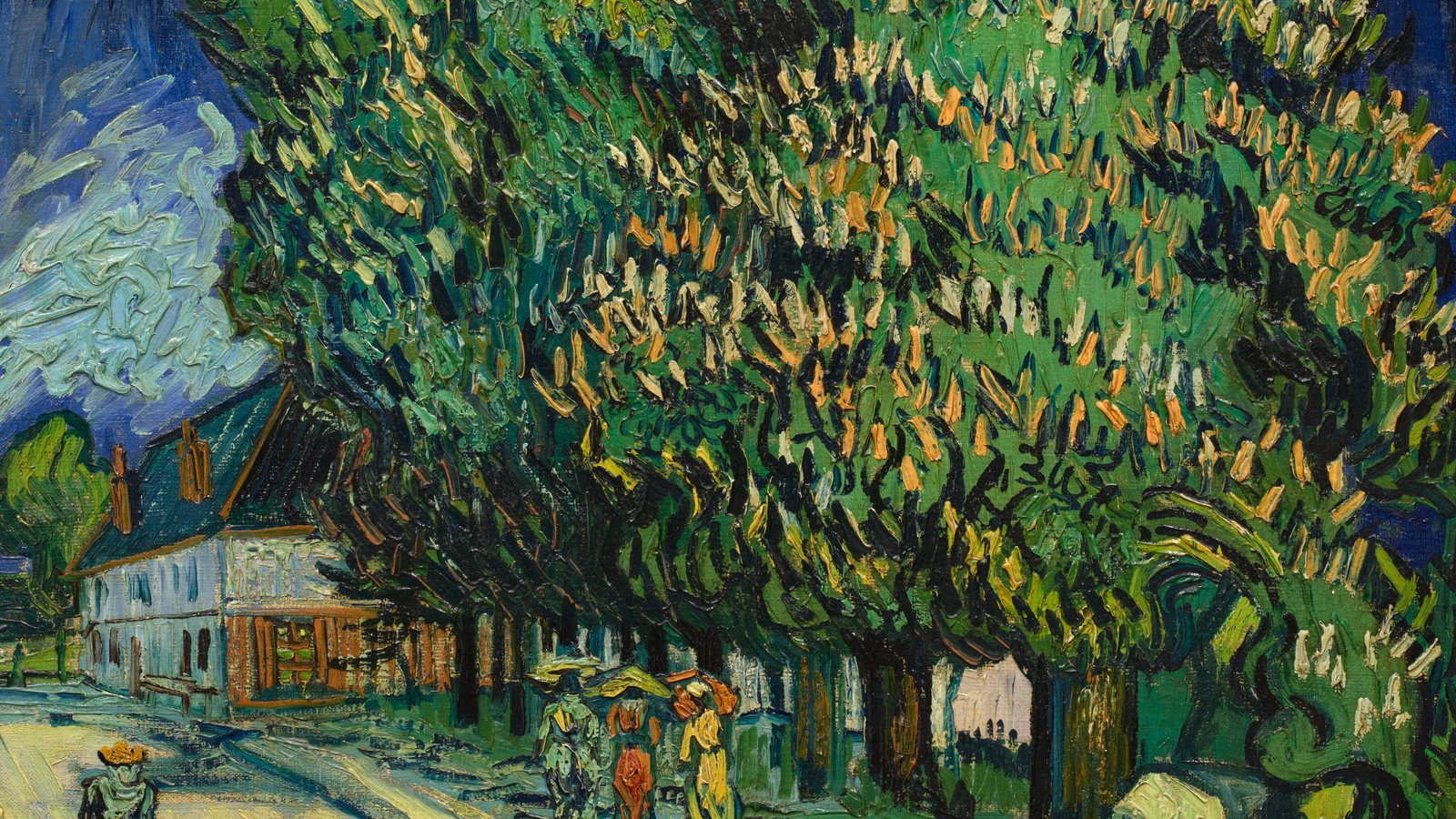

Vincent van Gogh’s Châtaigniers en fleurs (Chestnut Trees in Blossom) sold at Sotheby’s New York on Wednesday, Nov. 18, for $190.4 million including fees. That is a new auction record for the artist, 62% above the $117.2 million that Orchard with Cypresses made at Christie’s in 2022.
The hammer price was $165 million, The Art Newspaper reported. Bidding opened at $135 million and lasted less than four minutes. It was in doubt until the day before, when the seller settled with heirs of a German-Jewish family who had owned it under the Nazis.
What sold, and what the Van Gogh record means
Van Gogh painted the canvas in Auvers-sur-Oise on May 24, 1890, according to Sotheby’s lot page. It measures 70 by 58 centimeters, about 28 by 23 inches. The next day he told his brother Theo he had just finished “a study of chestnut trees.” He died nine weeks later, at 37.
It is not the only chestnut picture from those weeks. The Kröller-Müller Museum in the Netherlands has another chestnut scene from Auvers, which has no people in it. This one shows a house on a road with passers-by under the trees. Sotheby’s catalogues it as F751 in the standard Faille catalogue.
The record is for Van Gogh at auction, not for art in general. Only three works have sold for more at auction, The Art Newspaper noted. They are Leonardo’s Salvator Mundi at $450 million, Klimt’s Portrait of Elisabeth Lederer at $236 million and Warhol’s Shot Sage Blue Marilyn at $195 million.
Sotheby’s has not named the buyer. The winning bid came from William Acquavella, the New York dealer, presumably acting for a client, The Art Newspaper reported. The painting led Legendary: The Blaquier-Arrieta Collection, a 12-lot sale that totaled $412 million with fees, The Boston Globe reported. Cézanne’s Arlequin brought $111 million.
A deal with the Fischer heirs, struck the day before
The seller was the family of the late Argentine collectors Nelly Arrieta de Blaquier and her husband, Carlos Pedro Blaquier, a sugar magnate. They bought the painting in 1975, and until Sotheby’s pre-sale viewings it had not been on public view since.
Its earlier history is what put the sale in doubt. Samuel Fischer, the Berlin publisher, bought it in 1909, and his widow Hedwig inherited it when he died in 1934, according to Sotheby’s provenance. The painting was already on deposit with the Paul Cassirer gallery in Amsterdam. In June 1936, three years into Nazi rule, it went to Henriette and Marcel Kapferer in Paris for $22,000.
Gunnar Schnabel, a Berlin looted-art researcher working with the Fischer heirs, learned of the sale on Nov. 7. He wrote to Sotheby’s on Nov. 12 asking it to delay. The heirs’ question was whether a Jewish family selling in 1936 was ever truly free to say no.
Sotheby’s answer was that this sale was different. “We are aware of the persecution experienced by the Fischer family,” it said. It added that “the circumstances around this transaction were different,” and noted that nobody claimed the painting after the war. Before the deal, Sotheby’s had said it was satisfied the family was free to sell, The Art Newspaper reported.
The two families reached an agreement on Nov. 17. Sotheby’s called it “a mutually satisfactory resolution” reached “in recognition of the painting’s complex Nazi-era history.” The terms are confidential. The heirs said they were “grateful for the trusting and fair negotiation.”
The math behind a $190 million canvas
Van Gogh himself sold only one painting on record in his lifetime, The Red Vineyard. The money in his work went to later owners, and this canvas shows how steep that climb was. The collector Gustave Fayet paid 3,800 francs for it in January 1909, The Art Newspaper found, then worth about $750. The Kapferers paid $22,000 in 1936. The Nov. 18 price is more than 8,000 times that, before any adjustment for inflation.
A painting earns only when it changes hands, and the gain goes to whoever owns it at the time. That is the opposite of a songwriter’s catalogue, which can pay for decades, as Paul McCartney’s royalty fortune shows. Van Gogh’s family let this canvas go in 1905, through the dealer Paul Cassirer.
Paper trails also drive prices well outside the art world. A pulled license hung over Edsel Ford II’s Revology Mustang when it went to auction. Here, a settlement turned an uncertain title into a clean one, and buyers paid for it.
What the settlement leaves open
The deal does not settle the broader question the heirs raised about forced sales in the 1930s. According to The Art Newspaper, it lets the Fischer heirs pursue claims if other paintings from the family’s collection come to market. Schnabel said the outcome “may offer some encouragement to other families who have faced persecution during the Nazi era.”
The painting now goes to a private owner whose name the public may never learn. Sotheby’s has not said whether the buyer plans to lend it, so its next public appearance depends on whoever Acquavella was bidding for.