
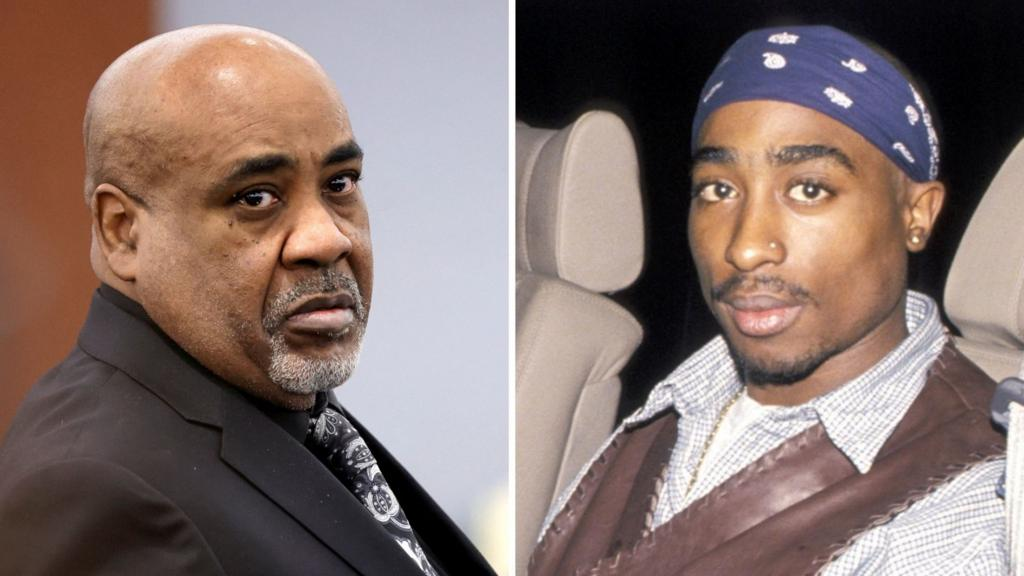
For nearly three decades, Tupac Shakur’s murder remained one of hip-hop’s most enduring mysteries. On September 1, 2026, that mystery reached a major legal turning point when a Las Vegas jury found Duane “Keffe D” Davis guilty of first-degree murder with a deadly weapon in the 1996 killing of the rap icon.
Davis, now 63, was not accused of pulling the trigger. Prosecutors argued that he organized the attack, supplied the firearm and directed the group that confronted Shakur after a fight involving Davis’ nephew, Orlando “Baby Lane” Anderson. Under Nevada law, a person who aids or orchestrates a killing can be held responsible for murder even if another person fires the fatal shots.
The verdict came after a trial that focused heavily on Davis’ own words over the years, including statements in interviews, recordings and his 2019 memoir, “Compton Street Legend.” His defense argued that those accounts were exaggerated stories intended to make money and burnish his reputation. The jury rejected that argument.
Who is Duane “Keffe D” Davis?
Duane Davis, better known by his street name Keffe D, is a former leader of the South Side Compton Crips and a longtime figure in the gang and drug world of Compton, California.
Born in Watts, California, Davis moved with his family to Compton when he was young. In his memoir, he described growing up in a family that initially had ambitions far removed from organized crime. His father won $50,000 betting on horses at the Agua Caliente Racetrack in Tijuana, and the family used the money to buy a home and two cars in Compton.
Davis later became involved in drug dealing and rose through the ranks of the South Side Compton Crips. He has described himself as a “shot caller,” a term used for someone with authority within a gang.
His criminal career eventually included a prison sentence from 1985 to 1989 for drug dealing. Davis later portrayed his time behind bars as a period that hardened him and strengthened his position within the criminal underworld.
How did Davis become connected to Tupac Shakur?
Davis was related to Orlando Anderson, one of the people present during the events that preceded Tupac’s killing.
On September 7, 1996, Davis, Anderson and others were in Las Vegas for the Mike Tyson-Bruce Seldon heavyweight boxing match. Shakur and members of his Death Row Records entourage were also at the MGM Grand.
After the fight, a confrontation broke out involving Shakur’s group and Anderson.
According to prosecutors, that confrontation became the immediate motive for the later shooting.
The prosecution’s theory was that Davis decided to retaliate after Anderson was beaten by members of Shakur’s entourage. Davis and three other men then went looking for Shakur and Death Row Records co-founder Marion “Suge” Knight.
What happened on the night Tupac was shot?
After leaving the MGM Grand, Davis and the other men traveled in a white Cadillac looking for Shakur and Knight.
Later that night, Shakur was riding in a BMW driven by Knight when the Cadillac pulled alongside them at a Las Vegas intersection.
Gunfire erupted from the Cadillac.
Shakur was struck four times. Knight was also wounded, but survived. Shakur was taken to a hospital and died from his injuries six days later, on September 13, 1996. He was 25.
For years, no one was charged in the killing.
The white Cadillac and the people inside it became central to the investigation, but the case remained unresolved for decades.
Did Duane Davis admit his role in Tupac’s murder?
Davis repeatedly discussed the shooting publicly, and those statements eventually became central to the prosecution’s case.
In his 2019 memoir, “Compton Street Legend,” Davis described being in the Cadillac with Anderson, Terrence Brown and DeAndre Smith on the night of the shooting.
He wrote that he obtained a gun and placed it in the back of the vehicle as the group went searching for Shakur and Knight.
Davis described the moment they found the pair in unusually direct language, writing: “No words exchanged, the time for talking had passed, the shit was about to go down!”
The memoir was not the only source.
Davis had also spoken about the killing in interviews and during recordings with investigators. Prosecutors used those changing but recurring accounts to argue that he had repeatedly acknowledged his role in the attack.
What did Davis say about the shooting?
Davis’ accounts changed over time, which became a major point of contention at trial.
In some versions of the story, he suggested the shooting was a response to actions by Shakur. In his memoir, he described a scenario in which Shakur appeared to reach beneath his seat before the shooting, portraying the incident as an escalation rather than a straightforward ambush.
Prosecutors argued that these differences did not erase the most important consistent detail: Davis repeatedly placed himself inside the white Cadillac from which the shots were fired.
The defense took the opposite position.
Davis’ lawyers argued that his stories were unreliable and had been embellished over years of interviews, documentaries and book promotion. They pointed to the lack of physical evidence directly placing Davis at the Las Vegas crime scene and argued that his statements were not enough to prove guilt beyond a reasonable doubt.
The jury ultimately sided with prosecutors.
What role did Orlando Anderson play?
Orlando Anderson was Davis’ nephew and one of the men inside the white Cadillac.
Prosecutors have long identified Anderson as the suspected gunman, although he was never prosecuted for Shakur’s murder.
Anderson died in a 1998 gang-related shooting in Compton, about two years after Shakur’s death. The other men prosecutors say were in the Cadillac, Terrence Brown and DeAndre Smith, also later died.
That left Davis as the only surviving person prosecutors could charge from the group they say carried out the attack.
Importantly, prosecutors did not have to establish that Davis himself fired the fatal weapon.
Their case was that he orchestrated the retaliation and provided the gun, making him criminally responsible for the killing.
Why was Davis not arrested until 2023?
Investigators had been aware of Davis for years.
The major breakthrough came after Davis began publicly discussing his involvement.
Las Vegas police arrested him in September 2023, more than 27 years after Shakur was killed. Authorities said the investigation had been strengthened by Davis’ public statements, his memoir and other evidence.
Police had also searched Davis’ home in July 2023 and seized electronic devices, photographs, computers and other material connected to the case, according to earlier reporting.
The arrest made Davis the first person formally charged in connection with the murder.
What is “Compton Street Legend”?
“Compton Street Legend” is Davis’ 2019 memoir, written with Yusuf Jah.
The book covers Davis’ experiences as a member and leader within the South Side Compton Crips, the origins of his criminal career, his connections to figures around Death Row Records and his accounts of the murders of Tupac Shakur and The Notorious B.I.G.
The book became especially important because Davis openly presented himself as someone with firsthand knowledge of the Tupac shooting.
That turned the memoir into something far more consequential than a celebrity tell-all.
Years later, prosecutors used passages from Davis’ own account as evidence against him.
The defense, meanwhile, argued that Davis had a financial incentive to make his stories more dramatic and that the memoir should not be treated as an unquestionable confession.
Why did prosecutors say the memoir mattered?
The prosecution’s case relied heavily on Davis’ own statements because much of the original physical evidence was decades old or unavailable.
According to prosecutors, Davis repeatedly described details that placed him in the Cadillac and connected him to the effort to retaliate against Shakur.
They also presented recordings from conversations with investigators and other interviews.
The prosecution argued that while Davis sometimes changed peripheral details, the core facts remained intact.
The defense countered that Davis was telling stories rather than making reliable admissions.
That disagreement over the meaning of his own words became one of the central battles of the trial.
What happened during the 2026 trial?
The trial began in Las Vegas in August 2026 and lasted several weeks.
Prosecutors presented 24 witnesses, while the defense called three witnesses. Jurors also heard extensive recordings of Davis discussing the shooting and his relationship to the people involved.
The defense argued that the prosecution lacked independent evidence proving Davis was in Las Vegas or inside the white Cadillac.
Prosecutors countered that Davis’ own repeated admissions, combined with testimony about the gang rivalry and the events at the MGM Grand, established his role.
The jury deliberated for less than three hours before reaching its verdict.
What was Davis found guilty of?
Davis was convicted of first-degree murder with a deadly weapon in connection with Tupac’s killing.
The prosecution had originally included a gang enhancement in the case, but prosecutors moved to dismiss that portion during the trial because of difficulties involving witnesses.
The core murder charge remained, and the jury found Davis guilty.
Davis did not admit guilt in court and had pleaded not guilty.
After the verdict, his attorney indicated that Davis planned to appeal.
Could Duane Davis receive life in prison?
Yes.
The murder conviction carries the possibility of a life sentence, potentially without parole, depending on the sentence imposed by the judge.
Sentencing will determine the exact punishment.
The conviction itself, however, is already historically significant because it represents the first criminal conviction in the nearly 30-year-old Tupac Shakur murder case.
Who actually fired the shots?
That question remains somewhat separate from Davis’ conviction.
Prosecutors accused Davis of organizing the attack and supplying the weapon, but they did not charge him as the person who physically fired the shots.
The prosecution’s theory has identified Anderson as the likely gunman, but Anderson was never tried and convicted in Shakur’s death.
Because Anderson died in 1998, there will never be a criminal trial establishing his role under the same standard now applied to Davis.
That distinction is crucial when describing the case.
Davis’ conviction establishes his criminal responsibility for the murder. It does not amount to a judicial finding that every detail of the prosecution’s reconstruction of the shooting has been independently proved.
Why did Tupac’s murder become such a legendary mystery?
Tupac was one of the biggest stars in hip-hop when he was killed.
His death came at the height of the East Coast-West Coast rap rivalry, a period marked by escalating tensions between artists and entourages associated with different parts of the country.
The murders of Tupac and The Notorious B.I.G., who was killed in Los Angeles six months later, became intertwined in popular culture.
For years, speculation filled the vacuum left by the absence of arrests and convictions.
Theories spread across documentaries, books, songs, interviews and online forums.
Davis’ emergence as a public figure connected to the shooting eventually changed that landscape.
The same willingness to talk that helped turn him into a source in the decades-long mystery ultimately became a major part of the prosecution’s case.
What makes the conviction significant for hip-hop history?
Tupac’s murder was not simply the death of a famous musician.
It became a defining event in the history of hip-hop, particularly because it occurred during a period of intense rivalry and violence surrounding the genre.
The lack of a conviction allowed the case to acquire almost mythical status.
For fans, every interview and new theory seemed to offer another potential answer.
Davis’ conviction does not answer every question surrounding Tupac’s death, but it establishes criminal accountability for at least one person prosecutors said played a central role in organizing the attack.
After nearly 30 years, that is a major change in a case that once seemed destined to remain unresolved.
The bottom line
Duane “Keffe D” Davis was a former South Side Compton Crips leader who became publicly associated with the mystery surrounding Tupac Shakur’s murder.
On September 1, 2026, a Las Vegas jury found him guilty of first-degree murder with a deadly weapon for his role in the 1996 killing. Prosecutors argued that Davis organized the attack after a confrontation involving his nephew, Orlando Anderson, supplied the weapon and helped direct the retaliation.
Davis’ 2019 memoir, “Compton Street Legend,” proved particularly significant because he had already described being inside the white Cadillac used in the shooting. Prosecutors supplemented those admissions with recordings, interviews and testimony. His defense maintained that his stories were exaggerated and unreliable.
The verdict does not mean the entire Tupac mystery has been resolved. The person prosecutors believe fired the fatal shots was never tried, and Davis plans to appeal.
But for the first time in nearly three decades, the case has produced a criminal conviction.
The man whose own stories helped keep Tupac’s murder in the public conversation has now had those same words used against him in court.