
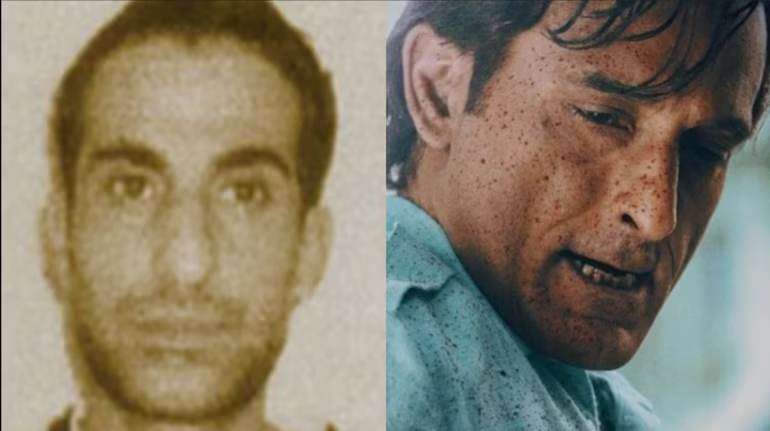
Akshaye Khanna’s performance in Dhurandhar has caught the internet off guard. His sharp-suited, cold-eyed gangster isn’t just a cinematic creation; it draws heavily from the real Rehman Dakait, one of Pakistan’s most feared crime figures.
This article breaks down his rise, his political maneuvers, and his abrupt death, while explaining why filmmakers continue to be fascinated by his legacy.
What shaped Rehman Dakait’s rise in Lyari?
Lyari, one of Karachi’s oldest settlements, sets the stage for his story. Long before Karachi’s skyscrapers, Lyari developed as an 18th-century hub for fishermen and Baloch communities. Over time, population pressure, poverty, and chronic state neglect created conditions where armed groups thrived.
Lyari as a cradle for crime
By the late 20th century, Lyari had become a dense urban pocket of almost a million residents packed into crumbling, sewage-lined streets. With limited schooling, few jobs, and minimal policing, crime emerged as both an economy and a survival strategy.
Rehman’s early criminal footprint
Born in 1980 to Dad Muhammad, a drug smuggler, and Khadija Bibi, Rehman entered the world already surrounded by illicit trade. As a teenager, he peddled drugs, earned a reputation for violence, and allegedly committed shocking acts, including a rumored stabbing at 13 and the unverified claim that he killed his mother at 15 due to rival gang affiliations.
Whether true or not, these stories solidified the mythology around him, earning him the moniker “Dakait” (meaning bandit). In Dhurandhar, Akshaye Khanna’s snarling dialogue references this ruthless persona.
His empire by his early twenties
By 21, Rehman commanded a gang involved in:
- Extortion
- Drug distribution
- Arms trafficking
- Kidnapping-for-ransom
Reports like The Express Tribune’s “Kingdom of Fear” describe his network as a shadow state within Lyari. Control was maintained through fear, informal taxation, and an army of street operatives.
How did gang wars turn Lyari into a battlefield?
One of the defining chapters of Rehman Dakait’s life was his bitter war with rival gangster Arshad Pappu. Their conflict split Lyari into armed blocs and paralyzed everyday life.
The Rehman vs. Pappu conflict
For years, narrow streets were reduced to conflict zones where:
- Snipers and gunmen guarded block boundaries
- Civilians avoided stepping out after dusk
- Shops shuttered abruptly during gunfire
- Police patrols often avoided confrontation
This turf war was less about ideology and more about control of drugs, extortion networks, and influence within political circles. The state’s weak presence allowed these groups to operate like local governments.
Why did politics become central to Rehman Dakait’s power?
Lyari has long been a stronghold of the Pakistan Peoples Party (PPP). For many residents, PPP leaders were their only perceived route to resources—and gang leaders often filled the gaps where political promises fell short.
Rehman’s proximity to political figures
Photographs and multiple reports have shown Rehman near:
- Zulfiqar Mirza (former Home Minister)
- Benazir Bhutto
- Other PPP-linked local leaders
While police have denied political interference, several officers speaking anonymously in past reports have suggested informal pressures and complexities on the ground.
A PPP member quoted in The Express Tribune noted:
“Political personalities ignored Lyari. As a result, people like Rehman Dakait filled that gap.”
Why politicians needed him and why he needed them
Rehman provided something invaluable to political actors: street control. In return, he gained political cover and legitimacy. This mutual dependence blurred the lines between state authority and criminal power.
Why did Rehman Dakait attempt to become a “legitimate” leader?
By 2008, Rehman wanted more than fear-based dominance. He wanted recognition, influence, and perhaps even political office.
Rebranding himself as Sardar Abdul Rehman Baloch
He distanced himself from the “Dakait” label, adopting his Baloch identity and presenting himself as a protector of his community rather than a gangster.
His biggest move was the establishment of the Peoples Aman Committee (PAC).
What was the Peoples Aman Committee?
PAC was framed as a peacekeeping group that:
- Patrolled streets
- Mediated disputes
- Attempted to halt intra-gang violence
- Forged alliances with political networks
The committee’s chairman, Maulana Abdul Majeed Sarbazi, later said Rehman genuinely wanted to end violence:
“Khan bhai felt that the fighting had to stop.”
PAC’s rise coincided with rumours that Rehman was being groomed for political influence—or that he sought it himself.
Why PAC changed Karachi’s dynamics
For a short period, PAC helped reduce violence through negotiated truces. But critics argued it was merely a criminal empire with a political mask. Either way, the group’s relationship with PPP became a contentious and closely watched aspect of Karachi’s security landscape.
How did Rehman Dakait die, and why do questions still linger?
In August 2009, police shot and killed Rehman Dakait in what was officially described as an “encounter,” a common term in South Asia for armed confrontations with criminals.
The official version
Authorities claimed he died during a shootout. His body, along with those of his associates, was displayed as evidence of a successful operation.
Why his death remains disputed
PAC leaders and several locals questioned the narrative.
Key doubts included:
- Autopsy reports suggested shots were fired from a distance of about three feet—unusual for a firefight
- The timing coincided with Rehman’s growing political ambitions
- Some PPP insiders anonymously suggested he was becoming “too big”
There were also fringe theories linking his death to alleged deals with Baloch separatist groups, though none have been officially proven.
Aftermath of his death
Following his killing:
- PAC quickly lost political backing
- PPP publicly distanced itself
- The state initiated broader crackdowns in Lyari
- Fragmented factions filled the power vacuum
Even today, Rehman remains a polarizing figure: a criminal to some, a protector to others.
Why does his story matter today?
Rehman Dakait lived only 29 years, yet his impact on Karachi’s social and political landscape remains deeply embedded. His story reveals:
- How urban neglect fuels criminal empires
- How political alliances shape gang power
- How crime can evolve into quasi-governance in vulnerable communities
For Indian cinema, his life offers a compelling character study—one that blends danger, charisma, and tragedy. Dhurandhar taps into this complexity, using fiction to explore the blurred lines between power and criminality.
TL;DR
Rehman Dakait was a powerful Lyari gangster whose influence extended into politics and community structures. His life—marked by violence, political alliances, and an attempt to rebrand as a community leader—inspired Akshaye Khanna’s character in Dhurandhar. His 2009 death in a disputed police encounter ended a turbulent era but did not erase his impact on Karachi or pop culture.