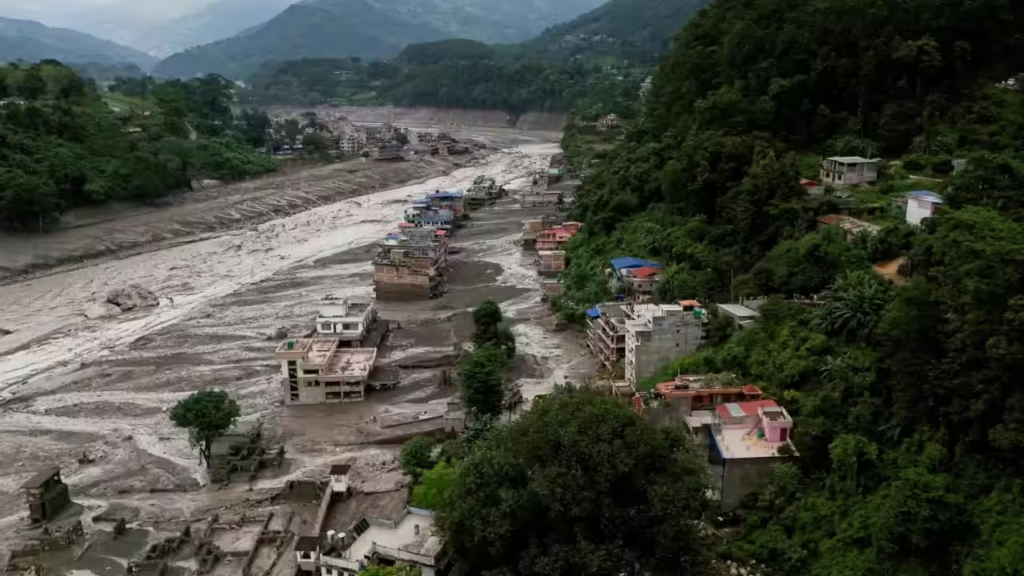
Nepal is demanding climate-related compensation from some of the world’s biggest greenhouse gas emitters after a catastrophic flash flood devastated communities along the country’s border with China.
Foreign Minister Shisir Khanal has singled out China, India and the United States, saying their historical emissions give them a responsibility to help vulnerable countries such as Nepal cope with climate-related losses.
Khanal has framed the demand as an issue of “justice and compensation,” rather than conventional foreign aid. The argument comes after a deadly Himalayan disaster in which a glacier-related collapse unleashed a massive torrent of water, ice, rock and debris through parts of Nepal and China’s Tibet.
The disaster has since killed more than 1,100 people across the affected region, while thousands remain missing, according to the latest reports.
Why is Nepal asking for climate compensation?
Nepal contributes very little to global greenhouse gas emissions but is highly exposed to the consequences of a warming planet.
Its geography makes the country particularly vulnerable. Much of Nepal is mountainous, and warming temperatures are affecting glaciers, snowpack, permafrost and high-altitude ecosystems.
Khanal argues that countries that have historically produced large quantities of greenhouse gases should bear greater responsibility for helping nations facing severe climate-related damage.
“Nepal’s greenhouse gas emissions are virtually negligible,” Khanal said, according to reporting from Nepal’s media. “Yet, we are paying the ultimate price for a global crisis we did not create.”
His argument reflects a wider principle in international climate politics: countries that contributed least to historical emissions can still face some of the most severe consequences of climate change.
What happened in Nepal?
The disaster struck on August 26 after a massive collapse involving ice and rock in the Himalayas triggered catastrophic flooding in the Bhotekoshi river system.
The flood swept through communities, roads, bridges, hydropower facilities and other infrastructure in northern and central Nepal.
The devastation extended across the border into Tibet, where Chinese authorities also reported deaths and large numbers of missing people.
Early reports initially explored whether an earthquake had triggered the event, but subsequent scientific assessments linked the disaster to a glacial collapse and associated ice-rock avalanche.
The flood was particularly dangerous because it did not follow the pattern of a conventional rainfall-driven disaster.
In some affected areas, residents had little warning before the water and debris arrived.
How many people have died in the floods?
The toll has continued to rise as rescuers recover bodies and search through damaged communities and infrastructure.
As of September 2, Reuters reported at least 1,114 deaths, while the Associated Press put the death toll at 1,118. Thousands of people remained missing.
China has separately reported deaths and hundreds missing in Tibet.
The figures remain fluid because rescue operations are continuing and many people were stranded or trapped in damaged structures, including hydropower tunnels.
That means the final human cost of the disaster is still not known.
Why does Nepal say this is a climate issue?
The immediate trigger for the flood was a glacial collapse, but scientists say climate change can increase the vulnerability of Himalayan environments to such disasters.
The Himalayas are warming rapidly, affecting glaciers and frozen ground that help stabilize steep mountain slopes.
When ice and rock collapse at high altitude, enormous quantities of debris can enter rivers and valleys.
That can generate destructive flood waves even when there is little or no rain at the time of the event.
The recent disaster has therefore become part of a larger discussion over the vulnerability of mountain communities to climate-related hazards.
Why are India, China and the US being named?
Khanal specifically identified India, China and the United States as countries with historical responsibility because of their large greenhouse gas emissions.
The three countries are among the world’s biggest current emitters, although their historical contributions, population sizes and per-capita emissions differ significantly.
China is currently the world’s largest annual greenhouse gas emitter, while the United States has produced a much larger share of cumulative historical carbon dioxide emissions. India has significantly lower per-capita emissions but is now among the largest annual emitters because of its large population and growing economy.
Nepal’s argument is therefore not simply about who emits the most today.
It is about the broader principle that responsibility should account for historical emissions, economic development and the ability to provide financial support.
What does “moral liability, not charity” mean?
Khanal’s language is deliberate.
By calling climate assistance a “moral liability” rather than charity, Nepal is arguing that vulnerable nations should not have to depend solely on voluntary donations after climate-related disasters.
The distinction reflects the broader climate debate over “loss and damage.”
Loss and damage refers to the economic and non-economic harm suffered by countries that experience climate impacts that cannot be fully prevented through adaptation.
These can include destroyed homes and infrastructure, loss of livelihoods, displacement and damage to cultural or environmental resources.
Nepal wants its disaster-related needs understood through that framework rather than treated simply as another humanitarian emergency.
Does international law already require India, China and the US to pay Nepal?
Not in the straightforward sense implied by the word “compensation.”
This is one of the most complicated parts of Nepal’s argument.
International climate agreements have increasingly recognized the importance of addressing loss and damage, including through the UN-backed Fund for Responding to Loss and Damage.
But that does not mean an individual country automatically has a legally enforceable obligation to compensate another country for every climate-related disaster.
Questions of historical responsibility, liability, causation and payment remain politically and legally contested.
Nepal’s demand is therefore both diplomatic and political. Its use of terms such as “moral liability” signals a claim for responsibility even where the legal basis for direct compensation can be far more difficult to establish.
Has Nepal formally sought climate-related funding?
Nepal has said it is pursuing international support through existing climate-finance mechanisms.
Recent reporting indicates that Kathmandu has formally approached the board of the Fund for Responding to Loss and Damage following the August disaster.
That is important because the fund was created specifically to help vulnerable developing countries respond to loss and damage associated with climate change.
The move allows Nepal to connect the disaster to a broader international financing framework rather than relying entirely on bilateral donations.
At the same time, the precise amount Nepal ultimately seeks and how much it could receive through existing mechanisms remain separate questions.
Why is Nepal particularly vulnerable to climate disasters?
Nepal’s geography magnifies the effects of environmental change.
Its landscape rises sharply from lowland plains to some of the highest mountains on Earth.
That creates steep valleys where landslides, floods and debris flows can travel rapidly downstream.
Many communities and infrastructure projects are located in these narrow valleys because there are relatively few areas suitable for transportation, housing and hydropower development.
As temperatures rise and glaciers change, the risks associated with unstable slopes, glacial lakes and sudden water releases become increasingly important.
What role does the Himalayas’ changing climate play?
Scientists have warned for years that Himalayan warming is affecting glaciers and other frozen environments.
Glacier retreat can create unstable conditions and contribute to the formation or expansion of glacial lakes.
At the same time, thawing permafrost and changes in snow and ice can weaken mountain slopes.
That does not mean every glacier-related disaster can be directly attributed to climate change.
Scientists distinguish between the immediate physical trigger of an event and the longer-term changes that may increase the likelihood or severity of such events.
For the August 26 disaster, the direct trigger was a major ice-rock collapse. The extent to which climate change contributed to the conditions behind that collapse remains part of the scientific discussion.
What does India say about climate responsibility?
India has long argued that climate policy should reflect the principle of equity.
New Delhi has emphasized that countries should consider historical emissions, per-capita emissions, development needs and the different capacities of nations when discussing responsibility for climate change.
India is also a developing country with a large population and has argued that poorer nations should retain room for economic growth while transitioning to cleaner sources of energy.
That creates an important nuance in Nepal’s demand.
Although India is one of the world’s major current emitters, its per-capita emissions remain substantially lower than those of the United States.
The climate debate therefore cannot be reduced to a simple ranking of annual national emissions.
What about China?
China is the world’s largest annual greenhouse gas emitter and has become central to debates over climate finance.
At the same time, Beijing is also a developing economy and has historically argued that developed countries bear a greater responsibility for financing climate action because they industrialized earlier and accumulated more historical emissions.
China has provided assistance to Nepal following the recent disaster, including rescue and relief support.
Nepal’s call for climate compensation is therefore distinct from the immediate humanitarian cooperation taking place between the two countries.
What about the United States?
The United States has played a central role in global climate policy and remains one of the world’s largest historical emitters.
The country has also been involved in international discussions over climate finance and loss and damage.
For Nepal, the argument is that countries with substantial historical emissions should contribute more to helping highly vulnerable nations adapt to a changing climate and recover from extreme events.
Washington, however, has not accepted the idea that historical emissions automatically create open-ended legal liability for climate-related disasters in other countries.
That distinction is likely to remain central to any future negotiations.
Why is the latest disaster strengthening Nepal’s argument?
The scale of the destruction has given Nepal a dramatic example to place before the international community.
The floods destroyed homes, roads, bridges and energy infrastructure and left thousands of people missing.
The crisis has also affected international travelers and workers in the region, demonstrating that the consequences extend beyond isolated mountain villages.
Nepal is now using the disaster to argue that climate vulnerability is not an abstract issue.
For a country with limited resources, recovering from an extreme event can consume money that would otherwise be used for development, health, education and infrastructure.
Can climate compensation prevent future disasters?
Money alone cannot prevent glacial collapses or flash floods.
But additional funding could help countries such as Nepal strengthen early-warning systems, improve disaster preparedness, reinforce infrastructure and relocate particularly vulnerable communities.
Those measures can reduce deaths and economic losses even when extreme events themselves cannot be stopped.
Experts have also emphasized the importance of improved monitoring of glaciers, unstable slopes and river systems across the Himalayas.
Regional cooperation is particularly important because rivers, glaciers and mountain hazards do not stop at national borders.
Why does early warning matter so much?
The latest disaster demonstrated the danger of events that occur with little warning.
Conventional flood-warning systems often depend on rainfall, river levels and other indicators.
A sudden collapse high in the mountains can provide far less preparation time.
Better satellite monitoring, sensors, communication systems and cross-border data sharing could help authorities detect dangerous conditions earlier.
For Nepal, strengthening those systems may be one of the most immediate uses of climate and disaster-resilience funding.
What happens next?
Nepal is expected to raise the issue at international climate and diplomatic forums as it seeks greater support for recovery and disaster resilience.
The government is also continuing rescue, identification and rehabilitation efforts following the August 26 disaster.
The immediate priority remains humanitarian: finding missing people, treating survivors and restoring damaged infrastructure.
But the diplomatic argument will continue after the emergency fades.
Nepal wants the catastrophe to become evidence in a much larger conversation about who pays when climate-vulnerable countries suffer increasingly severe losses.
The bigger climate justice debate
Nepal’s demand captures a central tension in global climate politics.
Developing countries often argue that they contributed relatively little to the accumulation of greenhouse gases but are experiencing increasingly severe consequences.
Major emitters, meanwhile, generally accept the need for climate finance while resisting formulations that could create unlimited legal liability for historical emissions.
The debate is therefore not simply about money.
It is about fairness, responsibility and how the international system should respond when climate impacts impose costs on countries with limited capacity to absorb them.
Nepal’s latest demand puts that question against the backdrop of one of the deadliest disasters in its recent history.
The bottom line
Nepal is seeking climate-related compensation following the catastrophic Himalayan floods of August 26, with Foreign Minister Shisir Khanal naming India, China and the United States as major emitters with what he calls a historical responsibility toward vulnerable countries.
Khanal has deliberately described the demand as “justice and compensation” rather than charity.
The disaster was triggered by a major glacial and ice-rock collapse that sent a destructive surge of water and debris through Nepal and into parts of Tibet. More than 1,100 people have now been reported dead across the affected region, while thousands remain missing.
Nepal’s argument draws on the international loss-and-damage debate, but there is an important legal distinction between seeking climate finance and proving that another country is legally liable for a specific disaster.
The immediate crisis is about rescue and recovery. The diplomatic battle that follows may be about something much larger: whether countries that contributed most to global warming should pay more of the costs borne by those now facing its harshest consequences.