
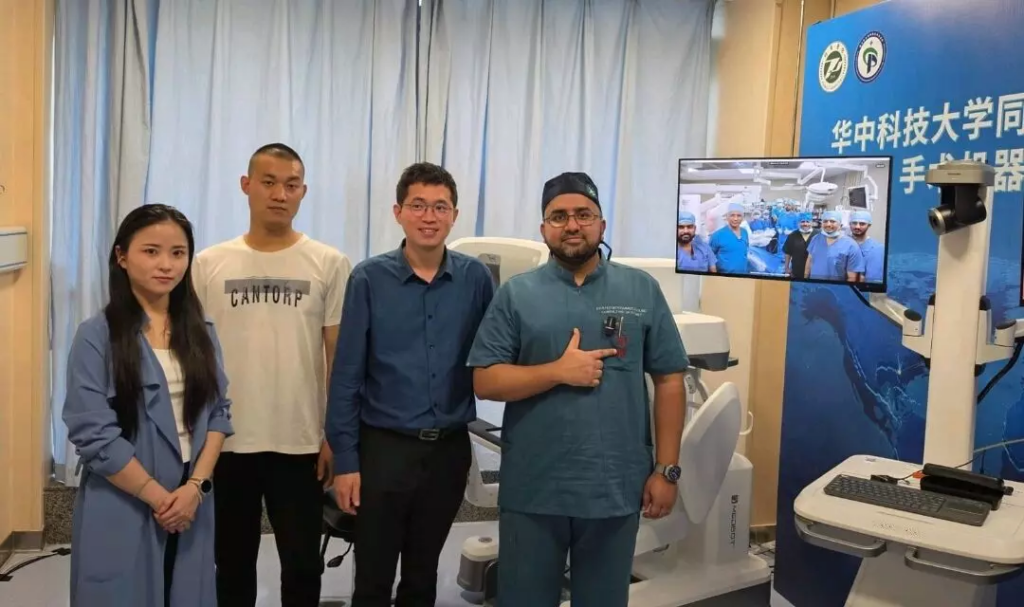
A surgeon sitting in China successfully performed a robotic operation on a patient in Hyderabad, more than 4,000 kilometers away, marking a major step forward for remote healthcare and robotic medicine.
The procedure, carried out by Syed Mohammed Ghouse of the Asian Institute of Nephrology and Urology (AINU), demonstrates how advances in robotics, internet connectivity, and surgical systems are beginning to reshape the future of medicine.
While remote robotic surgery has been tested before in different parts of the world, this case has drawn attention in India because it showed real-time international telesurgery functioning successfully across two countries.
What happened in the Hyderabad remote surgery?
Remote robotic surgery between China and India
The operation took place on May 18.
Where were the doctor and patient?
- The patient was in Hyderabad, India
- Dr. Ghouse was at Tongji Hospital in Wuhan, China
Despite the physical distance, the surgery was conducted live using a robotic surgical platform connected through high-speed internet infrastructure.
What surgery was performed?
The patient reportedly suffered from:
- Lower ureteric stricture
The procedure performed was:
- Robotic ureteric reimplant surgery
According to reports, the patient recovered successfully and was discharged the same day.
How can a doctor operate from another country?
The process is known as telesurgery or remote robotic surgery.
How robotic surgery works
In robotic surgery, surgeons already operate indirectly.
Instead of standing over the patient with instruments, the surgeon:
- Sits at a console
- Controls robotic arms remotely
- Views magnified real-time images from inside the body
The remote surgery simply extended that setup across international borders.
The three main components
According to Dr. Ghouse, the system involved:
- A patient cart attached to the patient
- An image cart processing surgical visuals
- A surgeon’s console controlling robotic instruments
The surgeon manipulates controls at the console, and robotic instruments replicate those movements in real time.
Was there a delay because of the distance?
How telesurgery systems work in real time
One of the biggest challenges in remote surgery is latency—the delay between a surgeon’s movement and the robot’s response.
What made the surgery possible
The procedure relied on:
- High-speed broadband connectivity
- Stable low-latency communication
- Real-time video transmission
Dr. Ghouse reportedly said the experience felt very similar to performing a standard robotic surgery inside the same operating room.
Internet requirements
The system reportedly required:
- Broadband speeds of roughly 30–50 Mbps
Reliable connectivity is essential because even tiny delays can matter during delicate procedures.
What happens if the internet fails during surgery?
This is one of the most important safety concerns surrounding telesurgery.
Backup systems were in place
According to the surgical team:
- Multiple leased internet lines were active simultaneously
- If one connection failed, another would immediately take over
Human backup inside the operating room
A trained surgical assistant remained physically beside the patient throughout the operation.
That assistant could:
- Intervene immediately
- Take control if necessary
- Ensure patient safety during emergencies
This hybrid human-machine setup is considered essential for remote surgical safety.
What technology was used?
The operation used the MedBot robotic platform developed by MicroPort.
Why this matters
The case highlights China’s growing role in:
- Medical robotics
- Surgical AI systems
- Advanced healthcare technologies
According to reports, the same robotic platform is already being introduced in India.
Why remote robotic surgery matters
The implications go far beyond a single operation.
Future of robotic and remote healthcare
Potential benefits include:
- Access to specialists from anywhere in the world
- Faster treatment in remote regions
- Reduced travel for patients and surgeons
- Global medical collaboration
In theory, expert surgeons could eventually operate on patients across continents without leaving their hospitals.
Could this become common in the future?
Possibly—but several challenges remain.
Major barriers include:
- Reliable ultra-fast internet infrastructure
- Legal and licensing regulations across countries
- Cybersecurity risks
- High equipment costs
- Emergency response planning
Remote robotic surgery is still relatively rare because medicine requires extremely high reliability standards.
Areas where it could expand first
Experts believe telesurgery may become especially useful for:
- Rural healthcare access
- Military medicine
- Space missions
- Disaster zones
- Specialist shortages
What are the risks of remote surgery?
While promising, the technology also raises concerns.
Key risks include:
- Internet disruptions
- Technical malfunctions
- Hacking or cybersecurity threats
- Delayed emergency intervention
Because of these risks, remote surgery systems typically require:
- Redundant backups
- On-site surgical staff
- Strict technical protocols
Why this surgery is a milestone for India
India has rapidly expanded its digital healthcare infrastructure in recent years.
This operation signals growing capability in:
- Advanced robotic medicine
- International medical collaboration
- Real-time telemedicine systems
It also demonstrates how healthcare may increasingly become borderless in the future.
TL;DR
- A Hyderabad patient underwent robotic surgery performed remotely from Wuhan, China
- The procedure was conducted by robotic surgeon Dr. Syed Mohammed Ghouse
- The surgery used high-speed internet and robotic surgical systems in real time
- Backup internet lines and on-site medical staff ensured patient safety
- The case highlights the future potential of remote robotic healthcare