
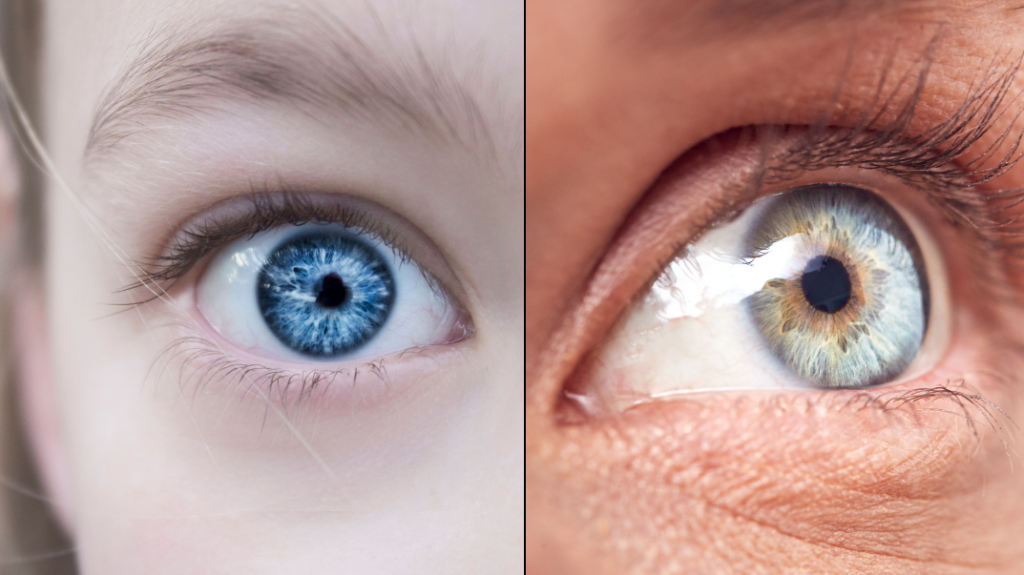
A striking claim keeps resurfacing online: every blue-eyed person on Earth descends from a single individual who lived thousands of years ago. It sounds like something pulled from a myth or a movie script, but the reality is more nuanced and, in some ways, even more fascinating.
The idea comes from genetic research, not folklore. But like many science headlines, it’s been simplified to the point where it risks being misunderstood.
What is the origin of blue eyes in humans?
Scientists agree on one key point: early humans almost certainly all had brown eyes.
Brown eyes come from higher levels of melanin, the pigment responsible for coloring not just our eyes but also our skin and hair. At some point between 6,000 and 10,000 years ago, a genetic mutation changed that.
This mutation didn’t “add” blue pigment. Instead, it reduced the amount of melanin in the iris, creating the appearance of blue.
Think of it less like painting something blue and more like turning down a dimmer switch on brown.
The gene switch that changed eye color
How do HERC2 and OCA2 work?
The science centers on two genes:
- OCA2: Controls how much brown pigment (melanin) is produced
- HERC2: Regulates OCA2
A mutation in the HERC2 gene effectively acts like a switch that limits OCA2 activity. With less melanin produced, the iris appears blue.
This is why blue eyes are actually a structural effect of light scattering, not a true pigment color.
Professor Hans Eiberg and his team at the University of Copenhagen were among the first to study this mutation in detail.
So, do all blue-eyed people come from one person?
The short answer: likely one original mutation, not one “founder person”
Here’s where the viral claim needs careful framing.
All blue-eyed individuals today share the same genetic mutation. That strongly suggests the mutation originated in a single individual or a small group of closely related individuals.
But that does not mean:
- Everyone with blue eyes is directly descended from one identifiable “first blue-eyed person” in a simple family tree
- There was literally one lone human whose descendants make up all blue-eyed people today
Instead, it means:
- The mutation happened once
- It spread through populations over generations
- It persisted because it wasn’t harmful and may have even been advantageous in certain environments
In genetic terms, it’s a shared ancestor at the mutation level, not a single genealogical ancestor in the way people often imagine.
Why did the blue-eyed mutation spread?
Evolution, environment, or chance?
Scientists are still debating why blue eyes became relatively common, especially in Europe.
Some leading theories include the following:
- Genetic drift: The mutation spreads simply by chance in smaller populations
- Sexual selection: Blue eyes may have been perceived as attractive, increasing reproduction rates
- Environmental adaptation: Lower sunlight levels in northern regions may have played a role, though this is less certain
Today, about 8 to 10 percent of the global population has blue eyes, with the highest concentrations in Northern and Eastern Europe.
Can eye color change over time?
Yes, and this often surprises people.
Many babies are born with blue or grayish eyes because melanin production hasn’t fully developed yet. Over time, the body may produce more pigment, turning eyes:
- Brown
- Green
- Hazel
This process typically stabilizes within the first few years of life.
That’s why a blue-eyed baby doesn’t always grow into a blue-eyed adult.
Why this claim keeps going viral
It’s simple, catchy, and almost true
The phrase “everyone comes from one person” is powerful. It taps into curiosity about identity and ancestry.
But the real science is more precise:
- There was likely one original mutation event
- That mutation connects all blue-eyed people genetically
- But human ancestry is far more complex than a single line of descent
In other words, it’s not a family tree with one root. It’s a vast, tangled forest with one shared genetic branch.
What this tells us about human genetics
The story of blue eyes is a reminder of how small changes in DNA can ripple across thousands of years.
A single mutation can:
- Alter physical traits
- Spread across continents
- Become part of millions of people’s identity
And yet, it doesn’t define us in isolation. Eye color is just one tiny thread in the much larger fabric of human genetics.
TL;DR
- Blue eyes are caused by a mutation affecting the HERC2 and OCA2 genes
- This mutation likely occurred once between 6,000 and 10,000 years ago
- All blue-eyed people share this mutation
- But they are not descendants of a single identifiable individual in a simple sense
- The trait spread over generations through populations, not one family line