No, we cannot be Sheldon here and claim that this is our spot. So, how do you go about it? If you’re attempting to save time, should you park your car in the first place you see, no matter how far out from the entrance? Or should you merely drive up and down lanes hoping for an elusive place closer in? Is there actually a scientific strategy for finding a good parking spot?
Study
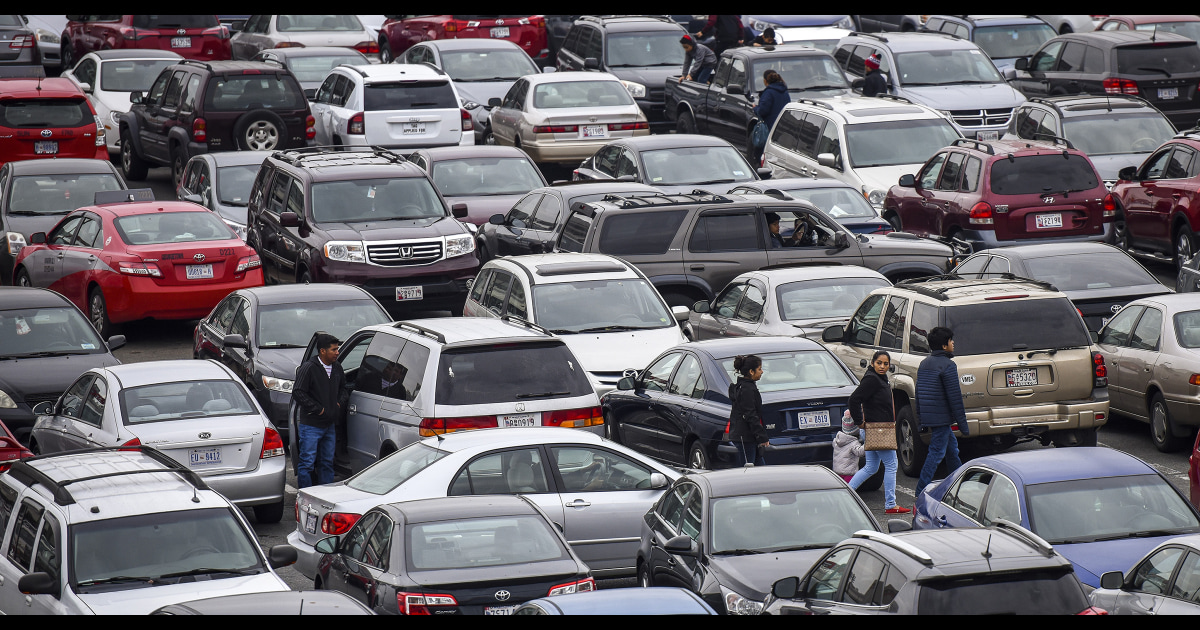
Physics professors Sidney Redner (from the Santa Fe Institute) and Paul Krapvisky (from Boston University) used their mathematical prowess to determine the best parking place search tactics in a study published in September 2019 in the Journal of Statistical Mechanics. In this case, the “best” location is the one closest to the mall entrance. Some individuals choose a good parking spot on the top floor of a parking garage to avoid getting their car scratched. But that’s a story for another day.
Parking styles were split into three groups by Redner and Krapvisky: meek, optimistic, and prudent.
Three groups
- “Meek” drivers will take the first available place. It may leave places towards the front unoccupied and result in a long walk.
- “Optimistic” drivers aren’t scared to explore. They are certain that no matter how many times they circle the parking lot, they’ll finally locate their perfect place.
- “Prudent” parkers are a little more aggressive than meek drivers, skipping the low-hanging fruit in search of a nearer position. But they are also hesitant to circle many times to get just a little closer to their destination. If they don’t discover something better right away, they can also reconsider a location that a “meek” driver would have.
The researchers used probability theory and rate equations to develop a simulation after determining their categories. The “prudent” technique was the best since it took the least amount of time. Then came the “optimistic” approach, and finally the “meek” method.
Redner is prompt to mark that this particular operation is purely mathematical. “We tried hard to minimize the number of free parameters by judicious choices, such as assigning the same speed for walking and driving,” he says. Of course, they couldn’t value for every variable. “The main complication was the inherent many-body nature of the parking process; namely, one doesn’t know in advance which spots are free and the game is whether to pick the current spot or try another spot (which may not be open) closer to the destination.”
They also neglected real-world variables like driver speed, intense competition for spots, or harried human beings’ irrationality.
The real world of a good parking spot
That concludes the mathematics portion of the narrative. Is there, however, a parking lot method that better actual people’s quirks?
“It is important to note this simple fact; The success of my parking strategy is, in part, dependent upon which parking approach the other drivers select,” says Andrew Velkey, an associate professor of psychology at Christopher Newport University in Virginia. “It is an excellent application of Game Theory (e.g. the Prisoner’s Dilemma). My ‘best’ strategy is only better if enough other drivers select one of the other alternative strategies. If everyone tried to play the same parking strategy, it would no longer be optimal.”
Most individuals, according to Velkey, spend much too much time seeking the “closest” location. The best parking spots (such as those directly in front of your ultimate destination) are frequently unavailable.
“Time and perceived scarcity are the two biggest factors that affect parking strategies. People will spend time looking for a parking space and incur a travel-time cost from their vehicle to their final destination after they have parked their car. It appears that people are often attempting to reduce the travel-time cost and often incur a greater acquisition time cost as a result,” he says. It’s most fascinating to note that somebody will seek to get a parking spot that is nearest to the door of the gym/exercise club they are about to enter.
Transportation Science
Velkey referred to a 1998 paper published in the journal Transportation Science where they determined that the optimal strategy was to randomly pick a row and go to the closest parking spot in the row (‘Pick a Row, Closest Space (PRCS)’), rather than driving up and down rows looking for a closer spot (‘Cycling’); to answer our parking lot question.
In other words, the time saved looking for a parking place compensated for the long walk to the front door. But it wasn’t a major time saver. In that model, the PRCS approach predicted a time of 61.31 seconds to the front door from the place. Whereas the Cycling technique predicted a time of 70.70 seconds.
Velkey claims that the rare occasions we do have a front-row seat become particularly memorable to us. But “perhaps even more memorable are the times when we park our cars and come across space right in front on our way to the entrance of the destination – we will employ a counterfactual ‘if I had only driven around more’ process when we notice these spaces we ‘missed,'” he says. “As a result, people will over-predict both the likely availability of these spaces and their own likelihood of obtaining these spaces.”