
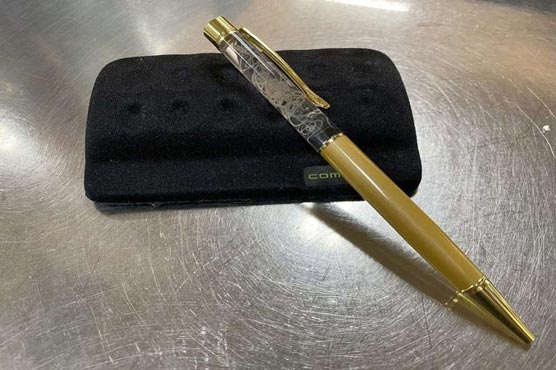
A resurfaced video of a Japanese novelty pen containing a real parasitic worm has sparked equal parts fascination and discomfort online. The so-called “Anisakis parasite pen,” first introduced in 2021, has gone viral again in 2026, prompting fresh debate over where creativity ends and common sense begins.
Created by a hobbyist in Japan’s Kochi Prefecture, the pen features a live specimen from the Anisakis genus suspended in herbarium oil. The concept is simple but unsettling: as you write, the worm appears to move inside the transparent barrel.
The internet, unsurprisingly, has a lot to say about it.
What Is the Anisakis Parasite Pen?
The pen is a handcrafted novelty item that gained initial attention in 2021 when it was reportedly sold at a roadside shop in Japan.
Where Was It Sold?
- Michinoeki Susaki, a fresh fish store and local market
- Priced at approximately 950 yen (around $6–7 at the time)
Inside each pen is herbarium oil, a clear liquid typically used for preserving plants, along with a visible parasitic worm.
Why Is It Moving?
The motion seen in the pen is what unsettles viewers the most. While some reports suggest the worms were alive at the time of assembly, others indicate that preserved specimens can still appear to shift slightly due to fluid movement and light refraction.
Why this matters: Whether alive or not, the perception of movement is enough to trigger strong reactions—raising questions about ethics in art and product design.
What Is Anisakis and Why Is It Dangerous?
Anisakis is a genus of parasitic worms commonly found in marine fish and squid. These parasites are not unusual in the food chain, but they are dangerous when they make their way into the human body.
Health Risks: What Is Anisakiasis?
Infection by these worms can lead to a condition known as anisakiasis.
Common Symptoms Include:
- Severe abdominal pain
- Nausea and vomiting
- Diarrhea
- Inflammation of the stomach or intestinal lining
In some cases, the worm can attach itself to the gastrointestinal tract, requiring medical removal.
How Do People Get Infected?
- Consuming raw or undercooked seafood
- Particularly, dishes like sushi or sashimi if improperly handled
Why Has the Pen Gone Viral Again?
The recent spike in attention came after a post on X (formerly Twitter), where a user shared footage of the pen along with a description of its origin.
The post quickly gained traction, pulling in hundreds of thousands of views and sparking a wave of reactions across platforms.
What Are People Saying?
The internet’s response has been overwhelmingly skeptical, and often humorous:
- “I don’t want to write with this.”
- “How is this even legal?”
- “Creative, sure—but I’m out.”
Others raised practical concerns:
- How long can a worm survive inside a sealed pen?
- Does this pose any health risk?
- Who is the target audience for such a product?
Why this matters: Viral content often blurs the line between curiosity and credibility. In this case, it’s also raising legitimate safety and regulatory questions.
Is It Legal to Sell Something Like This?
The legality of such products depends on several factors, including:
Key Considerations
- Biological material regulations: Transport and sale of կենդ organisms may be restricted
- Consumer safety laws: Products must not pose health risks
- Labeling requirements: Clear disclosure of contents
Japan has relatively strict food safety and wildlife regulations, but novelty items like this can fall into gray areas—especially if the organism is preserved and not intended for consumption.
Where Does Art Cross the Line?
The Anisakis pen sits at an unusual intersection of art, biology, and shock value.
A Long History of Unusual Materials in Art
Artists have historically used unconventional materials to provoke thought or process:
- Damien Hirst’s preserved animals in formaldehyde
- Jewelry made from organic materials
- Food-based installations that decay over time
In that context, the parasite pen isn’t entirely unprecedented—but it does push boundaries in a more commercial, everyday object.
Why It Feels Different
- It’s functional, not just display art
- It involves a parasitic organism, not a neutral specimen
- It’s marketed as a consumer product, not gallery work
This combination makes it more personal—and, for many, more disturbing.
Should You Be Concerned About Health Risks?
For most users, the risk is likely minimal, if the pen is properly sealed and the contents are contained.
However, concerns remain:
Potential Risks
- Leakage or breakage exposing biological material
- handling or misuse
- Psychological discomfort (which is real, even if not physical)
Experts would likely advise caution, especially for individuals unfamiliar with biological needs.
The Bigger Picture: Viral Trends and Shock Value
The resurgence of the Anisakis pen highlights a broader trend: content that shocks or unsettles often performs best online.
Why These Trends Spread
- Visual novelty grabs attention instantly
- Emotional reactions drive sharing
- Algorithms amplify engagement
But virality doesn’t equal value—and in some cases, it can obscure important context, like safety or legality.
TL;DR
- A Japanese pen containing an Anisakis parasite has gone viral again in 2026
- Originally sold in Kochi Prefecture in 2021 for about 950 yen
- Anisakis is a parasitic worm that can cause anisakiasis if ingested
- Online reactions range from curiosity to outright disgust
- The product raises questions about legality, safety, and the limits of creative design